

What is high level system design?
What high-level System Design is really about

Few phrases appear more frequently in engineering discussions than “high-level system design.” It shows up in architecture reviews, technical interviews, engineering roadmaps, design documents, and countless learning resources. Most engineers encounter the phrase relatively early in their careers, yet many spend years feeling only partially confident about what it actually means. The words themselves seem straightforward. High-level suggests zooming out. System design suggests architecture. And yet, when people are asked to explain what high-level system design really represents, the answers often become surprisingly fuzzy.
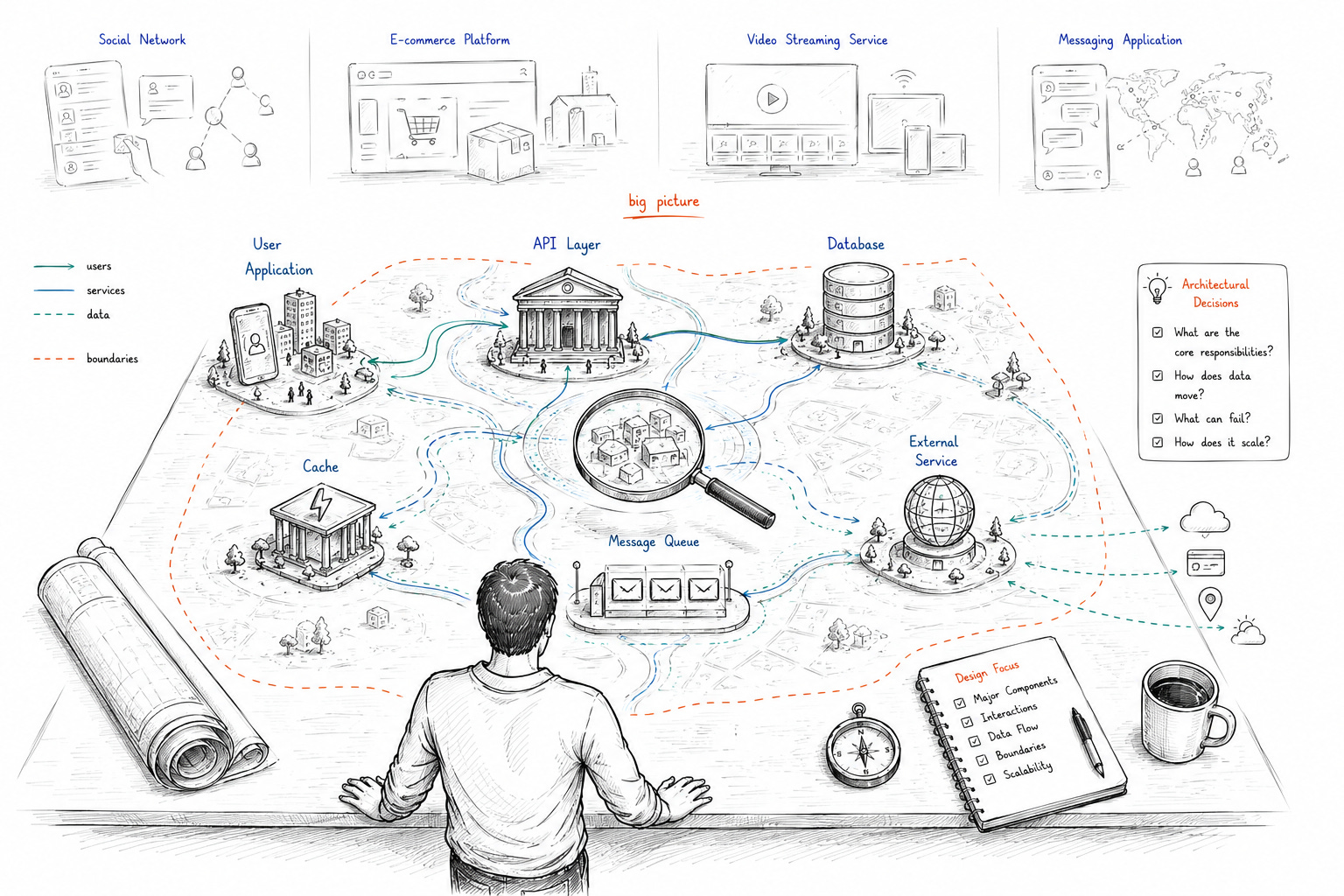
Part of the confusion comes from the fact that high-level design feels obvious and abstract at the same time. Everyone understands that it involves looking at the bigger picture, but defining what that bigger picture actually includes is harder. Some people think it means drawing boxes and arrows. Others associate it with scalability discussions, distributed systems, or infrastructure planning. Many candidates preparing for interviews treat it as a specific phase of architecture rather than a way of thinking.
After spending years helping engineers learn System Design, I’ve become convinced that high-level system design is ultimately about perspective. It is less about the artifacts engineers create and more about the lens through which they view complexity. The diagrams matter, but they are not the point. The architecture matters, but even that is not the deepest lesson.
The most important thing about high-level system design is not what you include. It’s what you deliberately leave out.
That may sound counterintuitive at first. Engineers are often trained to think in terms of precision and detail. Yet the ability to abstract complexity—to temporarily ignore details in order to reason about larger relationships—is one of the most important skills in software engineering. High-level system design is where that skill becomes visible.
Why engineers naturally focus on implementation
Most software engineers begin their careers in a world dominated by implementation details. They learn programming languages, frameworks, libraries, testing strategies, deployment pipelines, and debugging techniques. Progress feels tangible because the feedback loops are immediate. Write code, run code, fix code. The relationship between effort and outcome is relatively clear.
This early stage of growth naturally shapes how engineers think. When confronted with a problem, the instinct is often to ask implementation questions. Which framework should we use? Which database should we choose? What data structure is most efficient? These questions are important because implementation is where ideas become reality. The challenge is that implementation details can also become so consuming that they obscure the larger system.
I’ve seen this repeatedly among engineers learning System Design. They encounter architectural discussions and immediately begin diving into technologies. They want to talk about caches, databases, APIs, queues, and deployment models. Those topics certainly matter, but they often appear before the engineer has fully defined the problem the system is trying to solve.
The irony is that implementation expertise is often what eventually creates the need for higher-level thinking. As engineers gain experience, systems become larger. Components interact in unexpected ways. Trade-offs become more visible. At some point, understanding individual pieces is no longer sufficient. The engineer must learn to reason about the relationships between those pieces.
That transition marks the beginning of systems thinking.
The shift from components to systems
One of the most important transitions in an engineer’s career happens when they stop viewing software primarily as a collection of components and start viewing it as a collection of interactions. This shift sounds subtle, but it changes almost everything about how architectural discussions unfold.
When engineers focus primarily on components, they often evaluate systems through the lens of individual technologies. The database becomes the center of attention. The API becomes the center of attention. The messaging system becomes the center of attention. Architectural conversations revolve around selecting and optimizing individual building blocks.
System-level thinking introduces a different perspective. Instead of asking how a component behaves, engineers begin asking how components influence one another. Boundaries become important. Dependencies become important. Communication patterns become important. The architecture becomes less about the pieces themselves and more about how those pieces collectively create behavior.
This shift also changes how complexity is perceived. Complexity stops being something that exists inside individual services and starts being something that emerges between services. A perfectly designed component can still contribute to a poorly designed system if its interactions create unnecessary coupling or operational friction.
The most valuable insight many engineers gain is that systems rarely fail because of a single component. They fail because of relationships. High-level system design is largely about understanding and shaping those relationships.
What high-level system design is really trying to accomplish
When engineers talk about high-level design, they are often talking about abstraction, even if they don’t use that word explicitly. Abstraction allows people to reason about systems that would otherwise be too complicated to hold entirely in their minds. Without abstraction, modern software systems would be nearly impossible to discuss meaningfully.
At its core, high-level system design attempts to create a manageable representation of complexity. It helps engineers identify the major forces shaping a system before they become distracted by implementation details. It creates a shared understanding of responsibilities, boundaries, and interactions.
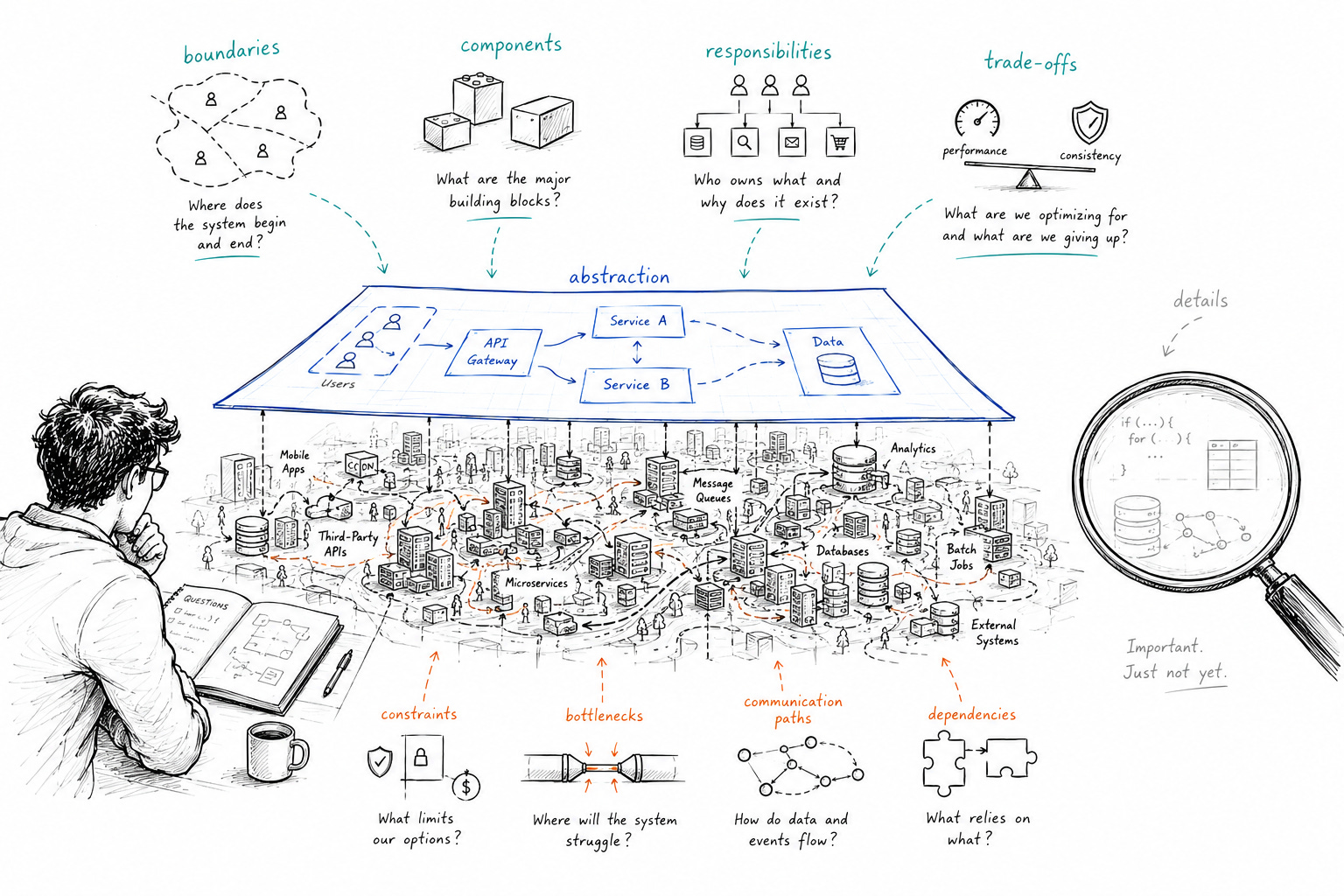
Several themes appear repeatedly in these discussions:
Defining boundaries
Identifying major components
Clarifying responsibilities
Exposing trade-offs
What’s interesting is that none of these activities require implementation details immediately. The goal is not to ignore implementation forever. The goal is to postpone implementation long enough to understand the structure of the problem.
This is why architecture often begins with questions rather than solutions. What are the primary constraints? Which components need to communicate? Where are the likely bottlenecks? Which trade-offs matter most? High-level design creates a framework for exploring these questions before committing to specific technical choices.
Why abstraction becomes necessary
As systems grow, abstraction becomes less of a convenience and more of a survival mechanism. Large-scale software systems contain too many moving parts for any individual to reason about every detail simultaneously. Engineers must develop ways of simplifying complexity without losing sight of what matters.
This is where abstraction becomes incredibly powerful. It allows teams to discuss scalability without immediately debating implementation details. It allows architects to reason about communication patterns without becoming distracted by protocol specifics. It allows organizations to coordinate around shared mental models rather than shared codebases.
At the same time, abstraction introduces its own risks. Every abstraction hides information. That is precisely what makes it useful. But hidden information can also create blind spots. Engineers may overlook operational realities, underestimate dependencies, or ignore implementation constraints because those details were intentionally omitted from the abstraction.
This tension explains why high-level design is both valuable and challenging. Good abstractions simplify complexity while preserving important truths. Poor abstractions simplify complexity by hiding critical realities. The difference is often difficult to recognize until systems encounter real-world pressure.
Experienced engineers learn that abstraction is not about removing complexity. It is about deciding where complexity should live.
Why interviews care so much about high-level design
Many engineers assume interviews emphasize high-level design because interviewers want to evaluate architecture knowledge. While that is partially true, I think something deeper is happening.
High-level design discussions reveal how engineers think. They expose prioritization. They expose communication skills. They expose trade-off awareness. They reveal whether someone can navigate ambiguity without becoming overwhelmed by it. These qualities are often more difficult to evaluate through implementation exercises alone.
High-level system design isn’t a test of memory. It’s often a test of perspective.
What interviewers frequently observe is not whether candidates know specific technologies, but whether they can organize complexity coherently. Can they define boundaries? Can they identify constraints? Can they explain why certain trade-offs make sense? Can they communicate architectural reasoning clearly?
This is one reason architectural discussions remain such a common interview format. They create opportunities to observe judgment rather than recall. Technologies change. Architectural reasoning tends to remain useful much longer.
The difference between architecture and implementation
One of the most persistent sources of confusion is that engineers often treat architecture and implementation as though they are competing activities. In reality, they are complementary perspectives operating at different levels of abstraction.
Architecture focuses on strategic decisions. It asks questions about boundaries, ownership, communication, scalability, reliability, and system evolution. Implementation focuses on execution. It translates architectural intent into working software. Both perspectives are necessary because systems require both direction and detail.
The challenge is that many engineers become comfortable operating primarily at one level. Some remain deeply implementation-focused and struggle to zoom out. Others become overly abstract and lose touch with operational realities. Strong engineers learn how to move between levels fluidly.
This ability becomes increasingly important as systems grow. Architectural decisions influence implementation. Implementation realities influence architecture. The two constantly shape one another. High-level system design is valuable not because it replaces implementation thinking, but because it complements it.
The most effective engineers understand both worlds and know when each perspective is appropriate.
The role of trade-offs in high-level thinking
At higher levels of abstraction, trade-offs become more visible. Implementation details often obscure competing priorities because engineers are focused on making specific solutions work. High-level design creates enough distance to see tensions more clearly.
Scalability competes with simplicity. Reliability competes with cost. Performance competes with flexibility. Security competes with convenience. These trade-offs exist throughout software engineering, but they become especially apparent when systems are viewed holistically.
One reason architectural thinking feels difficult is that there are rarely perfect answers. Every decision creates benefits and consequences simultaneously. Engineers must decide which outcomes matter most and which compromises are acceptable.
This is why many experienced architects spend less time searching for ideal solutions and more time evaluating trade-offs. The architecture becomes a reflection of priorities. Understanding those priorities often matters more than understanding any specific technology.
High-level system design ultimately teaches engineers how to think in terms of consequences rather than components.
Implementation-focused thinking vs high-level system design thinking
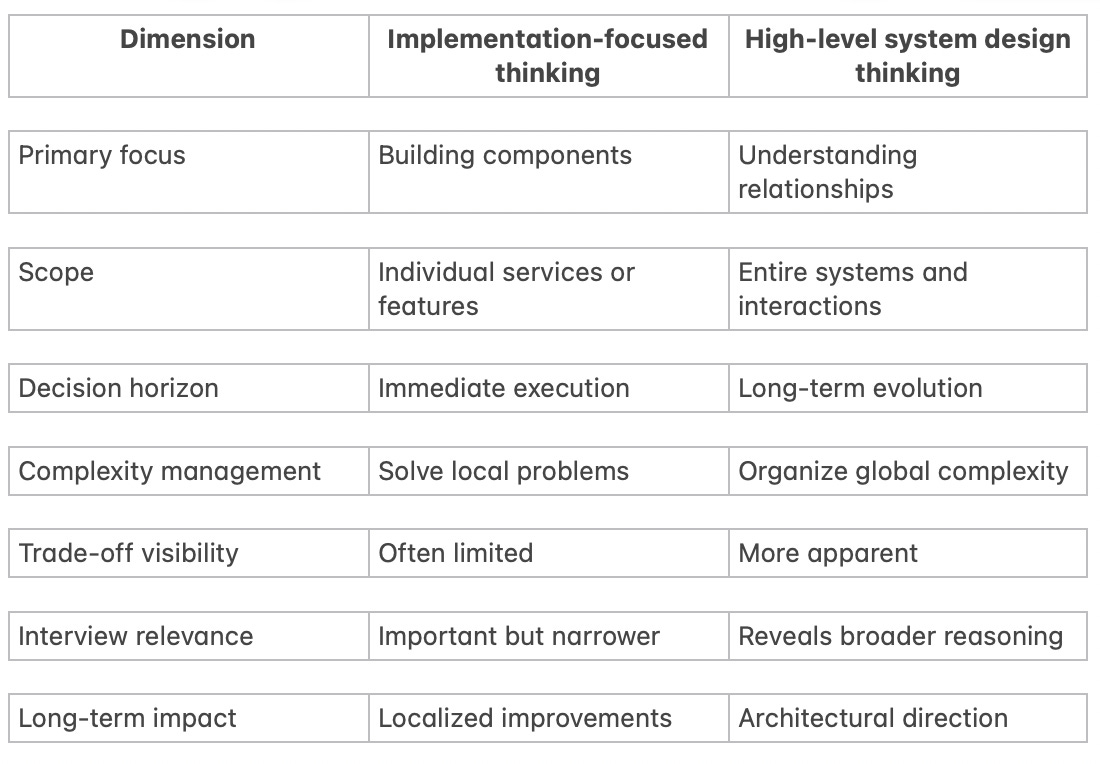
The comparison highlights something important. Neither mode of thinking is inherently superior. Systems require both. The challenge is knowing which perspective is most useful in a given situation.
Many engineers spend years strengthening implementation skills before intentionally developing architectural thinking. That progression is natural because architecture builds on implementation experience. The best abstractions often emerge from deep familiarity with details.
Why real systems rarely match their diagrams
One lesson engineers eventually learn is that architecture diagrams are snapshots rather than realities. They capture intentions at a particular moment in time. Real systems continue evolving long after those diagrams are created.
Requirements change. Teams grow. Technical debt accumulates. New services emerge. Old assumptions stop being valid. The architecture adapts continuously because the environment around it changes continuously.
This creates a gap between how systems appear and how systems behave. Diagrams often look clean because clarity is useful. Production systems often look messy because reality is messy. The difference is not necessarily a sign of poor engineering. It is often a sign of adaptation.
High-level design remains valuable despite this evolution because its purpose is not to predict every future detail. Its purpose is to provide enough structure for engineers to reason effectively as the system changes.
Architecture is less a destination than an ongoing conversation.
Misconceptions about high-level system design
Several misconceptions appear repeatedly whenever engineers discuss high-level design.
One is the belief that it consists primarily of drawing boxes and arrows. Diagrams can certainly help communicate ideas, but the value lies in the reasoning behind the diagram rather than the diagram itself.
Another misconception is that high-level design is somehow less technical than implementation. In practice, architectural thinking often requires broader technical understanding because decisions influence entire systems rather than isolated components.
People also frequently assume there is one correct architecture. Real systems rarely behave that way. Different designs reflect different priorities, constraints, and trade-offs. Context matters more than templates.
Finally, many engineers treat high-level design as an interview skill rather than an engineering skill. Interviews may highlight architectural thinking, but the ability to reason about systems remains valuable long after the interview ends.
What strong System Design thinkers tend to do differently
Over time, certain patterns emerge among engineers who become particularly effective at System Design. They tend to develop strong abstraction skills. They identify which details matter and which details can be deferred. They communicate complex ideas clearly. They think in terms of systems rather than isolated technologies.
Perhaps most importantly, they remain curious about relationships. They ask how decisions influence other decisions. They explore dependencies. They examine trade-offs. Their attention naturally gravitates toward interactions because interactions are where many architectural challenges originate.
Strong architects are rarely the people who know the most details. They’re often the people who know which details matter.
This observation becomes increasingly important as systems grow more complex. Knowledge remains valuable, but prioritization becomes equally valuable. Engineers cannot reason about everything simultaneously. The ability to focus on the right things becomes a competitive advantage.
What high-level design teaches about engineering
The deeper lesson behind high-level system design extends beyond architecture itself. It teaches engineers how to think about complexity. It teaches them how to abstract without oversimplifying. It teaches them how to reason about relationships, consequences, and trade-offs.
These skills influence far more than System Design interviews. They shape product decisions, organizational structures, operational practices, and technical strategy. Engineers who develop strong architectural thinking often become better communicators because they learn how to organize complexity coherently.
In many ways, abstraction is one of the defining skills of engineering. Every discipline relies on representations that simplify reality enough to make reasoning possible. Software engineering is no different. High-level design simply makes that process explicit.
The goal is not avoiding details. The goal is learning when details help and when they distract.
TLDR; learning to see the system
High-level system design is often described through diagrams, architectures, and system boundaries. Those things matter, but they are ultimately secondary. The deeper skill is perspective.
Learning to think at a high level means learning to see relationships rather than components. It means understanding how abstractions help manage complexity. It means recognizing trade-offs before they become operational problems. It means developing the ability to zoom out far enough to understand the system as a whole.
The journey from implementation-focused thinking to architectural thinking is not a journey away from code. It is a journey toward context. Engineers gradually learn that systems are shaped as much by interactions as by individual technologies.
The journey from writing code to designing systems is often the journey from seeing parts to seeing relationships.
And perhaps that is why high-level system design remains such an important concept. It teaches engineers how to see software not as isolated pieces of functionality, but as interconnected systems whose behavior emerges from the relationships between them. That perspective continues to matter long after the diagrams are forgotten.