

TikTok System Design
How TikTok built the experience around what the system could learn.

Most internet products change gradually. A new feature appears, users adapt, competitors respond, and eventually the industry shifts. TikTok felt different. Within a surprisingly short period of time, it changed what millions of people expected from software itself. Users opened the app and immediately encountered something that felt almost unnervingly effective. The system seemed to understand interests before users could articulate them. Content discovery became effortless. The experience felt less like searching for information and more like information finding you.
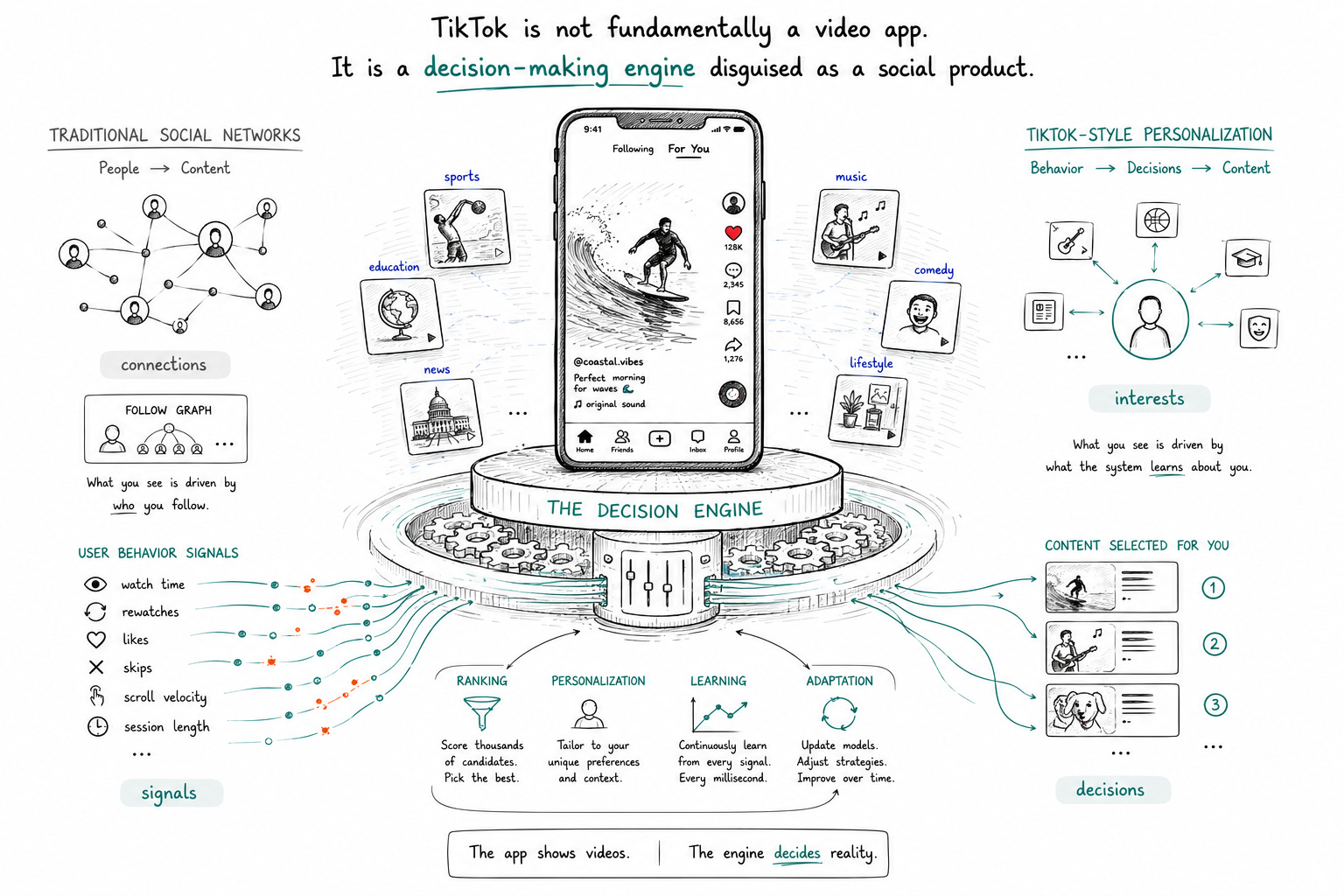
What fascinated me wasn’t simply TikTok’s growth. Internet history is full of fast-growing products. What made TikTok interesting was how thoroughly it reshaped assumptions about personalization. For years, many social networks operated around explicit connections. You followed people, subscribed to creators, or joined communities. TikTok elevated a different idea. Instead of building the experience primarily around who you knew, it built the experience around what the system could learn.
Most people understandably think of TikTok as a social media application. They see videos, creators, comments, likes, and sharing features. Those things certainly matter. But from a systems perspective, TikTok is something more interesting. At its core, it is a recommendation system operating at extraordinary scale, continuously making decisions about what to show, when to show it, and how to adapt those decisions based on new information arriving every second.
The most important system inside TikTok isn’t video delivery. It’s decision-making.
That observation is part of what makes TikTok such a compelling engineering problem. The infrastructure is impressive, but the real challenge lies in how intelligence, personalization, and scale intersect. Studying TikTok system design is ultimately less about social media and more about understanding how modern software increasingly competes through its ability to make good decisions.
Why TikTok is a different kind of engineering problem
Many large-scale internet systems revolve around retrieval. Search engines retrieve information. Streaming platforms retrieve content. Traditional social networks retrieve posts from people users choose to follow. TikTok operates under a different model. Instead of primarily retrieving known content, it continuously decides what content should be surfaced next. That distinction sounds subtle, but architecturally it changes almost everything.
In search systems, users provide intent explicitly. They type a query, and the system attempts to satisfy it. In recommendation-driven systems, the platform must infer intent from behavior. Every interaction becomes a signal. Every pause, swipe, replay, or engagement event contributes to an evolving understanding of user preferences. The architecture therefore spends enormous resources not simply storing and serving content, but interpreting behavior.
This shifts the center of gravity for the entire product. Traditional social networks often optimize around relationships and content creation. TikTok optimizes around relevance. The recommendation engine is not an accessory attached to the platform. It is the platform. The quality of recommendations directly determines the quality of the user experience.
What makes this difficult is that relevance behaves differently from infrastructure metrics. Engineers can measure latency, throughput, and availability relatively directly. Relevance is probabilistic. It evolves continuously. It depends on context, timing, behavior, and changing interests. Designing systems around that reality requires a different way of thinking about software.
When recommendations become infrastructure
One of the most important shifts in modern internet architecture is that recommendation systems evolved from product features into foundational infrastructure. Early recommendation engines often existed as secondary enhancements layered on top of products. Today, in many applications, recommendations determine the product experience itself.
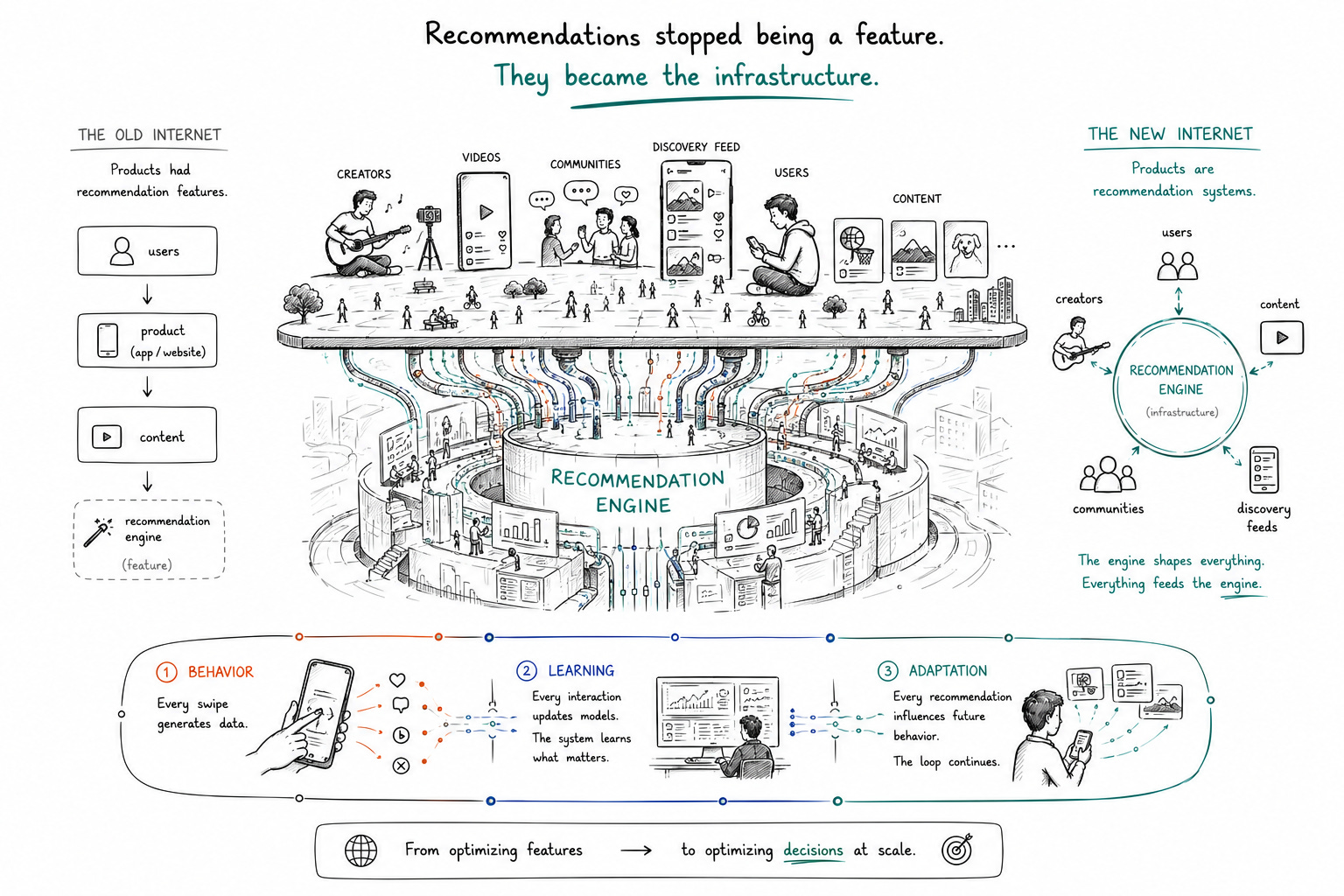
TikTok represents perhaps the clearest example of this transition. The recommendation engine influences what users discover, how long they remain engaged, which creators gain visibility, and how content propagates throughout the ecosystem. The architecture increasingly revolves around supporting decision-making systems rather than simply supporting content storage and delivery.
Several characteristics make these systems fundamentally different:
Every swipe generates data
Every interaction updates models
Every recommendation influences future behavior
This creates a fascinating feedback loop. The system learns from user behavior while simultaneously shaping future user behavior through its recommendations. The architecture is not simply reacting to users. It is participating in a continuous cycle of observation, prediction, and adaptation.
Over time, recommendation quality became a competitive advantage in ways many organizations initially underestimated. Infrastructure scale remained important, but recommendation intelligence increasingly became the differentiator. Two platforms might deliver content equally well, yet the platform that understands users more effectively often creates a dramatically different experience.
The scale problem most users never see
When people think about TikTok’s scale, they often focus on video delivery. That certainly matters. Delivering enormous volumes of video content globally requires sophisticated storage systems, content distribution networks, caching strategies, and networking infrastructure. But content delivery is only one dimension of the challenge.
Every day, TikTok processes billions of interactions. Users watch videos, skip videos, replay content, follow creators, engage with trends, and generate behavioral signals continuously. The system must ingest these signals, process them, update recommendation models, and serve personalized experiences across a global user base. The volume of data becomes staggering.
What makes this particularly difficult is that recommendation workloads scale differently from traditional web applications. A typical application might serve similar content to large groups of users. TikTok increasingly serves individualized experiences. Personalization transforms scale from a content problem into a decision-making problem. The infrastructure must continuously determine not just what content exists, but which content is most relevant for a specific user at a specific moment.
This creates architectural challenges that go beyond storage or throughput. Data pipelines, ranking systems, feature stores, machine learning infrastructure, and real-time processing systems become central components of the architecture. Scale is not simply about handling traffic. It is about maintaining intelligence under traffic.
Real-time feedback loops change everything
Traditional software applications often operate through relatively straightforward request-response interactions. A user performs an action. The system processes it. A result is returned. TikTok operates inside a more dynamic environment where user behavior continuously influences future system behavior.
Every interaction contributes to a feedback loop. A user watches a video slightly longer than average. The system interprets that signal. Future recommendations shift accordingly. A user repeatedly engages with a certain category of content. The recommendation engine adapts. Over time, the experience becomes increasingly personalized through continuous adjustment.
Most applications respond to user actions. Systems like TikTok evolve because of them.
This feedback-driven architecture creates both opportunities and challenges. On one hand, the system becomes remarkably adaptive. On the other hand, designing systems that continuously learn requires careful attention to latency, data quality, model behavior, and operational reliability. Small delays can affect recommendation freshness. Poor signals can distort personalization. Feedback loops amplify both strengths and weaknesses.
What fascinates me most is how this changes the relationship between software and users. The product is no longer static. It becomes an evolving system shaped by interactions occurring across millions of users simultaneously.
Why TikTok became a popular System Design interview topic
It’s not surprising that TikTok-style architectures have become common discussion topics in System Design interviews. One thing we’ve observed repeatedly is that engineers are drawn to systems that combine multiple difficult problems into a single product. TikTok does exactly that.
That’s part of why resources like the TikTok System Design Interview Questions article exist. Engineers frequently encounter questions about recommendation-driven systems because these architectures force discussions around scalability, personalization, distributed processing, latency, and trade-offs simultaneously. They reveal how different architectural concerns interact in real-world systems.
What’s interesting is that candidates often assume these discussions are primarily about scale. Scale certainly matters, but recommendation-heavy systems reveal something deeper. They force engineers to think about decision-making infrastructure. The challenge isn’t simply serving content efficiently. The challenge is serving the right content efficiently.
That distinction mirrors a broader trend in software. Increasingly, modern applications compete not only on functionality, but on the quality of the decisions they make on behalf of users.
The importance of strong fundamentals
Despite the sophistication of recommendation systems, the underlying architecture still depends heavily on foundational systems concepts. This is something many engineers underestimate initially.
Recommendation engines may appear highly specialized, but they still rely on storage systems, caching strategies, distributed communication, data partitioning, consistency models, and reliability mechanisms. The advanced behavior emerges from combinations of relatively familiar building blocks. The complexity comes from scale and coordination rather than entirely new principles.
That’s part of why resources like Grokking the Fundamentals of System Design continue to resonate with learners. Many engineers struggle not because they cannot understand recommendation systems, but because they underestimate how much those systems depend on fundamentals. Advanced architectures are often built on surprisingly simple concepts repeated and scaled effectively.
Strong foundations remain valuable because technologies evolve faster than principles. Recommendation models will change. Infrastructure platforms will change. But the underlying reasoning around scalability, reliability, and distributed systems remains remarkably durable.
Learning how systems fit together
One challenge many engineers encounter is moving from understanding individual concepts to understanding entire systems. They learn databases, caching, queues, APIs, and distributed services separately. Connecting those concepts into coherent architectures often proves more difficult.
That’s part of why resources like Grokking the Modern System Design Interview were created. The goal is helping engineers observe how systems emerge from interacting components rather than isolated technologies. Real-world architectures rarely depend on a single idea. They depend on how ideas work together.
TikTok provides a particularly interesting example because it combines multiple layers of infrastructure simultaneously. Recommendation systems interact with content delivery systems. Data pipelines interact with ranking engines. Personalization layers interact with storage infrastructure. Understanding the architecture requires understanding relationships rather than components alone.
This is one reason systems thinking feels different from memorization. It focuses less on individual technologies and more on interactions between them.
Traditional social media vs TikTok-style recommendation systems
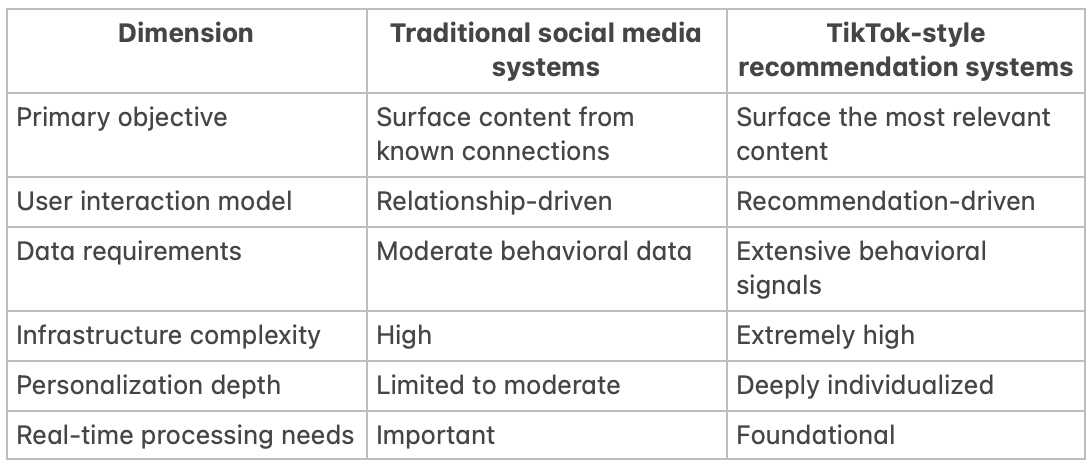
The comparison highlights an important architectural shift. Traditional social platforms primarily organize information. Recommendation-driven platforms increasingly interpret information. That difference changes infrastructure priorities, data requirements, and system behavior significantly.
The architecture becomes less about storing content and more about deciding which content deserves attention.
The challenge of designing for engagement
Optimizing for engagement sounds straightforward conceptually, but it creates surprisingly difficult engineering problems. Recommendation quality depends on balancing multiple competing priorities simultaneously. The system must consider relevance, freshness, diversity, latency, and personalization while operating under significant scale constraints.
This balancing act affects architecture directly. Fresh recommendations require timely data processing. Personalized recommendations require extensive behavioral information. Low latency requires efficient infrastructure. Content diversity requires exploration mechanisms. Every objective influences system design decisions.
The challenge becomes even more complicated because user interests evolve continuously. What feels relevant today may feel irrelevant tomorrow. Systems optimized for engagement must therefore adapt continuously rather than relying on static assumptions. The architecture becomes a living system responding to behavioral change in real time.
This is part of why recommendation infrastructure has become one of the defining engineering challenges of the modern internet.
Fast learning versus deep learning
Many engineers become interested in recommendation-driven architectures because they encounter them during interview preparation or career growth. Sometimes they need a quick refresher. Other times they seek deeper understanding.
Resources like System Design Interview: Fast-track in 48 Hours often help engineers organize existing knowledge efficiently. There is certainly value in structured refreshers, particularly when someone already possesses strong foundations and needs to reconnect concepts quickly.
But there is also an important distinction worth remembering.
Fast preparation can improve performance. Deep understanding changes how engineers think.
Recommendation systems illustrate this particularly well. It is possible to learn architectural patterns relatively quickly. Developing intuition about why those patterns exist takes longer. The difference matters because real engineering rarely presents familiar diagrams. It presents new problems that require adaptable thinking.
The goal is not memorizing architectures. The goal is developing judgment.
Misconceptions about TikTok system design
Several misconceptions appear repeatedly when people discuss TikTok system design.
One is that TikTok is primarily a video streaming platform. Video delivery matters enormously, but the recommendation infrastructure ultimately defines the experience. The videos are important. The decisions are more important.
Another misconception is that the recommendation engine exists as a separate component attached to the platform. In reality, recommendation logic influences nearly every aspect of the architecture. It shapes data pipelines, storage strategies, ranking systems, and processing requirements.
People also tend to assume scale is the hardest problem. Scale is certainly challenging, but recommendation quality may be even harder. Delivering content efficiently is difficult. Determining which content deserves delivery can be even more difficult.
Finally, there is a belief that more data automatically creates better recommendations. Data helps, but data alone is insufficient. Systems must interpret signals correctly, adapt intelligently, and balance competing objectives continuously.
What TikTok reveals about modern software architecture
The most interesting lesson from TikTok may have little to do with TikTok specifically.
Across the industry, products increasingly compete through personalization, recommendations, prediction, and intelligent decision-making. Recommendation systems are no longer limited to social media. They appear in commerce, entertainment, education, finance, and productivity software. Many modern applications now contain recommendation infrastructure in some form.
This reflects a broader architectural shift. Software increasingly operates through systems that observe behavior, learn patterns, and adapt experiences dynamically. Recommendation systems, AI-assisted products, and personalization engines all represent variations of this trend. The infrastructure increasingly exists not only to process requests, but to make decisions.
TikTok simply happens to be one of the clearest examples of this evolution.
Studying it helps us understand where modern software is heading.
Conclusion: recommendation systems became the product
TikTok’s significance extends far beyond social media. What makes it architecturally interesting is not simply its scale, popularity, or growth. It is the way it demonstrates how recommendation infrastructure can become the defining element of a product experience.
The platform reveals how personalization, ranking systems, feedback loops, and distributed infrastructure increasingly work together to shape modern software. The recommendation engine is not supporting the product. In many ways, it is the product.
For engineers, this offers an important lesson. Understanding systems today increasingly means understanding how data, infrastructure, intelligence, and user behavior interact. The challenge is no longer simply building systems that work. It is building systems that make increasingly effective decisions under enormous scale and complexity.
And perhaps that’s the broader story behind TikTok system design. Products once competed through features. Increasingly, they compete through intelligence. The architectures that succeed will be the ones that learn, adapt, and reason about users more effectively than the systems that came before them.