

Why engineers eventually need a System Design deep dive into real-world distributed systems
One thing we’ve observed repeatedly over the years is that engineers eventually outgrow simplified examples—not because those examples are wrong, but because they have already served their purpose.

Every engineer begins their System Design journey with simplified diagrams. We sketch a few services, add a database, introduce a cache, perhaps place a load balancer at the front, and suddenly the architecture looks complete. These examples are incredibly valuable because they teach us how systems are composed. They introduce the vocabulary of architecture without overwhelming us with the complexity that real production environments inevitably accumulate.
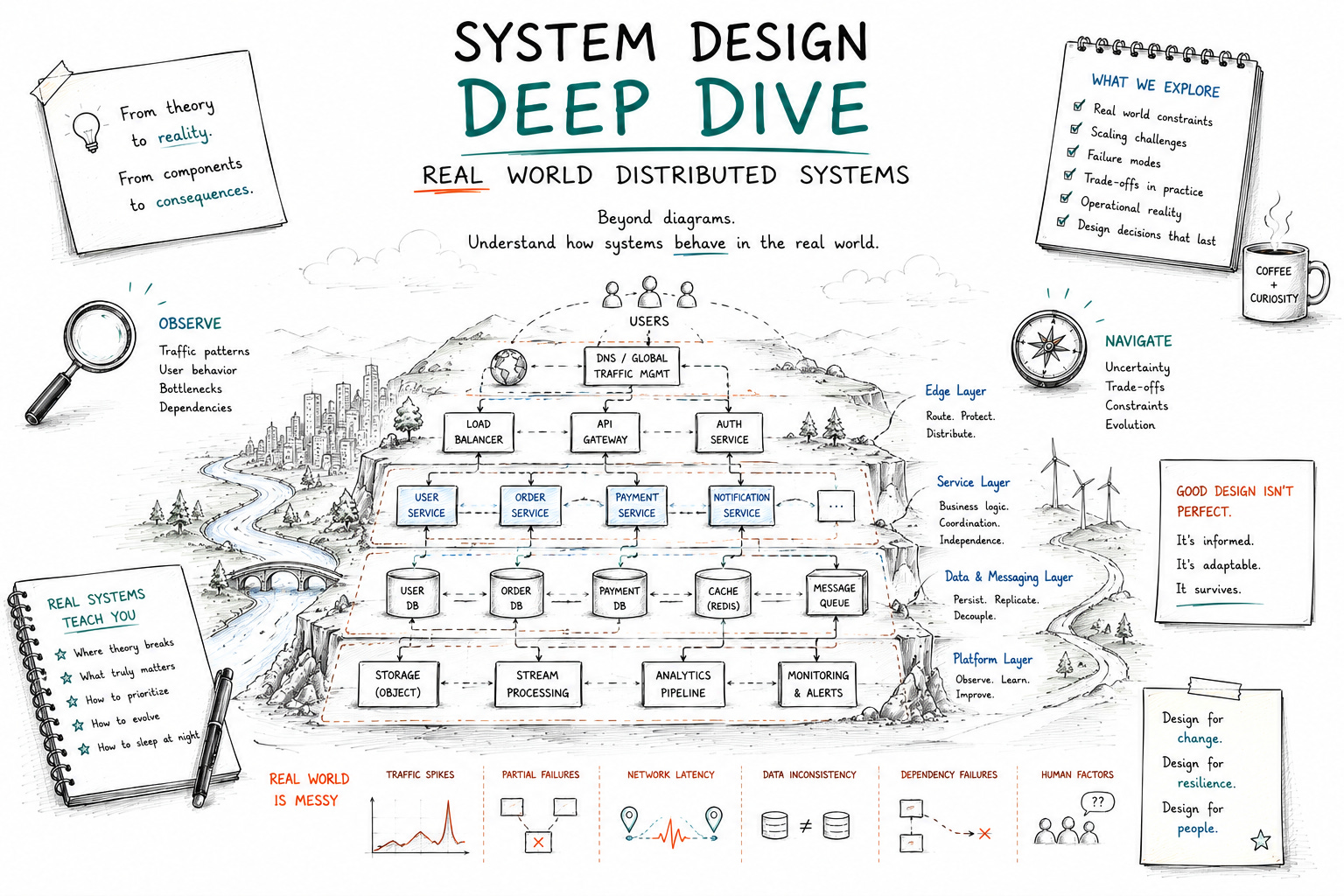
Eventually, though, something changes. The diagrams that once answered our questions begin creating new ones. An engineer who has studied enough examples eventually starts wondering why real companies build systems that look so different from interview exercises. Why does Netflix operate thousands of services instead of a handful? Why does Amazon organize ownership the way it does? Why do production architectures often seem messier than the elegant diagrams found in books and presentations?
That moment is an important milestone in an engineer’s growth. It signals that learning is shifting from understanding what a distributed system looks like to asking why it became that way. The next classroom is no longer the simplified architecture diagram. It is the production system itself.
Beginner diagrams teach you what a system could look like. Production systems teach you why it rarely ends up looking that way.
One thing we’ve observed repeatedly over the years is that engineers eventually outgrow simplified examples—not because those examples are wrong, but because they have already served their purpose. Abstraction is an incredible teaching tool, but mature engineering eventually requires returning to the complexity those abstractions intentionally removed.
Why simplified systems are only the beginning
Educational examples deliberately remove complexity because learning becomes impossible if every concept arrives at once. A URL shortener is not introduced to teach every operational challenge of distributed storage. A messaging system example is not trying to capture every deployment strategy or every production incident. Instead, these examples isolate a handful of architectural ideas so learners can focus on one problem at a time.
That reduction in complexity is what makes System Design approachable. Without abstraction, beginners would struggle to separate important ideas from operational noise. They would spend their time worrying about deployment pipelines before understanding why replication exists. They would become distracted by monitoring dashboards before learning how services communicate.
The interesting part is that the same abstraction which enables learning eventually becomes a limitation. Once engineers understand the building blocks, they naturally become curious about everything that was intentionally left out. The clean architecture diagrams stop feeling complete because real software rarely behaves so neatly.
Good education does not hide complexity forever. It introduces it gradually. The goal is never to remain inside simplified examples but to use them as stepping stones toward understanding the systems engineers actually build and maintain.
The moment engineers become curious about production
There is a recurring question that appears among experienced learners. It is usually not “What is sharding?” or “What is replication?” Instead, it sounds more like: Why did Netflix choose this architecture? Or Why does Amazon organize services this way? Or Why do real distributed systems look nothing like interview diagrams?
These questions reveal an important shift in thinking. Early learners focus on components. Experienced learners focus on evolution. They become less interested in isolated technologies and more interested in the forces that shape entire systems over years of growth.
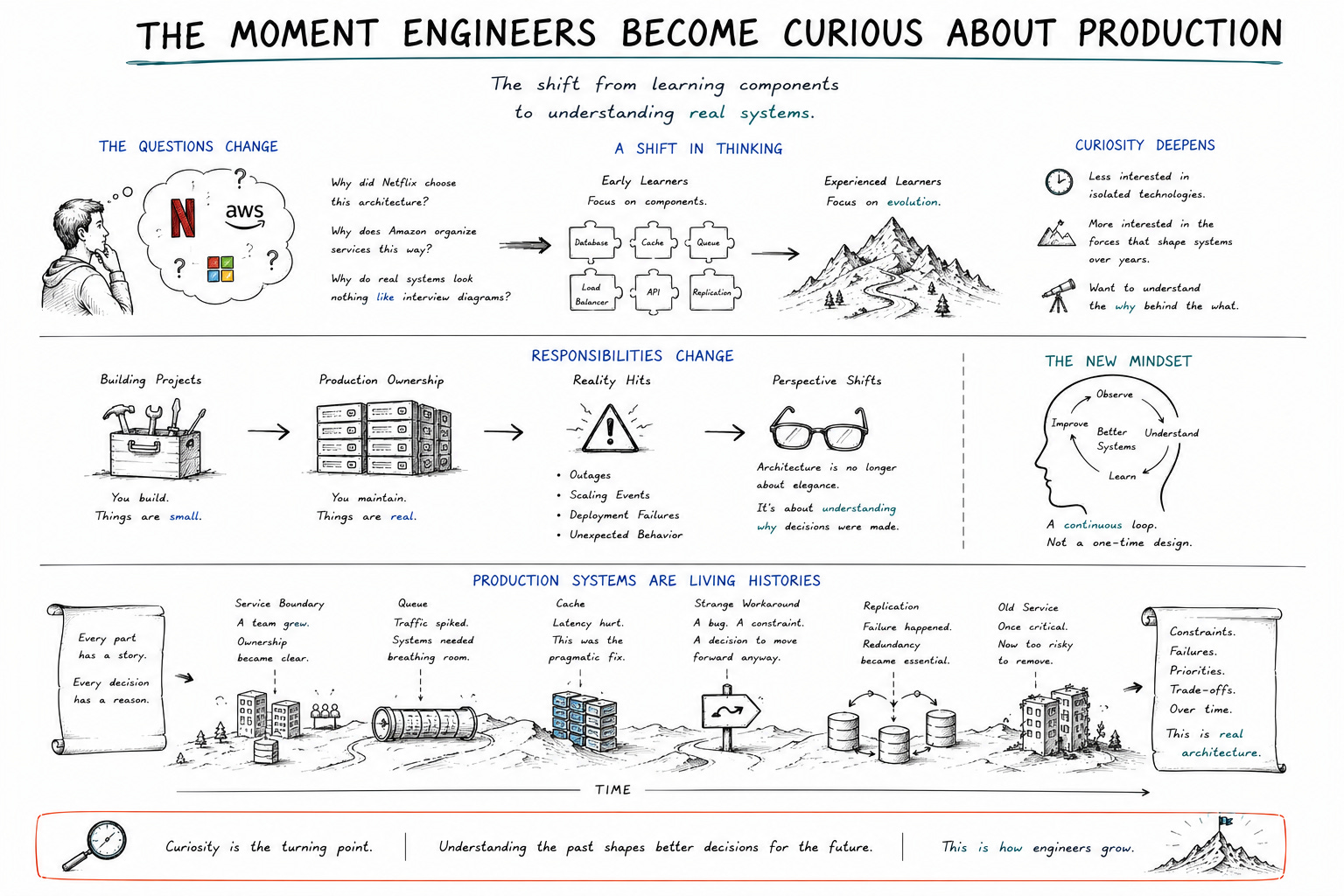
Curiosity changes because responsibilities change. Engineers begin maintaining production services rather than isolated projects. They experience outages, scaling events, deployment failures, and unexpected customer behavior. Suddenly architecture becomes less about designing something elegant and more about understanding why previous decisions made sense at the time.
Production systems become fascinating because they are living histories of engineering decisions. Every service boundary, every queue, every cache, and every unusual workaround tells a story about constraints, failures, priorities, and trade-offs that accumulated over time.
What real-world distributed systems introduce
Production environments introduce realities that simplified examples intentionally avoid.
Systems evolve continuously.
Requirements change unexpectedly.
Teams grow and ownership shifts.
Failures happen regularly.
These realities reshape architecture in ways diagrams rarely capture. Technical debt becomes part of the conversation. Organizational boundaries influence service boundaries. Operational reliability becomes just as important as scalability. Engineers begin optimizing not only for performance but also for maintainability, recoverability, and observability.
Real distributed systems also reveal that architecture is rarely static. Systems adapt to changing business priorities, customer growth, regulatory requirements, and infrastructure limitations. Every change introduces new compromises, and those compromises become part of the architecture itself.
Perhaps the most valuable lesson is that complexity rarely arrives all at once. It accumulates gradually through hundreds of reasonable decisions made over many years.
Why production systems look messy
Many newcomers assume experienced engineering teams produce perfectly elegant architectures. Reality is usually far more interesting. Production systems often look messy because they have survived years of changing priorities, evolving products, acquisitions, migrations, customer growth, and operational incidents.
Production systems are rarely designed all at once. They are negotiated over years.
This observation changes how engineers evaluate architecture. Instead of asking why a system contains imperfections, they begin asking what historical decisions created them. A seemingly awkward service boundary may exist because it reduced operational risk during a migration. A duplicated component may reflect organizational ownership rather than technical preference.
Engineering maturity often involves becoming more sympathetic toward existing systems. It is easy to criticize architecture without understanding the constraints under which it evolved. It is much harder—and much more valuable—to understand why experienced engineers made those choices.
That perspective encourages humility. Complex systems are not monuments to perfect planning. They are evidence of continuous adaptation.
From architecture to operations
One of the biggest differences between educational examples and production systems is that production introduces operations as a first-class engineering concern. Designing services is only one part of building distributed systems. Keeping those services healthy over months and years becomes equally important.
Observability, monitoring, incident response, deployments, recovery procedures, and maintenance gradually become inseparable from architecture itself. A beautifully designed service provides little value if nobody can diagnose failures quickly or deploy updates safely.
Operations also reveal that architecture is judged under pressure rather than during design reviews. Systems earn trust when they continue serving customers despite failures, traffic spikes, hardware outages, and unexpected behavior. Reliability is not merely designed. It is continuously practiced.
Studying production systems therefore teaches something diagrams rarely communicate: architecture is an operational discipline as much as it is a design discipline.
Educational examples vs real-world distributed systems
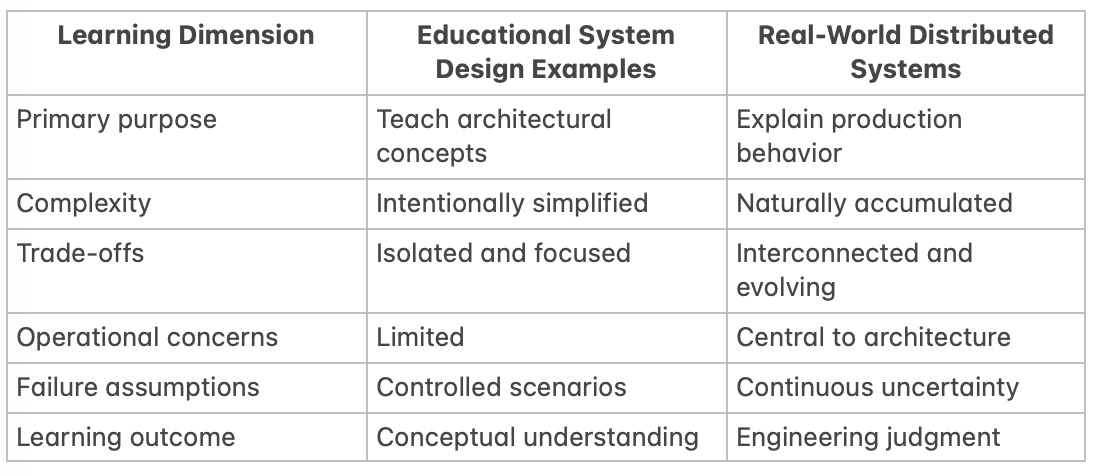
The progression from the left column to the right mirrors the progression of many engineering careers. Educational examples provide clarity. Production systems provide context. One is not better than the other—they simply answer different questions.
Without simplified examples, beginners struggle to learn. Without production examples, experienced engineers struggle to mature. Strong engineering education eventually connects both perspectives.
Why failure becomes the real teacher
Production systems expose engineers to something educational diagrams rarely can: failure. Services become unavailable. Databases slow down. Deployments introduce unexpected behavior. Traffic patterns shift overnight. Hardware fails. Human assumptions turn out to be incomplete.
While nobody enjoys production incidents, they often produce deeper learning than successful deployments ever could. Failure forces engineers to examine assumptions, understand dependencies, and improve resilience. It exposes weaknesses that remained invisible during normal operation.
Many engineers discover that their greatest architectural lessons come not from designing successful systems but from recovering imperfect ones. Failures reveal how systems actually behave rather than how we expected them to behave.
This is one reason experienced engineers often discuss incidents with such care. They are not celebrating failure. They are recognizing its educational value.
Misconceptions about real-world distributed systems
Several misconceptions appear repeatedly as engineers begin exploring production architectures. One is the belief that real systems closely resemble textbook diagrams. In reality, diagrams usually represent simplified snapshots rather than operational histories.
Another misconception is that complexity automatically reflects better engineering. Sometimes complexity is unavoidable. Just as often, it represents accumulated compromise. Experienced engineers usually value simplicity precisely because they understand how expensive unnecessary complexity becomes.
Some people also assume distributed systems matter only for internet-scale companies. In practice, distributed thinking appears whenever multiple services, databases, or teams must coordinate. Scale changes the intensity of these problems, but not their existence.
Perhaps the most limiting misconception is that studying production systems only benefits senior engineers. Curiosity about real architecture can improve judgment at every stage of an engineering career.
Experienced engineers often spend less time admiring architectures and more time asking why those architectures had to evolve.
When diagrams become stories
Eventually every mature engineering career reaches a point where architecture diagrams stop being endpoints and start becoming stories. Every service reflects previous decisions. Every database migration reflects changing priorities. Every monitoring dashboard reflects lessons learned from previous incidents.
Studying system design deep dive real world distributed systems is ultimately less about mastering greater complexity and more about appreciating greater context. Real production systems teach engineers that architecture is never isolated from operations, organizations, or time. The most valuable lessons rarely come from idealized examples. They emerge from systems that have survived years of growth, uncertainty, and continuous change.
As engineers become more experienced, they often stop asking, “How does this architecture work?” and begin asking, “Why did this architecture become this way?” That question reflects a deeper kind of learning—one grounded not only in technology, but in engineering judgment itself.
The deepest lessons in System Design are rarely found in perfect diagrams. They’re found in imperfect systems that have survived real users, real failures, and real time.