

OpenAI forward deployed engineer
The OpenAI Forward Deployed Engineer Isn’t Really Building Features

For years, software engineering followed a fairly predictable pattern.
Product teams gathered requirements, engineers built features, QA verified the implementation, and customers eventually told everyone whether those decisions had been the right ones. The feedback loop wasn’t always fast, but it was usually clear. Companies built products first and learned from users afterward.
Large language models have quietly disrupted that sequence.
Modern AI products don’t simply execute predefined workflows. They become part of the customer’s workflow itself. Every organization uses them differently. Every deployment uncovers new edge cases. Every successful implementation teaches engineers something the original product team never anticipated.
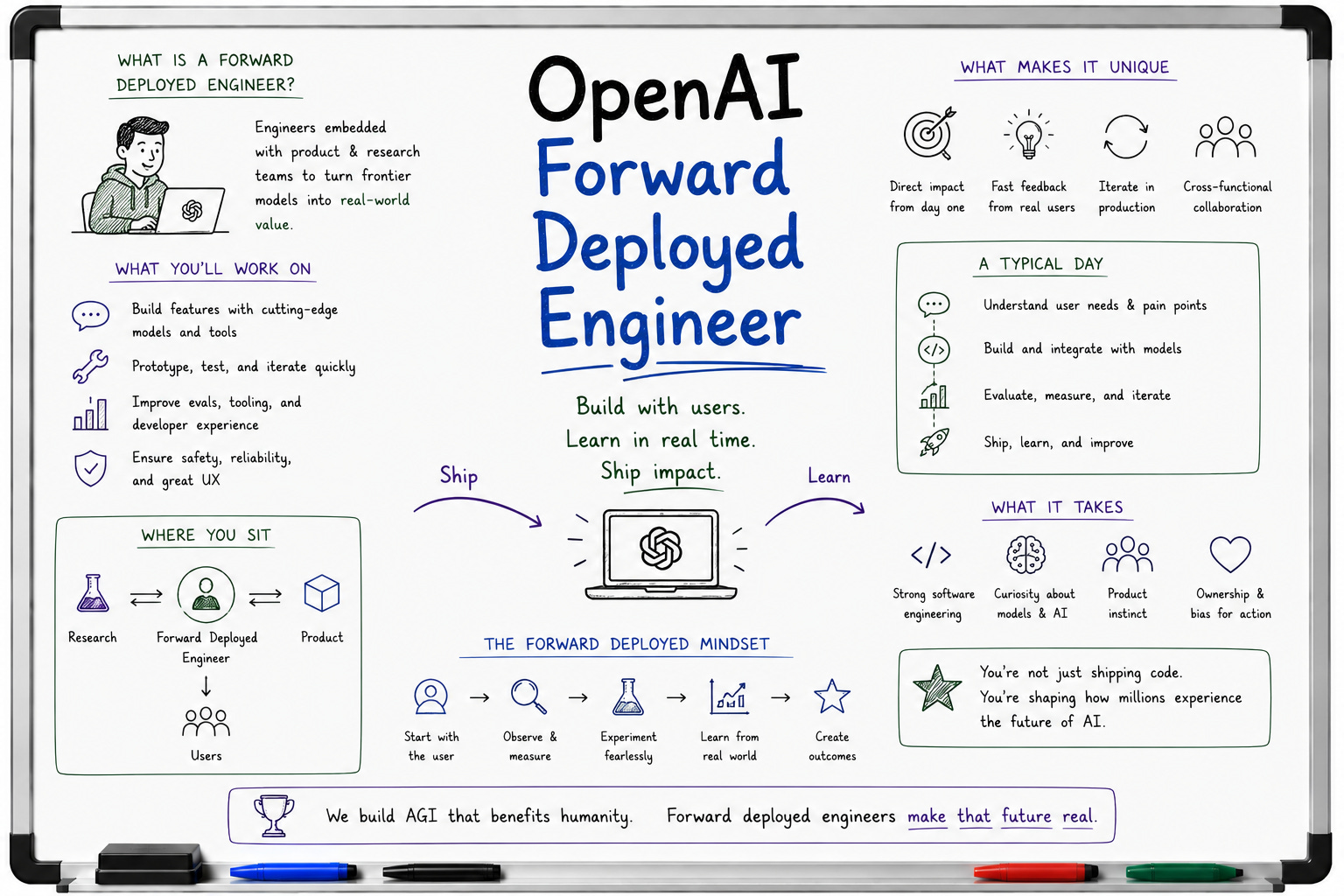
That’s one reason I find the idea of the forward deployed engineer role so interesting.
At first glance, it resembles something the software industry has seen before. The title suggests customer engineering, implementation consulting, or technical solutions work. Those comparisons aren’t entirely wrong, but I don’t think they capture what makes the role unusual.
The job isn’t simply helping customers use an existing product.
It’s helping the product discover what it should become next.
OpenAI describes Forward Deployed Engineers as people who work closely with customers to solve difficult technical problems, build prototypes, integrate models into complex environments, and relay those lessons back into the platform itself. The role combines software engineering, product thinking, and customer collaboration in ways that are increasingly difficult to separate. Engineers aren’t operating on the sidelines after the product ships. They’re participating in the product’s evolution while it’s being used in the real world.
That changes the nature of engineering itself.
Rather than optimizing code in isolation, forward deployed engineers optimize the relationship between technology and reality. They discover where elegant architectures meet messy organizations, where impressive demonstrations collide with imperfect business processes, and where assumptions made inside the company encounter customers who never read the original design document.
Viewed from that perspective, the role begins making much more sense.
The interview probably isn’t asking whether you can integrate another API.
It’s asking whether you can learn from customers quickly enough that the next version of the product becomes better for everyone.
The most valuable forward deployed engineers don’t simply solve customer problems. They transform customer experience into product knowledge.
The boundary between engineering and product is disappearing
Traditional software organizations often draw clear lines between different responsibilities.
Engineers write code.
Product managers gather requirements.
Solutions architects assist customers after deployment.
Support teams investigate production issues.
Each function contributes to the final product while remaining largely independent from the others.
AI products don’t always allow those boundaries to survive.
Imagine two companies deploying the same language model. One uses it to accelerate software development. Another integrates it into clinical documentation workflows. A third builds internal legal research tools. Although the underlying model remains identical, the engineering challenges surrounding those deployments become completely different. Prompt strategies evolve differently. Evaluation criteria change. Reliability expectations vary dramatically. Integration problems emerge in places nobody anticipated during development.
The engineers working closest to those customers inevitably begin seeing patterns long before anyone else.
One customer invents an effective workflow that dozens of future customers eventually adopt.
Another exposes a failure mode that never appeared during internal testing.
A third demonstrates that a capability originally designed for one use case solves an entirely different problem. They’re product insights.
That’s why I think the most successful forward deployed engineers naturally move between software engineering, systems thinking, communication, and product design without treating those disciplines as separate careers. Every customer conversation becomes another opportunity to understand how AI behaves outside carefully controlled environments.
In many ways, they’re conducting field research for the engineering organization.
Every interview round measures your ability to reduce uncertainty
Candidates often prepare for technical interviews by dividing subjects into familiar categories.
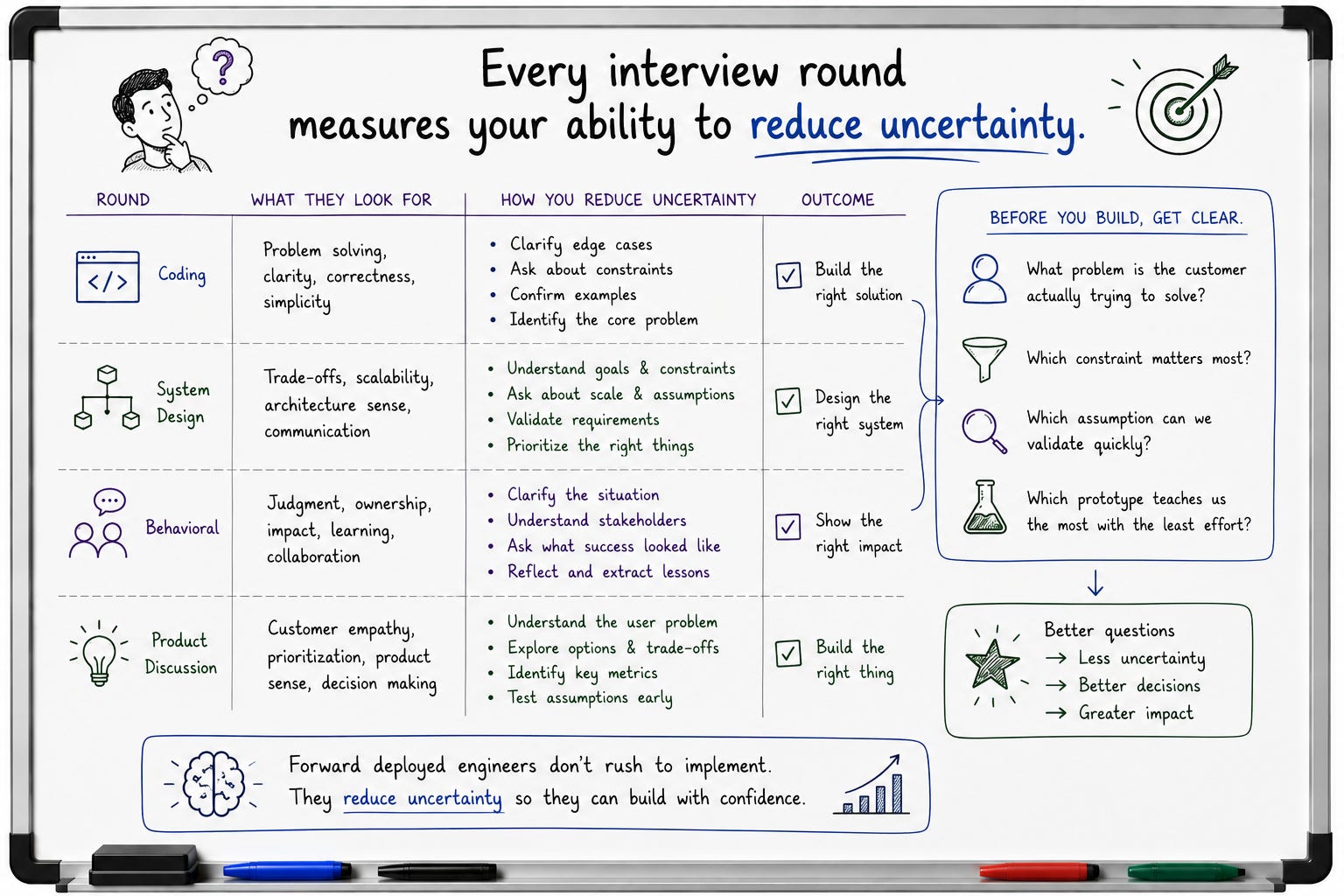
Coding
Behavioral questions
Product discussions
For forward deployed engineering, those categories feel much less independent.
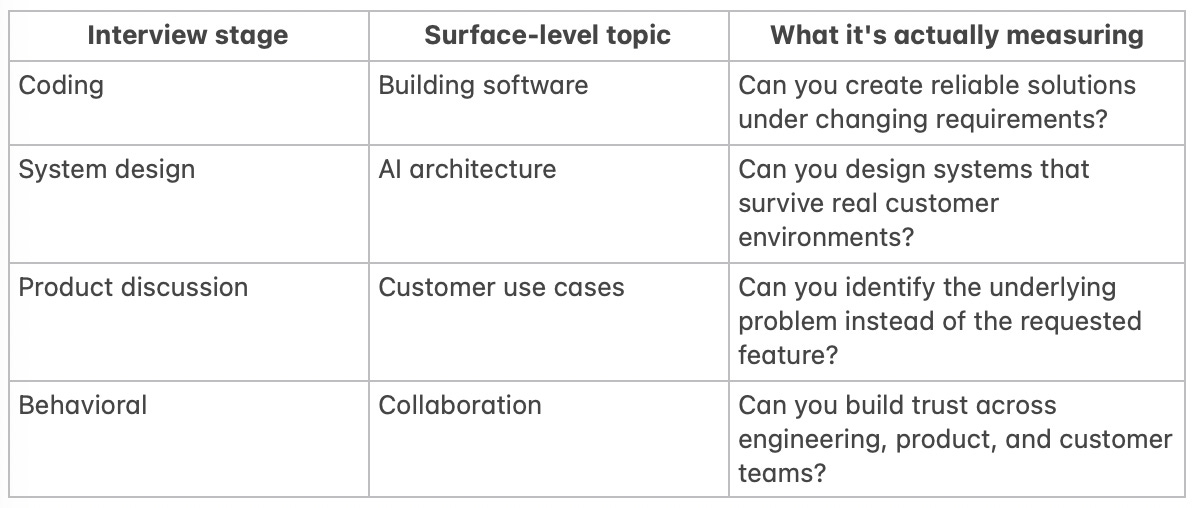
Notice what appears across every row.
Instead of rushing toward implementation, they ask better questions. What problem is the customer actually trying to solve? Which constraint matters most? Which assumption can we validate quickly? Which prototype teaches us the most with the least engineering effort?
Those questions reduce uncertainty before anyone writes code.
That’s a surprisingly valuable engineering skill.
The hardest engineering problems aren’t technical
One misconception about forward deployed engineering is that success depends primarily on technical depth.
Technical expertise is certainly essential. Engineers need to understand distributed systems, APIs, authentication, deployment, security, performance, and the practical limitations of modern language models.
Yet many customer engagements fail for reasons that have nothing to do with technology.
Sometimes an impressive prototype quietly solves a problem nobody considers strategically important. Experienced forward deployed engineers gradually learn that their first responsibility isn’t writing software.
It’s understanding reality.
That means asking uncomfortable questions, validating assumptions early, communicating tradeoffs honestly, and recognizing when the customer’s requested solution isn’t actually addressing the underlying problem.
Those skills rarely appear in programming textbooks. They become obvious only after enough real deployments.
That’s why I suspect the most interesting OpenAI Forward Deployed Engineer interviews aren’t searching for candidates who immediately produce elegant architectures.
They’re looking for engineers who know how to discover the right architecture in the first place.
Great prototypes answer questions. Great products answer them repeatedly.
One characteristic seems to appear repeatedly whenever experienced engineers talk about building software for customers.
The first version is almost never the final version.
That’s true for most software, but I think it’s especially true for AI.
Traditional applications tend to become more predictable as requirements mature. Teams gather feedback, refine workflows, and gradually stabilize the product. Large language models introduce a different dynamic. Every deployment teaches customers new ways to use the technology, which means every successful implementation creates entirely new requirements. Solving one problem often exposes three more that nobody realized existed.
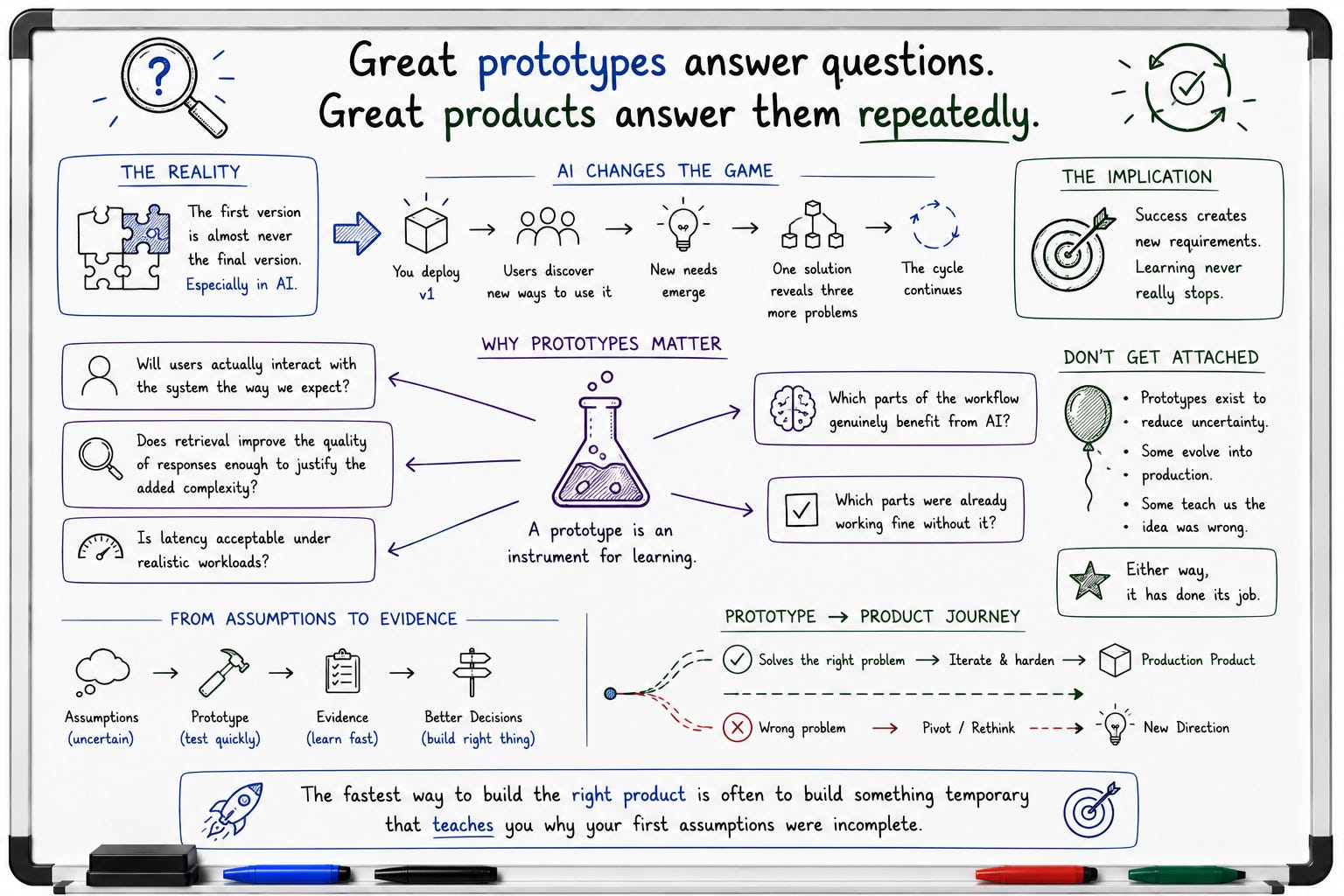
That’s why I suspect prototypes occupy such an important place in forward deployed engineering.
A prototype isn’t simply unfinished software.
It’s an instrument for learning.
A good prototype helps answer questions that were impossible to resolve through meetings alone. Will users actually interact with the system the way everyone expects? Does retrieval improve the quality of responses enough to justify the added complexity? Is latency acceptable once the application begins processing realistic workloads? Which parts of the workflow genuinely benefit from AI, and which parts were already working perfectly well without it?
Those answers influence the product far more than another week of internal planning ever could.
What’s particularly interesting is that forward deployed engineers can’t become emotionally attached to those prototypes. Their purpose isn’t to survive forever. Their purpose is to reduce uncertainty as quickly as possible. Sometimes that means the prototype evolves into production software. Other times it teaches everyone that the original idea wasn’t solving the right problem in the first place.
In either case, it has done its job.
The fastest way to build the right product is often to build something temporary that teaches you why your first assumptions were incomplete.
Customer conversations become engineering inputs
One habit I’ve noticed among experienced engineers is that they rarely treat customer feedback as a list of feature requests.
Instead, they treat it as evidence.
Imagine a customer asking for an increasingly complicated approval workflow around an AI assistant. On the surface, the request appears straightforward. Another engineer might immediately begin designing permissions, role hierarchies, and additional user interface components.
A forward deployed engineer is more likely to pause.
Why is the customer asking for approvals?
What risk are they trying to reduce?
Do they actually distrust the model, or do they simply lack visibility into how decisions are being made? Would better observability solve the problem more effectively than additional workflow complexity? Is this challenge unique to one organization, or does it reveal a broader limitation in the product itself?
Those questions often matter more than the implementation.
The interesting part is that every customer engagement gradually becomes another data point for product development. Patterns begin emerging across organizations. Different customers independently struggle with similar workflows. Similar deployment challenges appear across entirely different industries. Teams invent clever workarounds that eventually deserve to become first-class product capabilities.
Over time, individual customer conversations stop being isolated consulting engagements.
They become signals about where the platform itself should evolve.
That’s one reason I think forward deployed engineering occupies such a unique position inside modern AI companies. These engineers spend their time where internal assumptions collide with real organizational complexity. They see failure modes before product teams do. They discover unexpected successes before they appear in analytics dashboards. They’re often the first people to recognize that customers consistently want something slightly different from what the original roadmap imagined.
In many ways, they’re translating reality into engineering decisions.
The best forward deployed engineers know when not to customize
One of the more subtle challenges in this role is resisting the temptation to solve every customer’s problem with a custom solution.
That’s surprisingly difficult.
When you’re working closely with one organization, every request feels urgent and entirely reasonable. Building another integration, another workflow, or another specialized feature can appear like the fastest path toward success.
Over time, however, those individual optimizations can quietly fragment the product.
Experienced forward deployed engineers eventually learn to ask a different question.
Is this solving one customer’s problem, or revealing a capability that many future customers will eventually need?
That distinction influences almost every technical decision.
Sometimes the correct answer really is a customer-specific implementation because the underlying workflow is genuinely unique. Other times, repeated requests from multiple organizations point toward a missing product abstraction. The engineer’s responsibility isn’t simply writing code. It’s recognizing the difference.
That requires balancing two competing priorities that rarely exist in isolation.
Customers need solutions today.
The product needs to remain coherent tomorrow.
Finding that balance is much harder than choosing technologies or designing APIs because there usually isn’t an objectively correct answer. It requires engineering judgment, product intuition, and enough humility to recognize when today’s quick fix could become tomorrow’s maintenance burden.
I suspect that’s exactly the kind of thinking interviewers are trying to uncover.
Preparing for an OpenAI Forward Deployed Engineer interview
If I were preparing for this role today, I’d certainly review the technical fundamentals. Distributed systems, APIs, authentication, cloud infrastructure, databases, retrieval systems, and modern LLM architectures all matter because they’re the building blocks you’ll use during customer engagements.
At the same time, I wouldn’t stop there.
I’d spend just as much time practicing conversations.
I’d revisit projects where requirements changed halfway through implementation and think carefully about why they changed. I’d practice explaining technical tradeoffs to non-engineers without oversimplifying them. I’d become comfortable identifying business problems before proposing technical solutions. Most importantly, I’d practice asking better questions instead of rushing toward immediate implementation.
Some preparation habits seem especially valuable for this kind of role:
Take a complex product idea and practice reducing it to the smallest useful prototype.
Explain an architectural decision to both an engineer and a non-technical stakeholder.
Review projects where customer feedback fundamentally changed the direction of development.
Practice identifying the underlying problem instead of accepting the requested solution at face value.
Become comfortable discussing tradeoffs between short-term delivery and long-term product design.
Interestingly, none of those exercises is unique to OpenAI.
They’re becoming increasingly valuable anywhere software engineers work closely with rapidly evolving AI products.
Looking beyond OpenAI
The more I thought about the Forward Deployed Engineer role, the less I saw it as a niche position inside one AI company.
Instead, it feels like a glimpse into how software engineering itself is changing.
For decades, engineers could afford to think of product development and customer adoption as largely separate phases. Build the software first. Learn from users later. AI compresses those stages together. Products evolve while customers are actively discovering new ways to use them. Engineering decisions become product decisions. Customer conversations become design reviews. Every deployment generates new knowledge that influences the next iteration.
That’s why I think the most interesting lesson from studying OpenAI’s Forward Deployed Engineer role has very little to do with APIs or enterprise integrations.
It’s that modern software engineering increasingly rewards engineers who can move comfortably between code, product thinking, and real-world problem solving.