

OpenAI Data Engineer Interview
The Most Interesting Thing About the OpenAI Data Engineer Interview Has Very Little to Do With SQL

Every generation of engineers tends to believe that interview preparation has become more difficult than it used to be. In some ways that’s true. There are certainly more technologies to understand, larger systems to reason about, and higher expectations around software quality than there were a decade ago. At the same time, I don’t think the biggest change has been the number of tools candidates are expected to know. The bigger change is that the problems companies care about have become fundamentally different.
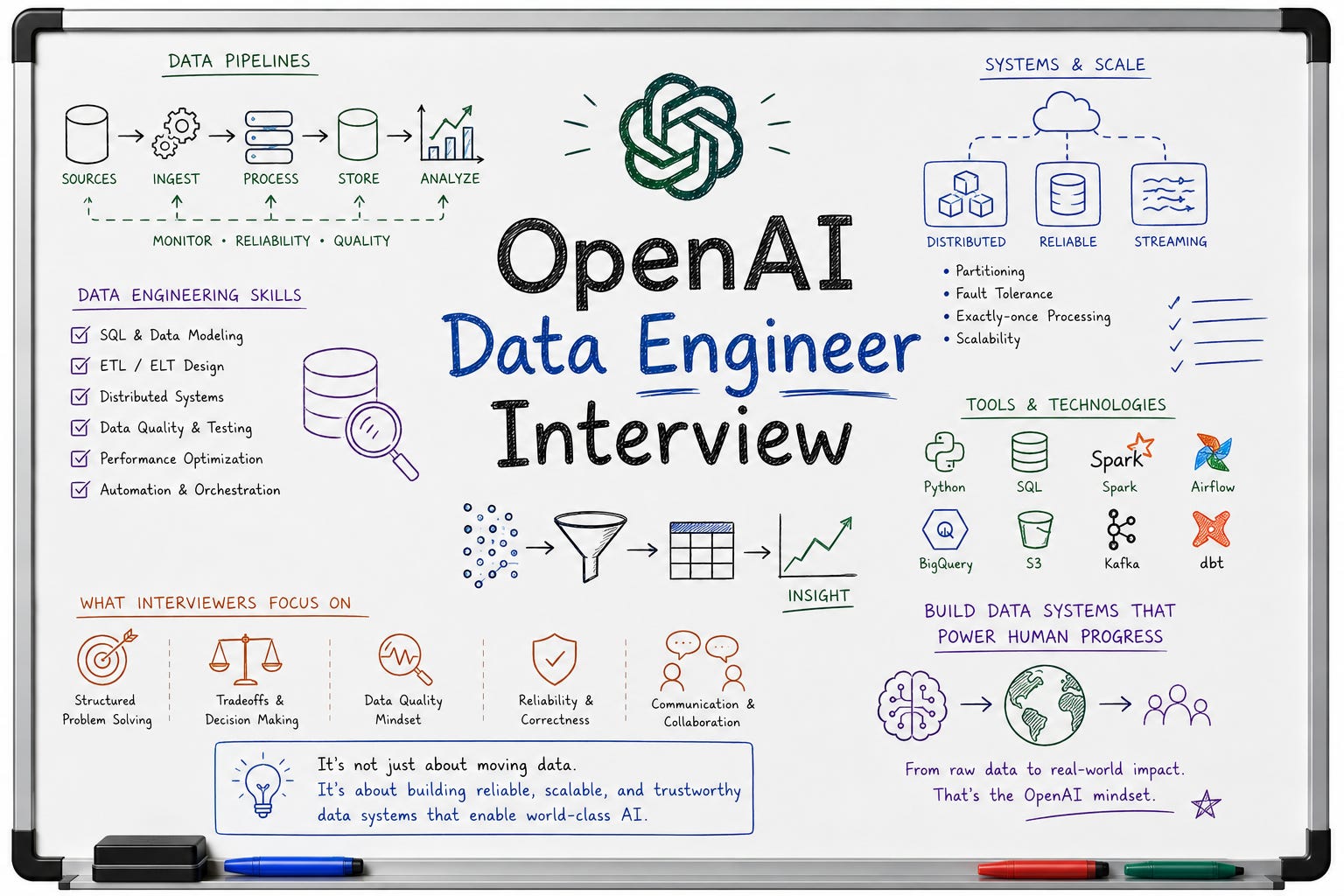
Data engineering is a good example of that shift. For years, preparing for a data engineering interview usually meant strengthening three areas: SQL, Python, and distributed data processing. Those skills are still essential today, and no serious data engineer can avoid becoming comfortable with them. Yet when I started looking closely at OpenAI’s expectations for data engineers, it became clear that those technologies are no longer the story. They’re simply the vocabulary used to evaluate something much broader.
Like most engineering organizations, OpenAI’s hiring process includes coding interviews, SQL assessments, system design discussions, and behavioral conversations. On paper, that doesn’t look dramatically different from what you’d expect at other companies building large-scale platforms. The interesting part isn’t the structure of the interview loop. It’s the consistent philosophy running underneath every stage. Whether you’re writing Python, debugging a SQL query, discussing a streaming architecture, or explaining a production incident, the interviewer is ultimately trying to answer one question: can this engineer build systems whose data people can trust?
That question is much more interesting than whether someone can remember the syntax for a window function or implement another coding exercise. It also reflects a broader reality about modern engineering. As AI products become larger, more distributed, and increasingly dependent on telemetry, the value of a data engineer shifts away from simply moving information through pipelines. The real responsibility becomes preserving the integrity of that information despite retries, partial failures, schema changes, late-arriving events, and every other complication that distributed systems inevitably introduce.
The OpenAI data engineering interview isn’t really testing whether you can process data efficiently. It’s testing whether you know how to preserve the truth while data moves through unreliable systems.
Data engineering has become an engineering discipline first and a data discipline second
One misconception I still encounter is that data engineering is primarily about building pipelines. While that’s certainly part of the job, it no longer captures the complexity of what modern data platforms actually do. Traditional ETL systems largely operated on predictable schedules. Data arrived in batches, transformations ran overnight, and analysts consumed the results the following morning. If a job failed, someone reran it. If a report was delayed by an hour, the business usually survived.
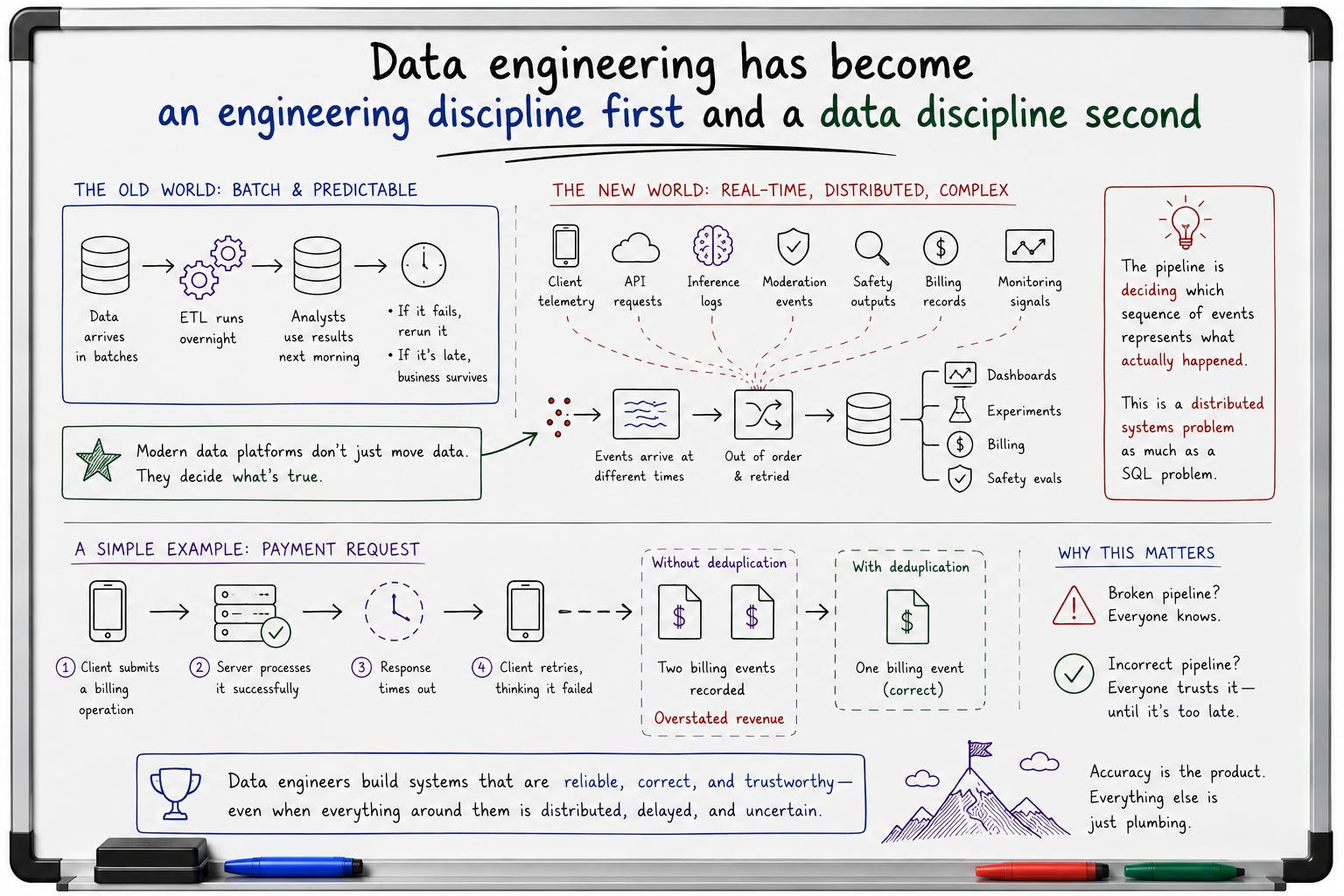
AI products operate under very different constraints. A single interaction with an application may generate client telemetry, API requests, inference logs, moderation events, safety classifier outputs, billing records, and monitoring signals, all produced by different services and often arriving at different times. Some events are retried after transient failures. Others arrive out of chronological order because distributed systems rarely deliver messages exactly when we expect them to. Meanwhile, downstream dashboards, experiments, billing systems, and safety evaluations are all assuming those events accurately describe reality.
That changes the nature of the work completely. The pipeline is no longer just transporting information between systems. It is deciding which sequence of events represents what actually happened. If that sounds like a distributed systems problem rather than a SQL problem, that’s because it is.
Imagine something as ordinary as a payment request. A client submits a billing operation, the server processes it successfully, but the response times out before reaching the caller. Believing the request failed, the client retries. Without some mechanism to recognize that both requests represent the same logical action, the downstream pipeline happily records two billing events instead of one. Nothing crashes. No exception appears in the logs. Every system continues functioning exactly as designed. The only symptom is that tomorrow morning’s revenue dashboard quietly reports numbers that are higher than reality.
Those are precisely the kinds of failures experienced data engineers worry about because they’re far more dangerous than obvious outages. A broken pipeline attracts immediate attention. An incorrect pipeline often earns everyone’s confidence before anyone realizes something is wrong.
Every interview round measures the same engineering habit
One aspect of OpenAI’s interview philosophy that I particularly appreciate is that the interview rounds don’t appear to evaluate isolated skills. Candidates often prepare for coding, SQL, system design, and behavioral interviews as though they were completely independent assessments. In reality, each conversation seems to examine the same engineering instincts through a different lens.
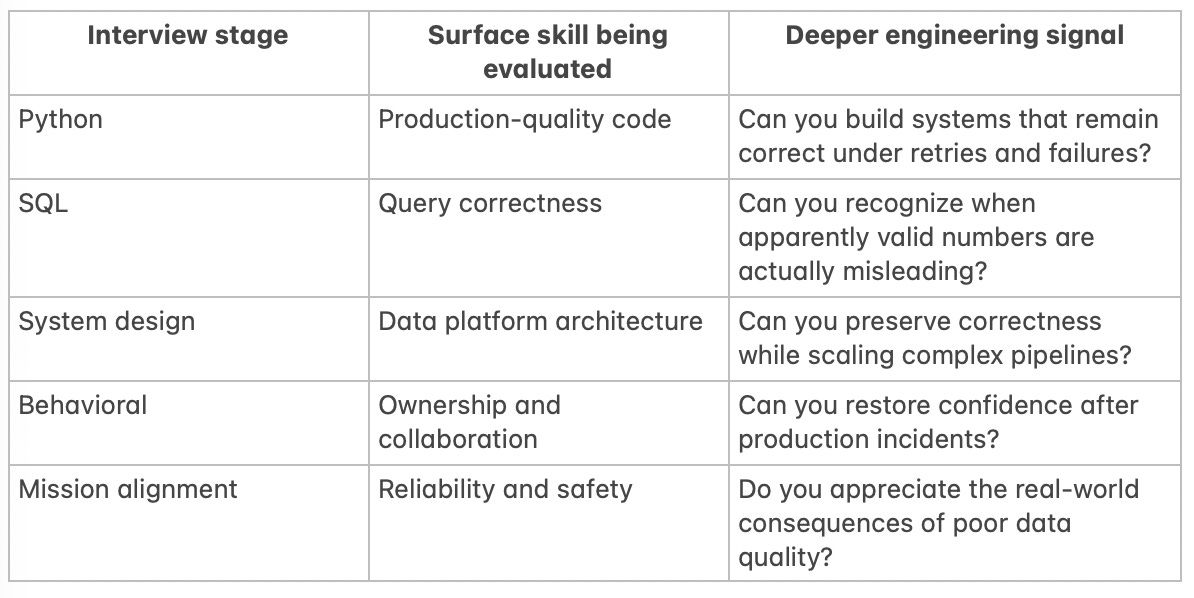
Looking at the interview this way explains why so many technical discussions revolve around incidents rather than isolated programming exercises. An interviewer may ask why a dashboard suddenly doubled overnight, why a streaming pipeline produced inconsistent counts after a deployment, or how duplicate events should be handled following a retry storm. None of those questions is really about memorizing technology. They’re about understanding how reliable systems behave when reality refuses to cooperate.
I’ve always believed that engineering interviews become much easier to reason about once you stop viewing them as collections of unrelated questions. Strong interviewers are usually searching for consistent habits rather than isolated moments of technical brilliance. Someone who naturally verifies assumptions before writing code often brings the same mindset into SQL debugging, architectural discussions, and production incident reviews. Likewise, an engineer who rushes into implementation without understanding the problem tends to repeat that behavior regardless of the interview format.
That’s why I think preparing for each interview round independently can sometimes be counterproductive. Instead of asking, “How do I pass the SQL interview?” it may be more useful to ask, “How would I convince another engineer that these numbers accurately represent reality?” The first question leads you toward syntax. The second leads you toward engineering judgment.
Reliable data isn’t created by perfect SQL queries. It’s created by engineers who constantly question whether the pipeline is faithfully describing the real world.
The hardest production bugs rarely look like bugs
Perhaps the biggest lesson I took away while studying OpenAI’s approach is that the most expensive failures in data engineering are often the ones that appear completely normal. Pipelines continue running, dashboards continue updating, and executives continue making decisions. Nothing appears broken until someone notices that two reports disagree or yesterday’s metrics suddenly look implausibly optimistic.
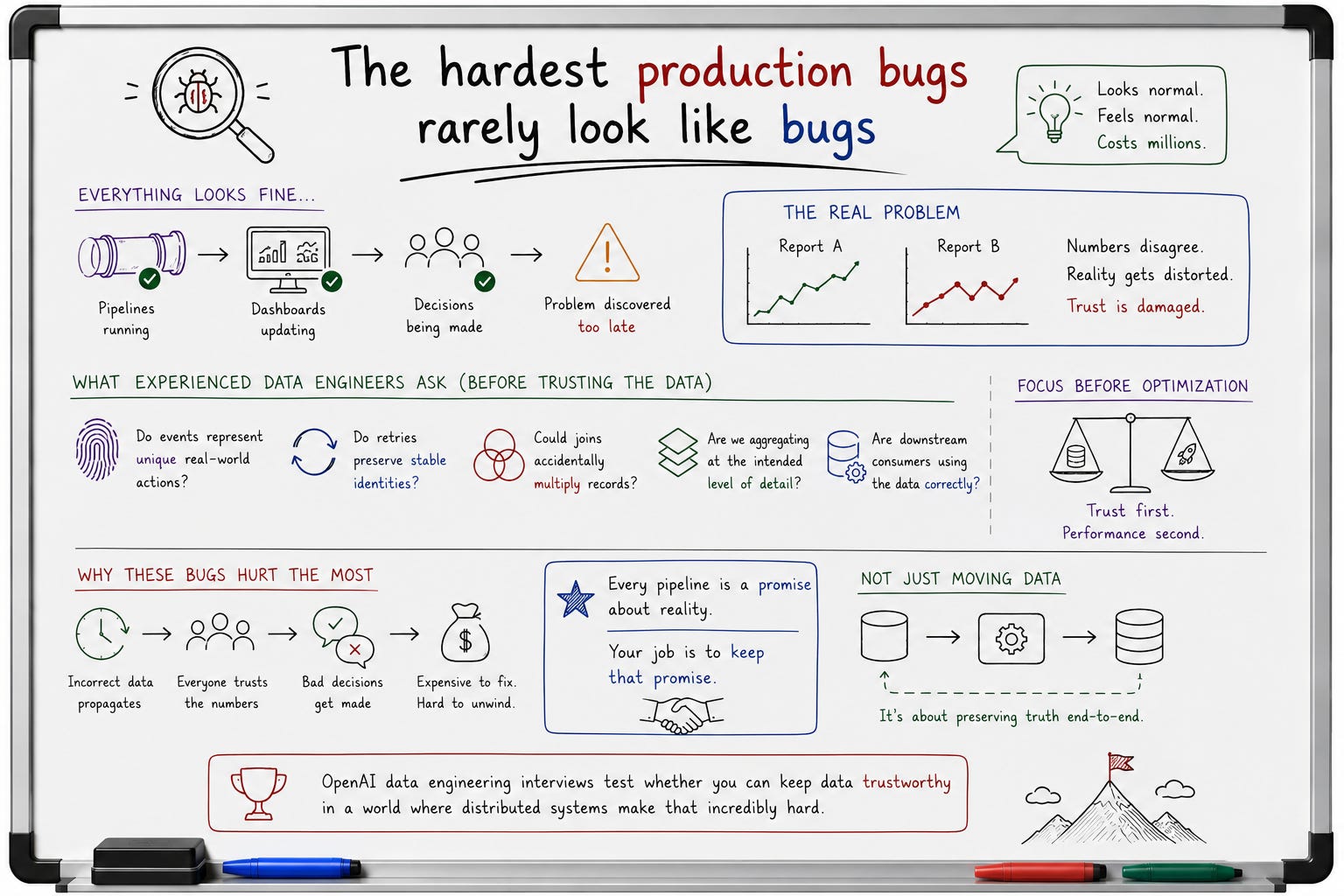
Experienced data engineers eventually develop a healthy skepticism toward seemingly successful pipelines because they’ve seen how easily incorrect assumptions propagate through distributed systems. Rather than asking, “Why did this query fail?” they often begin somewhere much earlier in the chain. They ask whether the underlying events represent unique real-world actions, whether retries preserved stable identities, whether joins accidentally multiplied records, and whether downstream consumers are aggregating data at the intended level of detail.
Those questions may sound mundane compared to discussions about streaming engines or warehouse technologies, yet they are often the difference between trustworthy analytics and expensive fiction. Before reaching for another optimization or another architectural pattern, the best engineers usually establish something far more important: whether the data deserves to be trusted in the first place.
That, more than anything else, is why I find the OpenAI data engineering interview so interesting. It isn’t really evaluating your ability to move data efficiently from one system to another. It’s evaluating whether you understand that every pipeline is ultimately making a promise about reality—and whether you know how to keep that promise even when distributed systems make it surprisingly difficult.
Why idempotency matters far beyond interviews
If there’s one technical concept that seems to appear repeatedly in discussions about modern data engineering, it’s idempotency. Unfortunately, it’s also one of those ideas that’s often explained in a way that feels more academic than practical. Candidates memorize the definition, repeat that repeated operations should produce the same result, and move on to the next interview topic without ever thinking about why companies like OpenAI care about it so much.
The reason becomes obvious once you stop thinking about individual requests and start thinking about production systems operating continuously. Distributed systems retry failed operations all the time. Networks drop packets, APIs time out, services restart, queues temporarily become unavailable, and clients naturally attempt the same operation again because they cannot distinguish between a request that genuinely failed and one whose response simply never arrived. Those retries are not exceptional events. They’re normal operating conditions.
The challenge is that the real world usually performs an action only once. A customer submits one payment. A user sends one prompt to a language model. A moderation service evaluates one response. If the software processing those events cannot recognize that multiple requests actually represent the same underlying action, the pipeline gradually drifts away from reality. Duplicate billing records appear, analytics inflate user activity, dashboards become inconsistent across teams, and debugging becomes significantly more difficult because every downstream system is now faithfully processing incorrect information.
This is why experienced data engineers rarely think about retries independently from correctness. Every retry forces an important question: if this operation executes twice, will the observable state remain correct? When the answer is yes, systems become remarkably resilient because transient failures stop affecting the integrity of the data. When the answer is no, seemingly harmless infrastructure behavior slowly transforms into business problems that nobody notices until conflicting reports begin appearing across the organization.
That mindset also changes the way interview questions should be interpreted. A prompt about duplicate events isn’t really asking whether you understand deduplication algorithms. It’s asking whether you’ve developed the habit of thinking about failure before it happens. Strong candidates don’t simply describe how duplicate records can be removed afterward. They explain how stable identities, idempotent writes, and well-defined ownership boundaries prevent incorrect data from entering the pipeline in the first place.
Good data engineers don’t spend their careers cleaning duplicated information. They design systems that make duplication increasingly difficult to create.
AI pipelines force us to rethink what “correct” actually means
Another lesson that stood out to me while studying OpenAI’s engineering philosophy is that AI products have quietly changed the nature of telemetry itself. Many traditional data platforms assumed that information would arrive in relatively predictable ways. Events were often processed in batches, timestamps followed a logical order, and the primary challenge involved scaling storage or improving query performance.
AI systems rarely enjoy that level of predictability.
Consider what happens when someone submits a single prompt to a conversational AI system. That interaction might generate client-side telemetry, server request logs, inference metadata, safety classifier results, billing records, moderation decisions, feedback events, and infrastructure metrics. None of those events necessarily arrives at the same time. Some are produced synchronously while others appear only after asynchronous processing completes. Network retries may reorder messages. Safety evaluations can finish after the original response has already been delivered. Additional metadata may appear hours later as downstream systems complete their work.
Suddenly, the familiar assumption that events naturally arrive in chronological order begins to disappear.
That creates a much more interesting engineering problem than simply processing large amounts of data. Pipelines now need to distinguish between event time, representing when something actually occurred, and ingestion time, representing when the platform happened to receive the information. Those are not always the same thing, and confusing them produces remarkably subtle bugs. A late-arriving event may represent reality more accurately than information that appeared earlier, forcing the pipeline to decide whether historical results should be corrected or preserved.
The technologies supporting these decisions—whether Spark Structured Streaming, Flink, or another processing engine—are certainly important, but I don’t think interviewers are primarily evaluating tool selection. They’re trying to understand whether you appreciate the tradeoffs involved. Lower latency often means accepting additional correction work later. Waiting longer improves correctness but increases state management, memory consumption, and operational complexity. Every architecture becomes an exercise in balancing competing constraints rather than searching for a universally correct answer.
That perspective is becoming increasingly valuable because AI applications continue moving toward real-time decision making. As systems become faster, the cost of incorrect data often grows faster than the cost of delayed data.
Trust isn’t maintained by pipelines alone
Once data begins flowing reliably through a system, many engineers assume the difficult work is finished. In reality, another challenge begins almost immediately. Pipelines rarely fail because someone deliberately changes every downstream dependency at once. They fail because assumptions gradually drift apart. A producer adds a new field. Another team changes the meaning of an existing column. A service starts emitting duplicate identifiers after a deployment. Weeks later, an analytics dashboard quietly begins reporting numbers that nobody can fully explain.
That’s one reason data contracts have become increasingly important across modern engineering organizations. At their core, contracts simply make assumptions explicit. They describe what constitutes a unique event, how schemas may evolve, what freshness guarantees downstream systems should expect, and which invariants producers are responsible for maintaining. None of those ideas is particularly glamorous, yet they dramatically reduce the number of situations where teams unknowingly build different interpretations of the same data.
Quality gates serve a similar purpose. Rather than waiting for executives to discover that a KPI suddenly doubled, pipelines can continuously verify assumptions that should always remain true. A few simple checks often catch remarkably expensive mistakes long before they reach a dashboard.
For example:
Verify that deduplication keys remain unique within their expected scope.
Detect unexpected join fan-out before aggregation occurs.
Monitor late-arriving event rates so changes in delivery patterns become visible.
Validate critical business metrics after every deployment instead of assuming correctness.
Notice that none of these checks attempts to repair incorrect data.
Their value comes from identifying broken assumptions before those assumptions spread throughout the organization.
That’s another recurring theme I noticed while studying OpenAI’s engineering expectations. The strongest systems don’t rely on people noticing problems manually. They continuously measure whether reality still matches the promises the platform is making.
Preparing for this interview means preparing to think differently
If I were preparing for an OpenAI data engineering interview today, I would certainly practice SQL, Python, and system design. Ignoring those fundamentals would be a mistake because they’re still the tools used to solve engineering problems. At the same time, I don’t think I’d organize my preparation around technologies.
Instead, I’d organize it around production incidents.
Every coding exercise would become an opportunity to ask how retries, partial failures, or changing requirements affect correctness. Every SQL problem would begin with the grain of the data rather than immediately writing a SELECT statement. Every system design discussion would start by defining which guarantees matter most before introducing technologies capable of providing them. Even behavioral preparation would focus less on describing successful projects and more on explaining situations where data quality, collaboration, or engineering judgment influenced an important business decision.
That approach naturally connects every interview round because it reflects how experienced engineers actually work. They don’t think in isolated categories like SQL, streaming, storage, or observability. They think about building systems that continue producing trustworthy answers even after deployments, retries, schema changes, and unexpected failures inevitably occur.
The more I studied OpenAI’s approach to hiring data engineers, the less I saw it as a specialized interview for AI companies. Instead, it felt like a preview of where the profession itself is heading. As software systems become increasingly autonomous and AI products generate unprecedented volumes of telemetry, organizations will depend even more heavily on engineers capable of preserving correctness amid enormous complexity.
That’s why I don’t think the defining skill of tomorrow’s data engineer will be writing clever SQL queries or choosing the newest streaming framework.
It will be earning—and keeping—everyone’s trust in the numbers.
Because once an organization stops believing its own data, every engineering decision that follows becomes significantly harder to make.