

Meta system design is not really about systems
Meta system design interviews are not testing what people think

Somewhere along the way, System Design stopped being an engineering skill and became a genre of content.
You can see it everywhere now. Endless architecture breakdowns with arrows aggressively pointing toward Kafka clusters. LinkedIn posts explaining how Netflix “really scales” written by people who have never operated systems under meaningful production pressure. Twitter threads treating distributed systems like collectible trading cards. At some point, the industry collectively decided that drawing boxes around microservices counts as architectural thinking. The diagrams became cleaner as the reasoning became shallower.
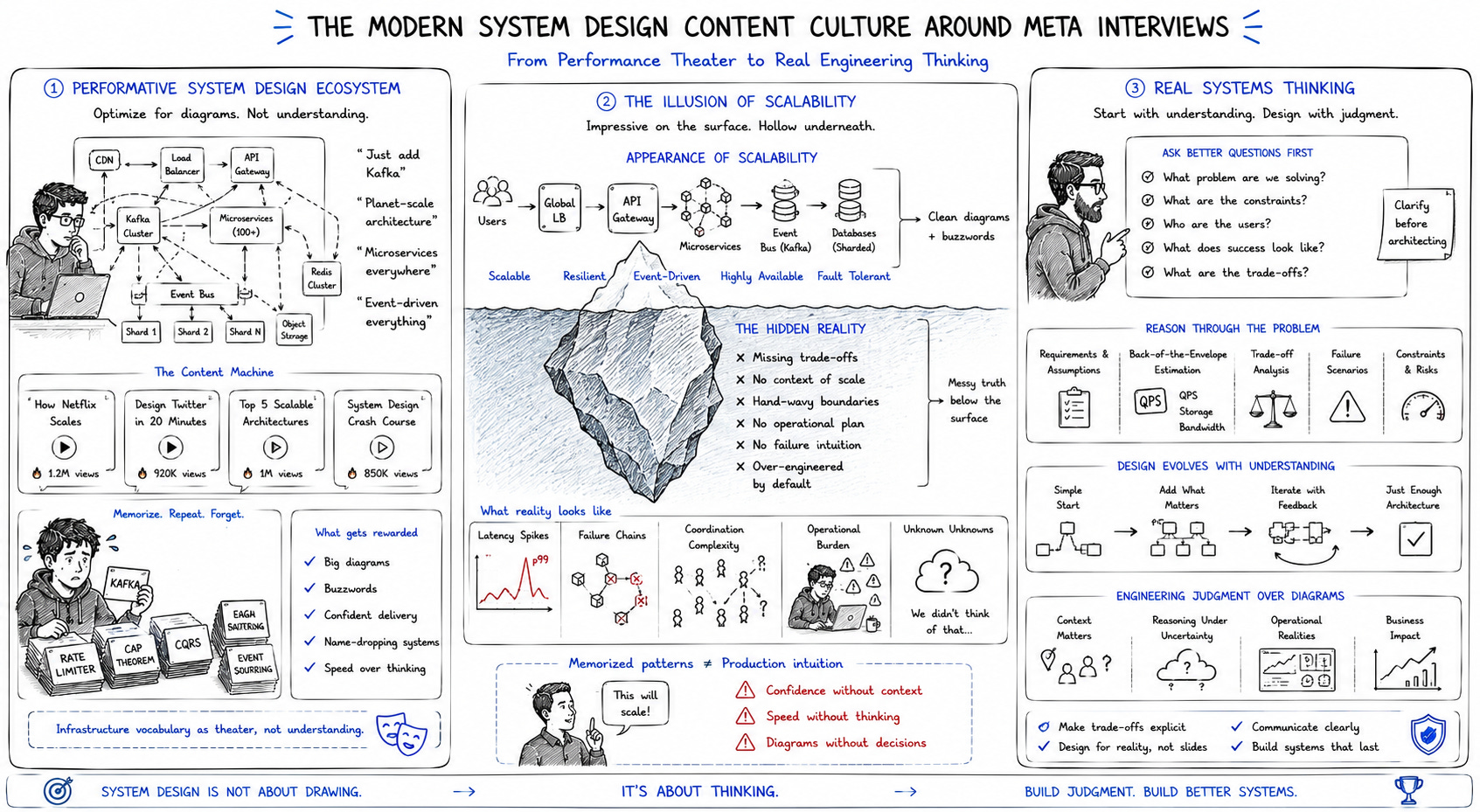
The strange thing is that none of this happened because engineers are unintelligent. Most engineers are perfectly capable of learning difficult systems concepts. The problem is that modern engineering culture rewards the appearance of scalability much faster than it rewards actual systems intuition. Infrastructure vocabulary became a kind of professional theater. If you say “event-driven architecture” confidently enough, people start assuming depth exists underneath it somewhere. Sometimes it does. Often it does not.
Meta interviews accidentally amplified this entire ecosystem. Not because Meta intended to create a global content industry around System Design preparation, but because the company became symbolically associated with scale itself. Once a company operates at planetary scale, people begin treating its architectural patterns like sacred engineering doctrine. Engineers started memorizing infrastructure decisions ripped entirely out of their original context. Suddenly everybody wanted to design systems as though they were supporting billions of users by next Tuesday.
There is something psychologically comforting about this style of preparation. Memorization feels measurable. Architecture diagrams feel concrete. Ambiguity does not. Real systems thinking requires sitting with uncertainty long enough to reason through incomplete information carefully, and most people find that emotionally uncomfortable. It is much easier to rehearse distributed systems terminology than it is to develop engineering judgment.
And so an entire industry emerged around reducing ambiguity into templates. The internet became full of people “learning System Design” while quietly avoiding the actual difficult part of systems engineering: thinking.
Meta system design interviews are not testing what people think
A lot of candidates walk into Meta System Design interviews believing they are about architecture recall. They think the interviewer is evaluating whether they can reconstruct the canonical design for Twitter, YouTube, or WhatsApp from memory with sufficient enthusiasm and enough mentions of Redis. This misunderstanding creates interviews that feel strangely theatrical from the very beginning. The candidate starts performing expertise instead of reasoning through constraints.
But experienced interviewers are usually looking for something much less visible and far more important. They are watching how candidates behave when certainty disappears. The entire structure of these interviews revolves around incomplete information deliberately. Requirements are vague. Constraints are partially defined. Priorities shift mid-conversation. The interviewer is not trying to trap candidates. They are trying to observe how candidates organize ambiguity mentally.
That distinction matters enormously because ambiguity is where memorized systems collapse. Someone who memorized the architecture for a social feed can repeat components comfortably while the conversation stays predictable. The moment the interviewer introduces an unexpected constraint, the reasoning starts to wobble. Suddenly the architecture no longer fits cleanly, and the candidate realizes they never actually understood why those components existed in the first place. They only memorized the choreography.
Strong engineers behave differently under uncertainty. They slow down instead of accelerating into architecture immediately. They ask clarifying questions because they understand constraints shape systems more than technologies do. They revise assumptions calmly when new information appears. Most importantly, they do not confuse confidence with speed. There is a particular kind of composure experienced engineers develop after enough production incidents where uncertainty stops feeling threatening and starts feeling normal.
That is what these interviews are actually exposing. Not whether candidates know distributed systems terminology. Not whether they watched enough architecture videos. The interview is testing whether candidates can think coherently while the ground keeps shifting underneath them. In other words, it is testing engineering maturity far more than architecture memorization.
And maturity is difficult to fake for very long.
The architecture theater problem
Modern System Design culture has developed a strange relationship with complexity. Engineers increasingly treat complexity itself as evidence of sophistication, as though adding enough infrastructure layers eventually transforms confusion into architectural brilliance. This is how perfectly reasonable systems discussions turn into sprawling diagrams containing queues, caches, shards, event buses, distributed locks, asynchronous pipelines, and eventually Kubernetes appearing somewhere almost out of professional obligation.
Redis became less of a technology and more of an emotional support mechanism.
The deeper issue is that engineering culture often rewards performative scalability. People want systems that look impressive before they want systems that behave coherently. Online architecture content reinforces this constantly because complexity is visually persuasive. Simple systems look unimpressive on whiteboards. Complicated systems look senior. Unfortunately, many distributed systems fail precisely because engineers optimize for architectural sophistication before understanding operational reality.
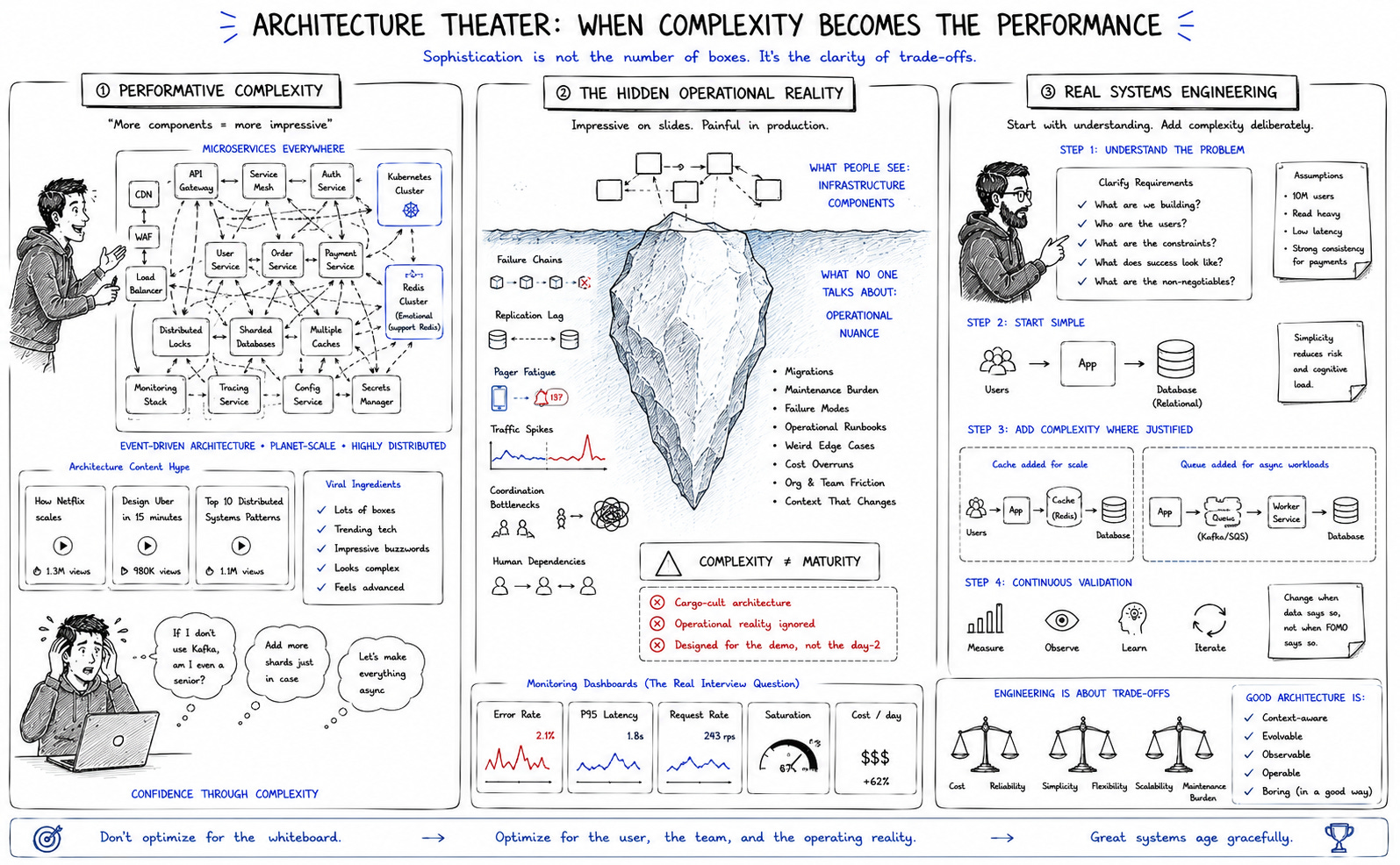
There is also a cargo-cult dimension to all of this. Engineers observe successful companies using certain infrastructure patterns and assume reproducing the patterns reproduces the engineering maturity underneath them somehow. They copy event-driven architectures without understanding coordination complexity. They discuss microservices before understanding organizational scaling constraints. They add distributed systems machinery to problems that barely require a relational database and decent indexing.
The internet accelerated this phenomenon dramatically because architecture content compresses poorly. The actual difficult part of distributed systems is operational nuance: trade-offs, migrations, failure modes, replication lag, uneven traffic, degraded behavior, human coordination, and maintenance burden. None of those things fit neatly into social-media-friendly diagrams. So the conversation shifts toward visible infrastructure components instead because they are easier to package as expertise.
A surprising amount of modern System Design discussion is really just infrastructure cosplay. Engineers rehearsing what large-scale architecture is supposed to sound like instead of reasoning through the realities of scale itself.
Why senior engineers think differently about systems
Experience changes how systems feel conceptually. Junior engineers often experience architectures as collections of technologies. Senior engineers experience architectures as collections of constraints. That shift sounds subtle until you sit through enough design reviews to notice how differently experienced engineers frame discussions from the beginning.
Less experienced engineers often start with solutions. Senior engineers usually start with failure. What breaks first? What operational burden does this create later? Which assumptions are fragile? What complexity are we introducing accidentally? Years of production exposure gradually train engineers to see architecture through the lens of trade-offs instead of features. Systems stop looking elegant and start looking expensive.
Operational pain changes architectural instincts permanently. After enough outages, migrations, cascading failures, and scaling incidents, engineers become suspicious of unnecessary complexity almost automatically. They stop romanticizing distributed systems because distributed systems eventually stop feeling glamorous in production. Reliability work has a way of stripping architectural ego out of people. There is nothing spiritually transformative about debugging replication lag at three in the morning while multiple dashboards quietly catch fire.
Senior engineers also think differently about simplicity. Younger engineers often associate simplicity with lack of sophistication because modern engineering culture subtly glorifies complexity. Experienced engineers understand the opposite. Simplicity is usually harder. It requires stronger prioritization, clearer constraints, and more disciplined reasoning. Anybody can create complicated systems. Creating systems that remain understandable under operational pressure is much rarer.
This is partly why senior engineers often sound calmer during architecture discussions. They understand that most systems problems are not solved through dramatic architectural innovation. They are solved through careful trade-offs, operational discipline, and incremental evolution over time. The excitement fades eventually. What remains is judgment.
And judgment is mostly accumulated scar tissue organized into intuition.
The real thing Meta interviews expose
People often describe System Design interviews as technical evaluations, which is true in the same way describing surgery as “knife-related work” is technically accurate but deeply incomplete. The technical dimension matters, obviously. But the interviews expose something broader and more human than most candidates realize.
They expose how people behave cognitively under uncertainty.
Communication becomes incredibly revealing in these interviews because systems thinking itself is fundamentally organizational. Distributed systems are already confusing enough internally. Engineers who make ambiguity harder to navigate create operational drag everywhere they go. Interviewers pay close attention to whether candidates structure conversations clearly, summarize assumptions explicitly, and adapt coherently as constraints evolve.
A lot of weak interviews fail because the candidate gradually loses conceptual organization. They begin jumping between unrelated infrastructure decisions reactively. One interviewer question suddenly triggers discussions about caching, replication, asynchronous messaging, and rate limiting simultaneously. The architecture becomes cognitively noisy because the candidate is trying to sound comprehensive instead of reasoning systematically.
Strong candidates feel different conversationally. Not necessarily smarter in obvious ways, but calmer and easier to follow. They isolate constraints deliberately. They explain trade-offs instead of defending decisions emotionally. They remain collaborative even when challenged. That emotional composure matters more than many engineers realize because large-scale engineering work constantly involves uncertainty, disagreement, incomplete information, and evolving constraints.
Interviewers notice emotional behavior constantly. Defensiveness. Panic-driven over-explaining. Rigid attachment to weak assumptions. These signals matter because senior engineering work is collaborative reasoning under pressure. Meta-style interviews reveal whether candidates can maintain conceptual clarity while uncertainty increases. That is far more valuable than memorizing infrastructure vocabulary.
The interviewer already knows how Instagram works. What they are trying to determine is whether you know how to think while the architecture is still unclear.
The internet’s distorted version of System Design
The internet transformed System Design into a spectacle. That transformation changed how engineers learn, discuss, and emotionally relate to distributed systems in ways that are both fascinating and slightly absurd.
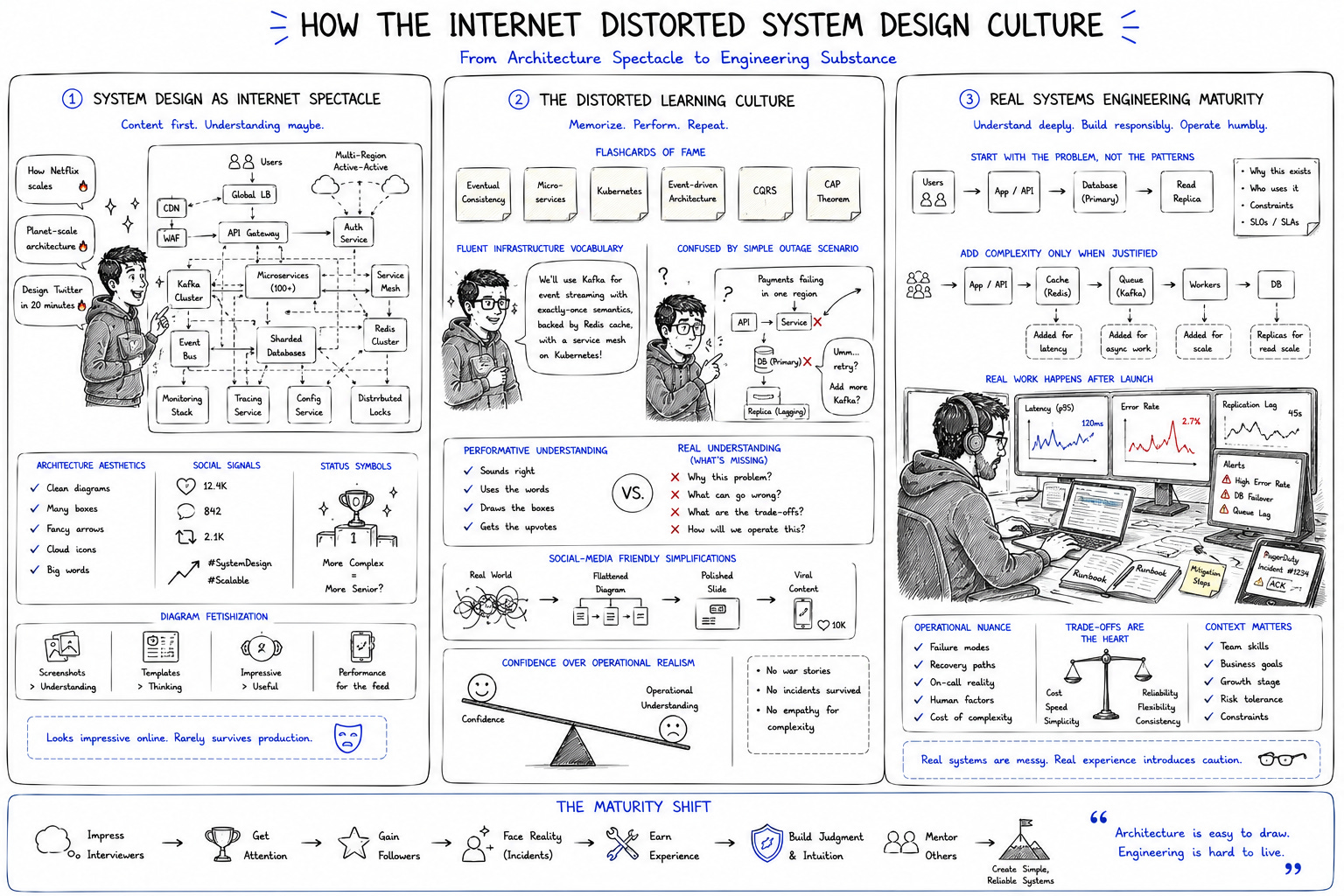
Architecture diagrams became visual status symbols. Engineers post them online the way people used to post photos of complicated home gym setups. The diagrams grow increasingly elaborate because complexity photographs well. Somewhere along the way, engineering culture developed a kind of diagram fetishization where boxes and arrows started carrying symbolic weight independent of reasoning quality. A messy but coherent architecture discussion became less culturally rewarding than a polished but shallow scalability breakdown.
Then came the distributed systems influencers.
There is something uniquely strange about watching people turn infrastructure abstraction into personal branding. Entire audiences formed around architecture explainers confidently narrating systems they have never operated. The internet rewards confidence, compression, and aesthetics far more than operational nuance. Real systems engineering is usually slow, uncertain, and deeply contextual. Social media prefers certainty and clean narratives. Naturally, complexity gets flattened into reusable content formulas.
This distorts preparation culture badly because candidates start optimizing for performative understanding. They learn how System Design is supposed to sound online rather than how systems actually behave operationally. The result is engineers who can discuss eventual consistency fluently while struggling to reason through simple failure scenarios coherently. Infrastructure vocabulary becomes disconnected from systems intuition entirely.
The irony is that genuinely experienced engineers often sound less impressive online precisely because real operational experience introduces caution. Production systems teach humility quickly. Engineers who have lived through outages understand how fragile architectural certainty usually is. Unfortunately, humility does not trend particularly well.
So the internet keeps rewarding architectural confidence theater while real engineering maturity continues developing quietly somewhere off-camera.
Why scaling systems changes the way engineers think
Scale changes engineering psychology long before it changes infrastructure.
At small scale, systems often feel forgiving. Mistakes remain localized. Inefficiencies stay invisible. Architectural shortcuts survive longer because operational pressure is limited. Engineers can think mostly in terms of features and implementation velocity. Large-scale systems remove that luxury gradually. Eventually every decision begins producing second-order effects somewhere else in the organization.
This is where engineering intuition starts changing fundamentally. Reliability stops feeling theoretical once outages become organizational events instead of isolated incidents. Suddenly replication strategies matter emotionally instead of academically. Latency spikes affect real business metrics. Background jobs interact unpredictably. Retry storms create cascading failures. Seemingly minor architectural assumptions generate disproportionate operational consequences months later.
Exposure to scale also changes how engineers think about optimization. Less experienced engineers often optimize locally because local optimization feels tangible and intellectually satisfying. Experienced engineers become more suspicious of optimization because they have seen how aggressively complexity compounds over time. Many production disasters begin as reasonable optimizations that nobody fully modeled operationally.
Scaling systems also forces engineers to think probabilistically rather than deterministically. At sufficient scale, weird edge cases stop being edge cases. Distributed systems become environments defined by partial failure, degraded behavior, timing variability, and coordination complexity. Engineers exposed to those realities develop different instincts around architecture entirely. They stop expecting systems to behave cleanly all the time.
This is partly why experienced distributed systems engineers often sound more conservative than internet architecture culture expects. They understand the hidden tax of operational complexity intimately. Every abstraction leaks eventually. Every optimization creates maintenance burden somewhere else. Every distributed coordination mechanism extracts payment later.
Scale changes architecture, but more importantly, it changes how engineers perceive risk itself.
What real architectural thinking actually feels like
Real architectural thinking is much less cinematic than people expect.
It does not usually feel like confidently sketching elegant systems onto whiteboards while orchestral music plays somewhere in the background. Most of the time it feels uncertain, iterative, and slightly uncomfortable. Good engineers spend enormous amounts of time navigating incomplete information carefully rather than making dramatic infrastructure declarations.
Real systems reasoning is deeply contextual. Trade-offs depend on organizational priorities, operational maturity, team structure, growth assumptions, product behavior, reliability expectations, and human coordination constraints simultaneously. This is why experienced engineers often hesitate before answering architectural questions definitively. They understand how much invisible context shapes engineering decisions underneath the surface.
Architectural thinking also involves emotional discipline more than people admit. Engineers constantly resist the urge to over-engineer because future complexity always sounds intellectually seductive. It takes maturity to accept imperfect solutions intentionally. Junior engineers often seek architectural certainty. Senior engineers become more comfortable balancing imperfect choices under evolving constraints because real systems rarely offer clean answers.
Another thing people misunderstand is that architectural thinking is fundamentally communicative. Systems become too complicated for isolated reasoning quickly. Engineers who cannot explain trade-offs clearly create organizational instability because complexity multiplies across teams socially as much as technically. This is why communication quality and systems thinking are deeply interconnected skills.
Real architectural maturity usually sounds quieter than performative expertise. It sounds like engineers discussing constraints honestly instead of projecting certainty theatrically. It sounds like careful trade-off reasoning instead of infrastructure enthusiasm. Most importantly, it sounds adaptive because real systems never stop evolving operationally.
The strongest engineers are rarely the ones most emotionally attached to architecture itself.
Final reflection
The strange thing about modern System Design culture is that it often mistakes visibility for understanding. Engineers spend years learning how scalable systems are supposed to sound while quietly avoiding the deeper discomfort of uncertainty, trade-offs, and operational ambiguity. Infrastructure vocabulary became easier to teach than engineering judgment. So naturally the industry optimized for vocabulary.
But real systems thinking was never really about memorizing architectures.
It was about learning how complexity behaves under pressure. Learning how distributed coordination fails in subtle ways. Learning how scaling introduces organizational problems as much as technical ones. Learning how reliability reshapes engineering instincts slowly over time. Most importantly, it was about learning how to remain intellectually coherent while certainty disappears.
Meta interviews became culturally influential partly because they expose that difference so aggressively. They reveal whether candidates are reasoning or rehearsing. Whether they understand systems conceptually or simply recognize architectural patterns socially. The uncomfortable reality is that memorized sophistication collapses quickly once ambiguity enters the room.
Experienced engineers eventually stop romanticizing distributed systems because production environments remove the illusion. Systems stop feeling elegant after enough outages, migrations, and scaling failures. What remains afterward is something quieter and more useful: judgment. The ability to reason carefully through imperfect constraints without becoming emotionally attached to complexity itself.
The interviewer already knows how Instagram works.
What they are trying to figure out is whether you know how systems fail.