

How do I practice a system design interview?
What Practicing a System Design Interview Is Really Teaching You

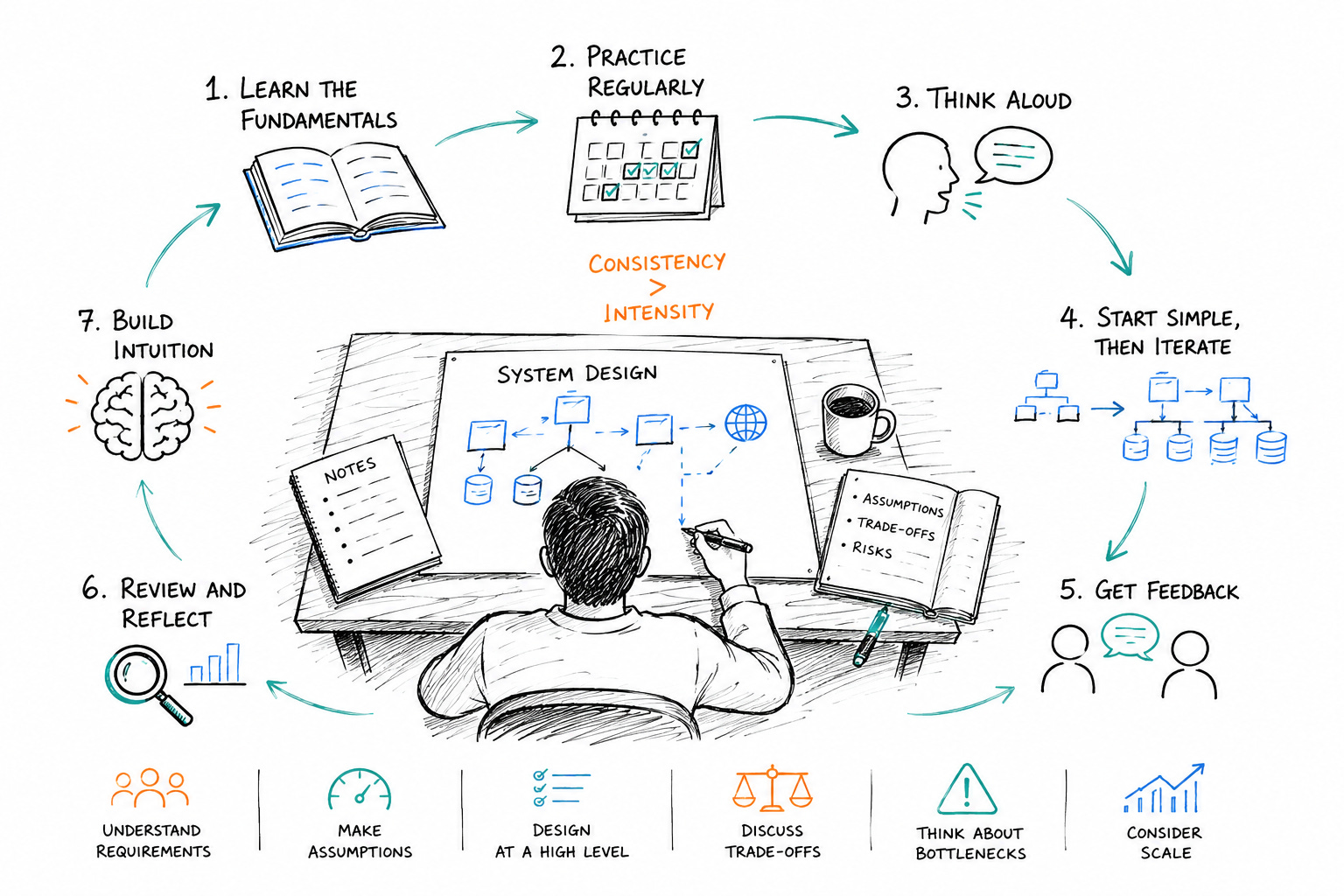
One of the most common questions engineers ask is deceptively simple: How do I practice a system design interview? At first glance, it sounds similar to questions people ask about coding interviews. How do I practice dynamic programming? How do I improve at algorithms? How many problems should I solve each week? These questions imply that improvement follows a relatively predictable path. Practice leads to repetition. Repetition leads to familiarity. Familiarity leads to confidence.
Then engineers begin practicing System Design and discover something unexpected.
The process feels different. Progress feels harder to measure. Some days, after spending hours reading about distributed systems, scalability, caching, databases, and architectural patterns, they still feel uncertain when faced with a new design problem. They understand more concepts than before, yet they do not necessarily feel more confident. The gap between knowledge and confidence can be surprisingly frustrating.
After years of helping engineers prepare for System Design interviews, I’ve become convinced that much of this frustration comes from a mismatch between expectations and reality. Many people approach System Design practice as though it were another form of knowledge acquisition. They expect to collect enough concepts that the interview eventually becomes predictable. But System Design is not primarily a knowledge problem. It is a judgment problem.
Most people practice System Design expecting answers. The real challenge is learning how to navigate uncertainty.
That distinction changes everything. Once engineers realize that System Design is fundamentally about reasoning rather than recall, the learning process starts to make more sense. The goal is not simply to know more. The goal is to think differently.
Why System Design feels harder to measure
One reason System Design practice feels uniquely frustrating is that progress rarely announces itself clearly. Coding interview preparation often provides immediate feedback. A solution either passes or fails. The algorithm is efficient or inefficient. The implementation works or it does not. Improvement can be measured through objective outcomes.
System Design behaves differently. Most architectural discussions do not end with definitive answers. Multiple solutions may be reasonable. Trade-offs may be difficult to evaluate conclusively. Requirements may remain partially ambiguous. Even experienced engineers frequently disagree about architectural decisions because those decisions depend on priorities rather than correctness alone.
This creates a learning environment where feedback becomes more subtle. Engineers may be improving significantly without feeling like they are improving. They become better at identifying constraints, recognizing trade-offs, asking clarifying questions, and reasoning about consequences. Yet none of these improvements produces the same immediate sense of accomplishment as solving a difficult coding problem.
The irony is that these skills are often more valuable than technical recall. Architectural reasoning compounds over time. The challenge is that it develops gradually enough that many learners underestimate their own progress. System Design often feels difficult not because learning is not happening, but because learning is happening in ways that are harder to observe.
What System Design practice is actually developing
If System Design practice is not primarily about memorizing architectures, what is it actually teaching?
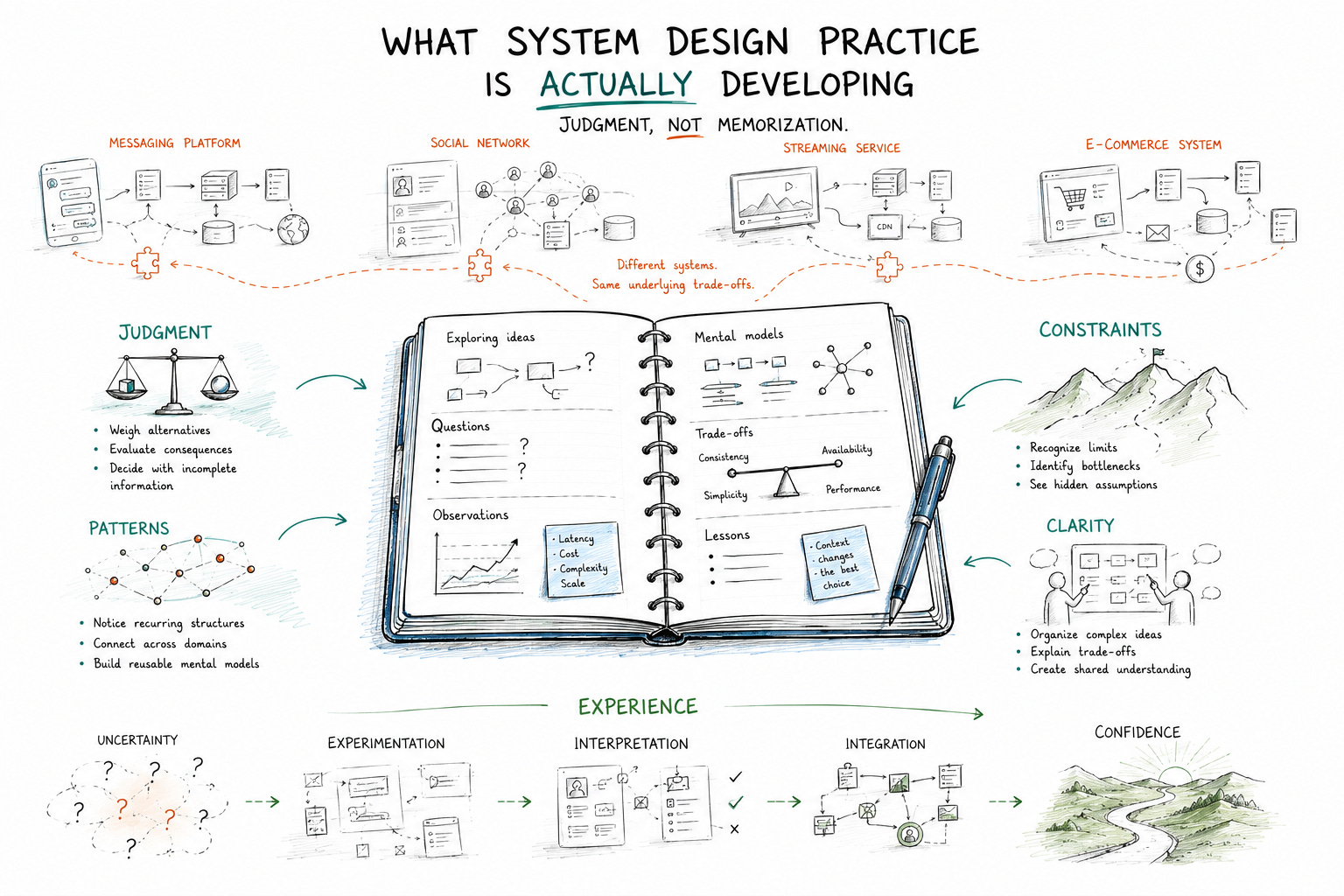
At a deeper level, it develops a collection of mental skills that are difficult to build through simple repetition. These include:
Architectural judgment
Constraint awareness
Pattern recognition
Communication clarity
Each of these skills requires exposure to ambiguity. Engineers learn to evaluate competing priorities. They learn to identify which requirements matter most. They learn to recognize recurring patterns without becoming dependent on them. Most importantly, they learn how to make decisions when information is incomplete.
These capabilities develop more slowly because they involve judgment rather than recall. Judgment emerges through repeated encounters with uncertainty. Engineers see similar trade-offs appear across different contexts. They observe how architectural choices influence system behavior. They begin recognizing patterns beneath the surface of individual technologies.
The process resembles learning a language more than memorizing facts. Fluency develops through exposure, interpretation, and repeated application. System Design practice gradually builds the ability to think through unfamiliar situations with increasing confidence.
Why ambiguity is part of the learning process
One reason System Design interviews feel uncomfortable is that ambiguity is intentional. The open-ended nature of the problems is not a flaw in the format. It is part of what makes the format useful.
Real-world architecture rarely begins with complete information. Engineers must make decisions despite uncertainty. Requirements evolve. Constraints change. Stakeholders disagree. Systems grow in unexpected directions. Waiting for perfect clarity is rarely an option.
System Design interviews attempt to simulate aspects of this reality. The goal is not to evaluate whether candidates can recall architectures. The goal is to observe how they reason when the path forward is not obvious. Ambiguity creates opportunities for judgment to become visible.
Strong System Design practitioners don’t become comfortable because they know all the answers. They become comfortable because they know how to think when answers are missing.
This perspective changes how practice feels. Instead of treating ambiguity as an obstacle, engineers begin treating it as part of the skill itself. Confidence stops coming from certainty. It starts coming from the ability to make progress despite uncertainty.
That shift often marks an important turning point in the learning journey.
The difference between memorizing systems and reasoning about systems
Many candidates initially prepare by studying famous architectures. They learn how large-scale companies handle messaging, storage, caching, recommendation systems, and content delivery. These examples are valuable because they expose engineers to real-world trade-offs.
The challenge is that memorized architectures rarely transfer directly into new situations. Interviewers often change requirements deliberately. Constraints evolve. Traffic patterns differ. Business priorities shift. Suddenly, a familiar architecture no longer feels like an obvious answer.
Reasoning behaves differently. Engineers who focus on understanding trade-offs rather than memorizing outcomes tend to adapt more effectively. They understand why architectural decisions were made. They recognize which constraints influenced those decisions. When the context changes, they can modify their reasoning accordingly.
This is how intuition develops. Not through repetition alone, but through repeated exposure to decision-making. Engineers gradually build mental models that help them evaluate unfamiliar problems. Instead of remembering solutions, they learn to evaluate possibilities.
The result is a form of confidence that feels more flexible and durable than memorization alone.
Why communication becomes part of the practice
One aspect of System Design that surprises many engineers is how heavily communication influences outcomes. Architecture discussions are not purely technical exercises. They are conversations.
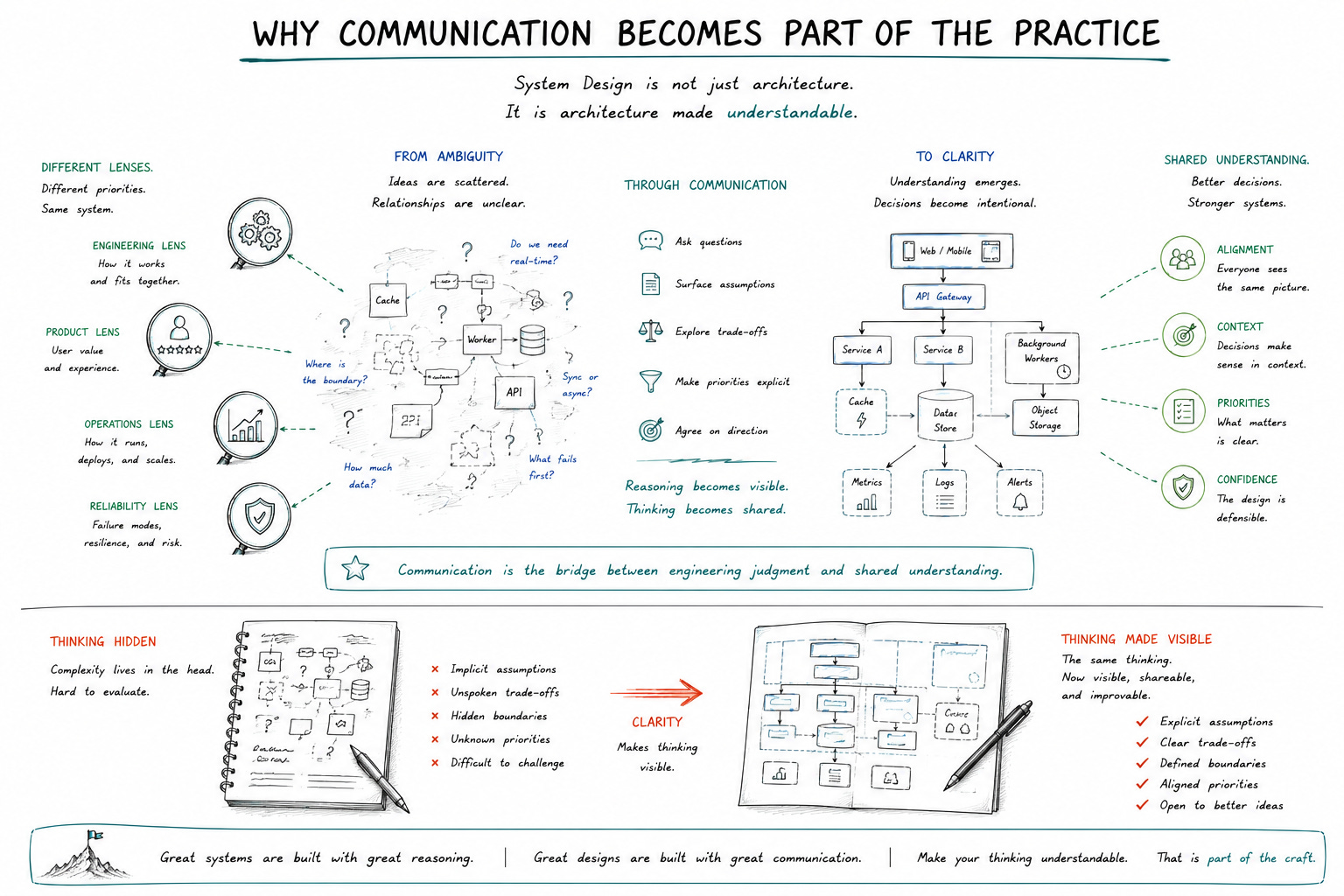
In real organizations, architectural decisions require alignment. Engineers must explain trade-offs to teammates, stakeholders, leadership, and operations teams. They must communicate assumptions, justify decisions, and create shared understanding around priorities. Technical correctness alone is rarely sufficient.
The same dynamic appears during interviews. Candidates who think clearly but communicate poorly often struggle to demonstrate their reasoning. Candidates who communicate effectively make their thought processes visible. The architecture becomes easier to evaluate because the decision-making becomes easier to follow.
This is one reason practice often feels different from studying. Engineers are not merely learning technologies. They are learning how to articulate judgment. The ability to explain trade-offs, assumptions, and priorities becomes part of the skill itself.
System Design is therefore both technical and conversational. Strong practice develops both dimensions simultaneously.
Knowledge-focused practice vs judgment-focused practice
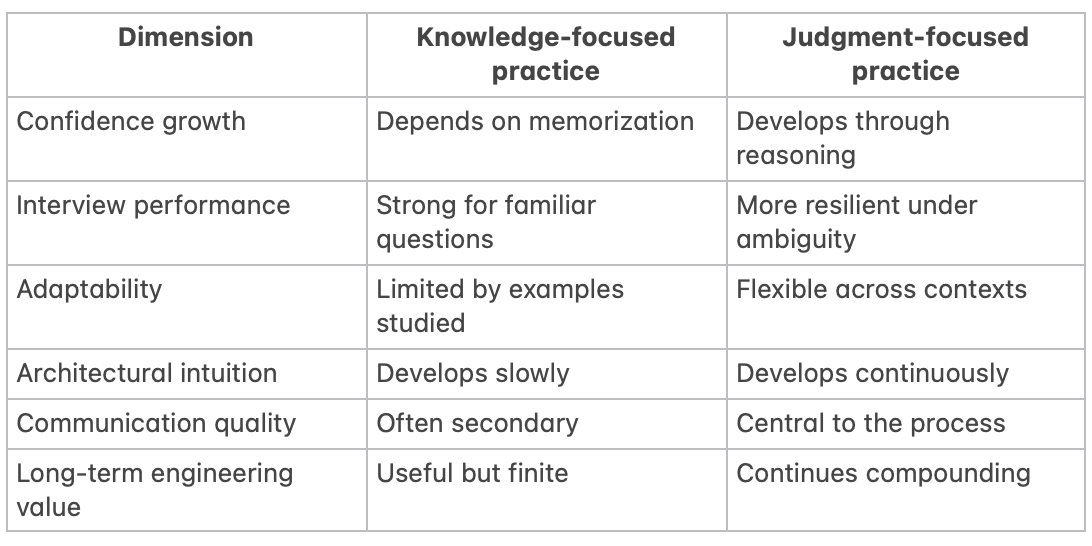
The comparison highlights an important distinction. Knowledge remains valuable. Engineers need concepts, vocabulary, and technical understanding. But knowledge alone rarely produces confidence in uncertain situations.
Judgment-focused practice creates a different kind of growth. Instead of optimizing for familiarity, it optimizes for adaptability. Engineers become more comfortable evaluating new problems because they trust their reasoning process rather than their memory.
This is often the point where System Design starts feeling less intimidating. The focus shifts from finding answers to understanding constraints.
Why there is no finish line
One misconception about System Design practice is that it eventually ends. Engineers sometimes imagine a future point where enough studying eliminates uncertainty entirely. They expect expertise to arrive as a permanent state.
Architecture does not work that way.
Technology evolves continuously. New infrastructure models emerge. New scalability challenges appear. Organizational structures change. User expectations evolve. Even experienced architects encounter unfamiliar situations regularly. The field remains dynamic because software systems remain dynamic.
This is one reason experienced engineers continue practicing. They are not practicing because they lack knowledge. They are practicing because systems thinking itself requires continual refinement. New contexts create new opportunities for learning.
The absence of a finish line can feel discouraging initially. Over time, many engineers discover it is actually liberating. The goal stops being mastery in the absolute sense. The goal becomes continuous improvement in judgment.
That mindset tends to create healthier relationships with learning.
Misconceptions about practicing System Design interviews
Several misconceptions appear repeatedly whenever engineers discuss System Design practice.
One is the belief that more diagrams automatically indicate better preparation. Diagrams can certainly help, but architecture is not measured by diagram quantity. The reasoning behind the diagrams matters much more.
Another misconception is that a perfect framework exists. Frameworks can organize thinking, but they cannot replace judgment. Every meaningful architectural discussion eventually extends beyond any predefined structure.
People also frequently assume strong candidates memorize architectures. In reality, memorization alone tends to break down when requirements change. Successful candidates usually demonstrate adaptability rather than recall.
Perhaps the most persistent misconception is that confidence comes primarily from knowing enough technologies. Technology knowledge contributes, but confidence often emerges from repeated exposure to uncertainty. Engineers become confident because they learn how to think through unfamiliar situations, not because they eliminate unfamiliarity entirely.
What practicing System Design teaches about engineering itself
When we zoom out, System Design practice reveals something broader about engineering. It teaches that many of the most important decisions in software do not involve obvious answers. They involve balancing competing priorities under uncertainty.
Scalability competes with simplicity. Reliability competes with operational cost. Flexibility competes with predictability. Every meaningful system reflects decisions about which priorities matter most. Architecture simply makes those decisions visible.
This is why System Design feels so connected to real engineering work. The skills developed through practice extend beyond interviews. Engineers learn how to reason through ambiguity, communicate trade-offs, and evaluate consequences. These capabilities remain valuable regardless of the technologies involved.
The deeper lesson is that engineering is often less about finding answers and more about making thoughtful decisions when certainty is unavailable.
Conclusion: learning to think in systems
The question How do I practice a system design interview? appears simple, but it points toward something much larger than interview preparation. It points toward the challenge of developing judgment in environments where ambiguity is unavoidable and trade-offs are unavoidable.
System Design practice often feels frustrating because progress is difficult to measure. Engineers cannot rely solely on memorization. They must learn to reason, communicate, prioritize, and adapt. These skills develop gradually through exposure to uncertainty rather than through repetition alone.
Over time, confidence emerges from a different source. It comes not from knowing every answer, but from trusting one’s ability to think through unfamiliar problems. Engineers become more comfortable because they understand how to navigate constraints, evaluate trade-offs, and communicate decisions clearly.
The most valuable outcome of practicing System Design interviews isn’t passing the interview. It’s learning how to reason clearly when complexity refuses to cooperate.
And perhaps that is why System Design remains such a valuable discipline. Beneath the architecture diagrams and distributed systems concepts lies a deeper lesson about engineering itself: the most important skill is not knowing what to build, but learning how to think when the path forward is uncertain.