

What Grokking the System Design really means
Long before engineers debated the latest frameworks or AI models, the idea of “grokking” represented something deeper than simply reading documentation or completing tutorials.

There are very few educational terms that become part of a profession’s vocabulary. Software engineering is full of technical language, but very few words describing how we manage to survive for years. “Grokking” is one of those rare exceptions. Long before engineers debated the latest frameworks or AI models, the idea of “grokking” represented something deeper than simply reading documentation or completing tutorials. It described the moment when a concept stopped feeling abstract and became part of the way you naturally thought about a problem.
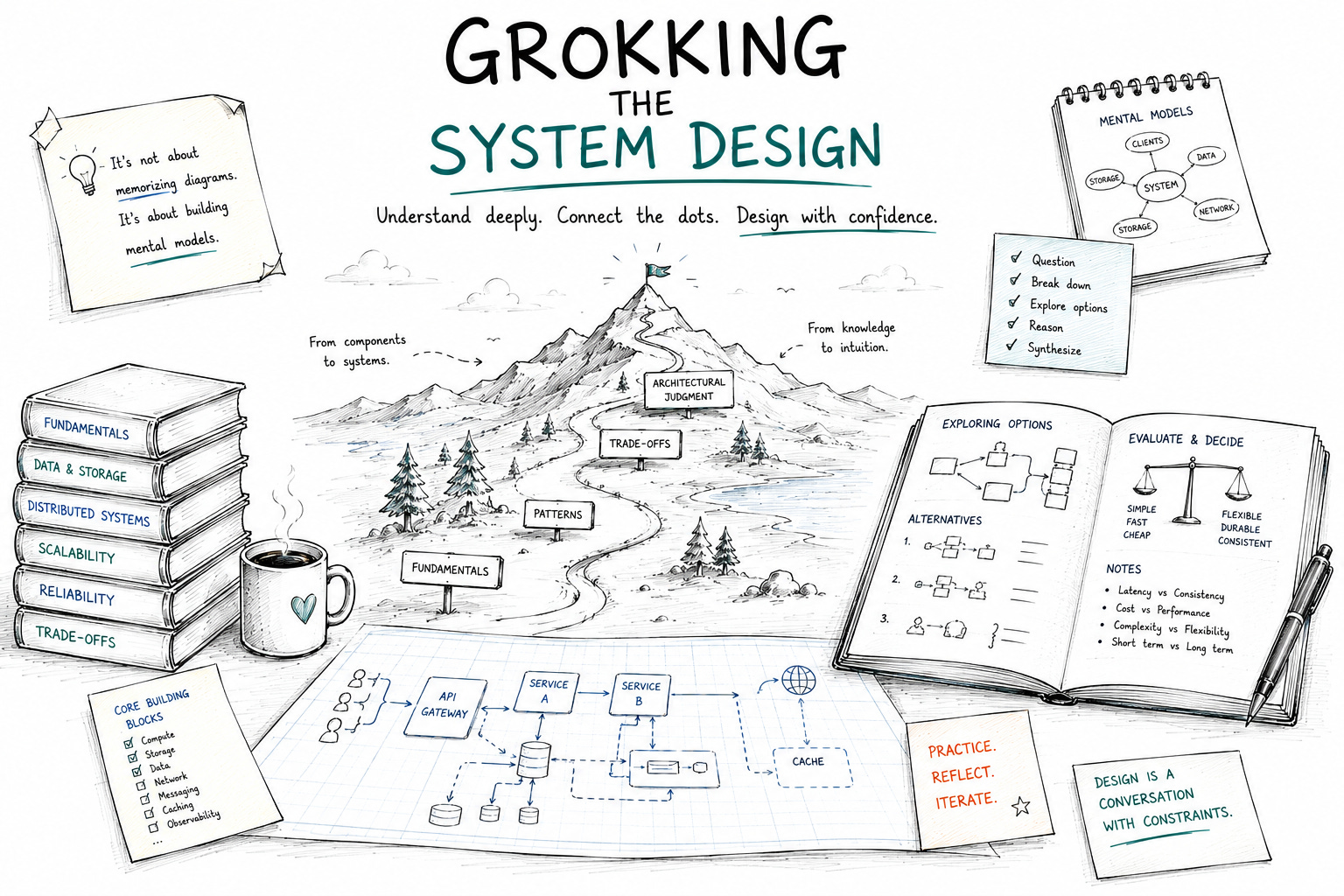
That is one reason the phrase Grokking the System Design has become so recognizable among software engineers. On the surface, it looks like the title of a learning resource. In reality, it reflects something much broader. Engineers are rarely searching for another collection of architecture diagrams. They are searching for confidence. They want to reach the point where distributed systems stop looking like disconnected technologies and start feeling like connected ideas. They want architecture discussions to feel intuitive rather than intimidating.
Engineers rarely struggle because information is unavailable. They struggle because information doesn’t automatically become intuition.
Over the years, I have noticed that System Design creates a very particular kind of frustration. Most engineers are excellent at learning programming languages, frameworks, and APIs because those subjects reward direct experimentation. You write code, observe the result, refine your implementation, and gradually improve. System Design behaves differently.
Why System Design feels fundamentally different
Programming education usually begins with implementation. We learn functions before architectures, algorithms before ecosystems, and classes before distributed services. This progression makes perfect sense because implementation is tangible. You can see your code execute, identify bugs, and measure progress quickly.
System Design asks different questions. Instead of asking whether a function is correct, it asks whether an entire architecture will continue working as millions of users arrive. Instead of focusing on one service, it asks how dozens of services coordinate under failure, latency, and changing business requirements. There are fewer definitive answers and far more trade-offs. Suddenly, software engineering becomes an exercise in balancing competing priorities rather than optimizing a single solution.
This is why many experienced developers feel like beginners again when they first study System Design. They are not lacking technical ability. They are developing an entirely new mental model. The skills that made them effective programmers still matter, but they must now be combined with abstraction, systems thinking, and architectural judgment.
Information is not the same as intuition
One of the biggest misconceptions about learning System Design is that enough reading eventually produces understanding. Information certainly helps. Engineers should know what load balancing, caching, replication, sharding, and asynchronous messaging are. But recognizing these concepts is only the first stage of learning.
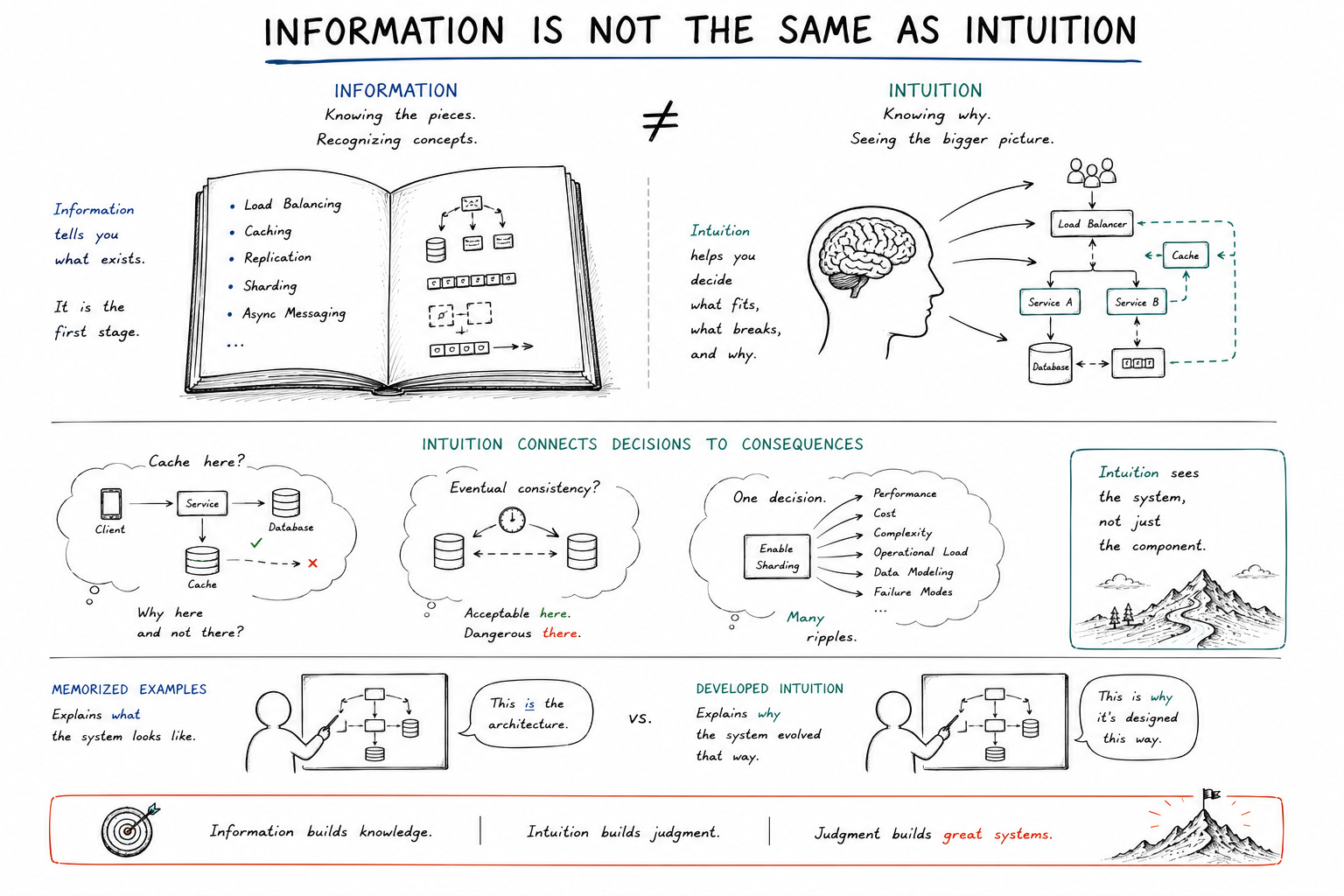
The harder step is developing intuition. Intuition allows an engineer to recognize why a cache belongs in one architecture but not another. It explains why eventual consistency is acceptable for one application but dangerous for another. It helps someone see how one architectural decision quietly influences half a dozen others.
That difference becomes obvious during architectural discussions. Someone who has memorized examples often explains what a system looks like. Someone who has developed intuition explains why the system evolved that way. The diagrams may look similar, but the reasoning behind them is very different.
What “grokking” actually means
For me, the idea of grokking has never been about consuming more educational content. It is about reaching a level of understanding where concepts begin connecting naturally. Instead of memorizing isolated ideas, engineers begin recognizing recurring relationships.
At its core, grokking encourages engineers to develop habits such as:
Seeing relationships instead of isolated components.
Recognizing recurring architectural patterns.
Thinking in terms of trade-offs rather than perfect solutions.
Connecting distributed systems concepts into coherent mental models.
These habits matter because System Design is ultimately an exercise in reasoning. Every architecture reflects a series of decisions made under constraints. Engineers who only memorize outcomes struggle when those constraints change. Engineers who understand the reasoning can adapt much more easily.
The goal of learning System Design is not remembering architectures. It’s learning how architectures emerge from constraints.
Why memorization eventually breaks down
Many engineers begin their System Design journey by collecting examples. They study URL shorteners, chat systems, ride-sharing platforms, streaming services, and social networks. At first, this approach feels productive because every new diagram seems to expand their knowledge.
Eventually, however, something interesting happens. A new design problem appears, and none of the memorized examples fit perfectly. The engineer starts wondering which architecture to copy, only to discover that there is no exact match.
This is where memorization reaches its limits. Real systems are shaped by context. A payment platform has different priorities from a recommendation engine. A healthcare application makes different trade-offs than a video streaming service. If we only remember finished architectures, we struggle whenever the problem changes. If we understand the reasoning behind them, we can adapt our thinking to new situations.
Why educational structure matters
One thing we observed repeatedly while building Grokking the Modern System Design Interview was that learners rarely failed because they lacked motivation. More often, they struggled because the information arrived in disconnected pieces. They understood caching in one article, load balancing in another, and databases somewhere else, but they found it difficult to combine those ideas into a coherent architectural conversation.
The goal was never to teach diagrams for their own sake. It was to help engineers connect concepts in a sequence that gradually strengthened architectural intuition. Resources like this exist because many learners do not need more facts. They need a clearer path that allows individual concepts to reinforce one another instead of remaining isolated.
Good educational structure reduces cognitive overload. It gives engineers opportunities to revisit ideas from different perspectives until they stop feeling like separate lessons and start becoming part of a larger system of thought.
Memorizing System Design vs grokking System Design
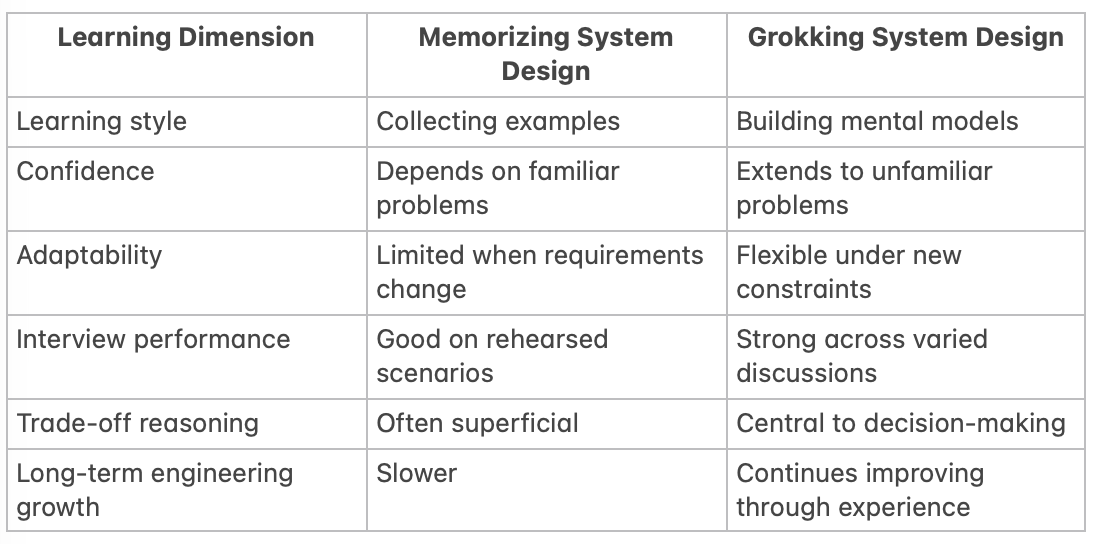
The distinction is important because careers rarely reward memorization for very long. Technologies evolve, architectures change, and business requirements shift constantly. Mental models remain valuable because they help engineers interpret new situations rather than repeat old answers.
There are no shortcuts to intuition
Modern engineering culture often celebrates acceleration. Faster tutorials, shorter roadmaps, and compressed learning plans all promise to reduce the time required to master difficult subjects. While structured learning can certainly improve efficiency, there are parts of engineering that simply require experience.
Architectural intuition belongs to that category. You can accelerate exposure to distributed systems, scalability patterns, and design trade-offs. You cannot completely accelerate the process of recognizing those patterns instinctively. That recognition grows through repeated encounters with increasingly complex systems.
The encouraging part is that intuition does not require decades before it begins appearing. Every thoughtful architectural discussion strengthens it. Every production incident teaches something new. Every time an engineer revisits an old design with more experience, their perspective changes slightly. Progress is gradual, but it is very real.
What strong learners tend to have in common
After watching thousands of engineers learn System Design, certain characteristics appear repeatedly among those who develop lasting intuition. Curiosity matters more than speed. Strong learners ask why architectures evolved instead of simply what they look like. They become interested in failures, constraints, bottlenecks, and unintended consequences.
They also remain comfortable with uncertainty. Rather than searching for universally correct architectures, they learn to evaluate competing trade-offs. Over time, this mindset transforms System Design from an intimidating interview subject into a practical way of thinking about software.
The strongest engineers rarely know every answer. They usually recognize the shape of the problem before they recognize the solution.
From diagrams to judgment
When people search for Grokking the System Design, they are often looking for more than a learning resource. They are looking for a different relationship with complexity itself. They want architecture to feel less like an overwhelming collection of technologies and more like a set of ideas they can reason about confidently.
That is why I believe the word “grokking” has endured. It reminds us that deep understanding is different from accumulated information. It encourages engineers to build intuition, recognize patterns, and think through trade-offs instead of memorizing finished diagrams.
In the end, System Design is not really about distributed systems, databases, or scalability. Those are important topics, but they are not the destination. The destination is better engineering judgment. The most valuable outcome of learning System Design is not simply performing well in interviews. It is becoming the kind of engineer who can approach unfamiliar systems with clarity, ask better questions, and make thoughtful architectural decisions even when no perfect answer exists.
The best System Design education doesn’t simply teach engineers how systems work. It changes how they think about systems altogether.