

What Google Docs System Design reveals about modern collaboration
At its core, Google Docs system design revolves around a surprisingly human problem.

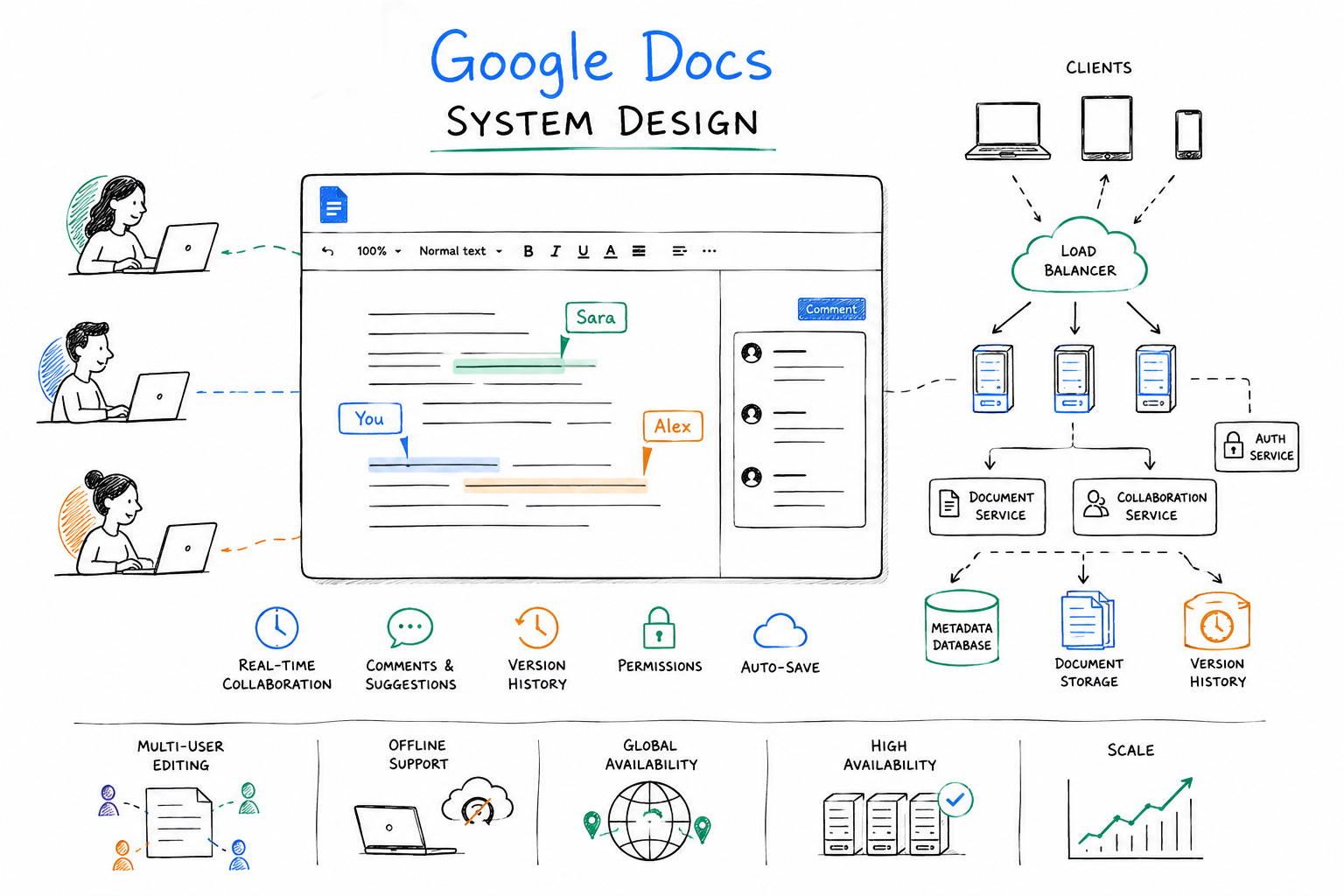
Today, collaborative editing feels so normal that most people barely notice it. We open a document, share a link, and watch cursors move across the screen as teammates type in real time. Comments appear instantly. Suggestions materialize from different continents. Entire meetings happen inside a shared document. The experience feels natural enough that it is easy to forget how unusual it would have seemed not very long ago.
There was a time when documents were fundamentally personal artifacts. A file lived on a machine. Sharing meant sending copies. Collaboration meant email attachments, version numbers, and the occasional confusion of trying to determine whether final_v3_revised_final.doc was actually the latest version. The workflow was accepted because it reflected how software was expected to behave. Documents belonged to individuals first and groups second.
Then products like Google Docs changed that expectation. Suddenly, collaboration became the default rather than the exception. Multiple people could edit the same document simultaneously. Changes appeared instantly. The document became a shared space instead of a personal file. What looked like a simple improvement in user experience was actually a profound shift in how software thought about ownership, coordination, and interaction.
The most impressive thing about Google Docs is not that multiple people can edit a document. It’s that most users never think about how difficult that should be.
That observation captures why Google system design remains such a fascinating subject. The product succeeded not because it exposed sophisticated technology, but because it hid it. Users experience collaboration as something intuitive and immediate. Underneath that simplicity lies one of the most interesting coordination problems in modern software engineering.
The challenge of shared reality
At its core, Google Docs system design revolves around a surprisingly human problem. When several people work together, they need confidence that they are seeing the same thing. They need a shared understanding of what exists, what changed, and what is happening right now. Collaboration becomes difficult when that shared understanding breaks down.
Software systems encounter the same challenge. Each participant interacts through a different device, network connection, and execution environment. Updates arrive at different times. Messages may be delayed. Connections may be interrupted. Yet the experience must still feel coherent. Everyone should believe they are working inside the same document.
This is why consistency becomes more than a technical concept. It becomes a user experience concern. If one person sees a sentence while another does not, confusion emerges immediately. If edits appear unpredictably, trust begins to erode. The architecture must support not only correctness but also confidence.
The deeper lesson is that collaboration systems are fundamentally coordination systems. The document itself is only part of the challenge. The larger challenge involves helping multiple participants maintain a shared understanding despite operating across distributed environments. Once viewed through that lens, collaborative editing begins looking much less like a document problem and much more like a systems problem.
Why latency matters differently in collaborative software
Latency matters in nearly every software system, but collaboration introduces a unique sensitivity to delays. In many applications, users tolerate small pauses because the interaction remains personal. A search result taking an extra moment may feel inconvenient but manageable. A report generation process can often take several seconds without fundamentally changing the experience.
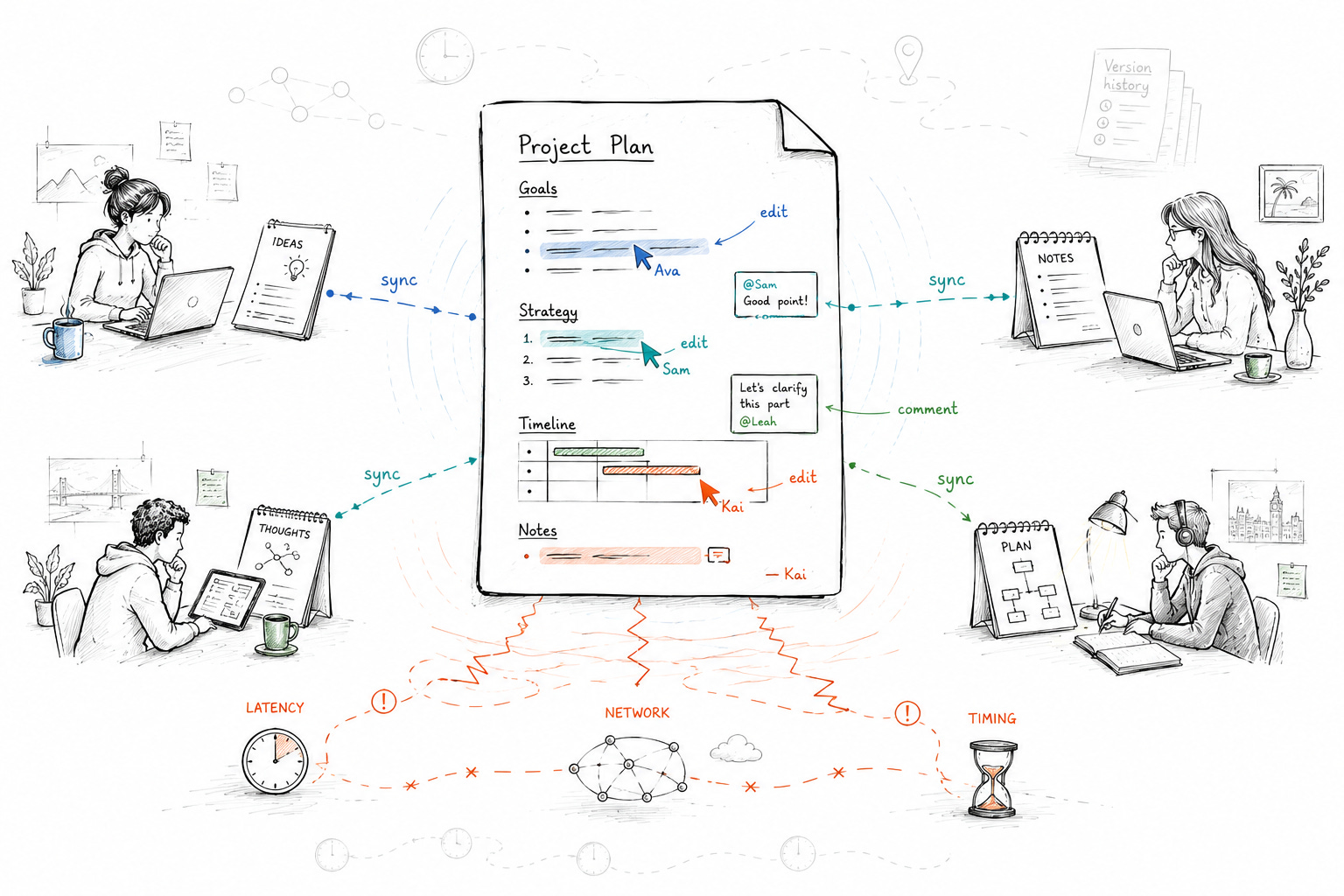
Collaboration changes the equation because users are not only interacting with software. They are interacting with one another through software. Delays influence communication. A pause in synchronization can create uncertainty about whether changes were received. A delay in visibility can make collaboration feel disconnected even if the underlying system remains technically correct.
Several qualities become particularly important:
Fast feedback
Shared context
Continuous synchronization
Consistent user experience
These characteristics help explain why collaborative systems often prioritize responsiveness so heavily. The goal is not merely efficiency. The goal is preserving the feeling of shared presence. Users should feel as though they are working together in real time, even when substantial coordination is occurring behind the scenes.
This reveals an important principle about architecture. Technical performance matters partly because of how humans perceive it. Milliseconds influence user trust. Responsiveness shapes confidence. Architecture and psychology become intertwined in ways that are easy to underestimate.
Why Google Docs became a classic System Design case study
Engineers are naturally drawn toward systems that combine technical depth with visible user impact. Google Docs occupies a unique position because it does both exceptionally well. The collaboration experience feels intuitive enough for non-technical users while simultaneously exposing some of the most interesting challenges in distributed systems.
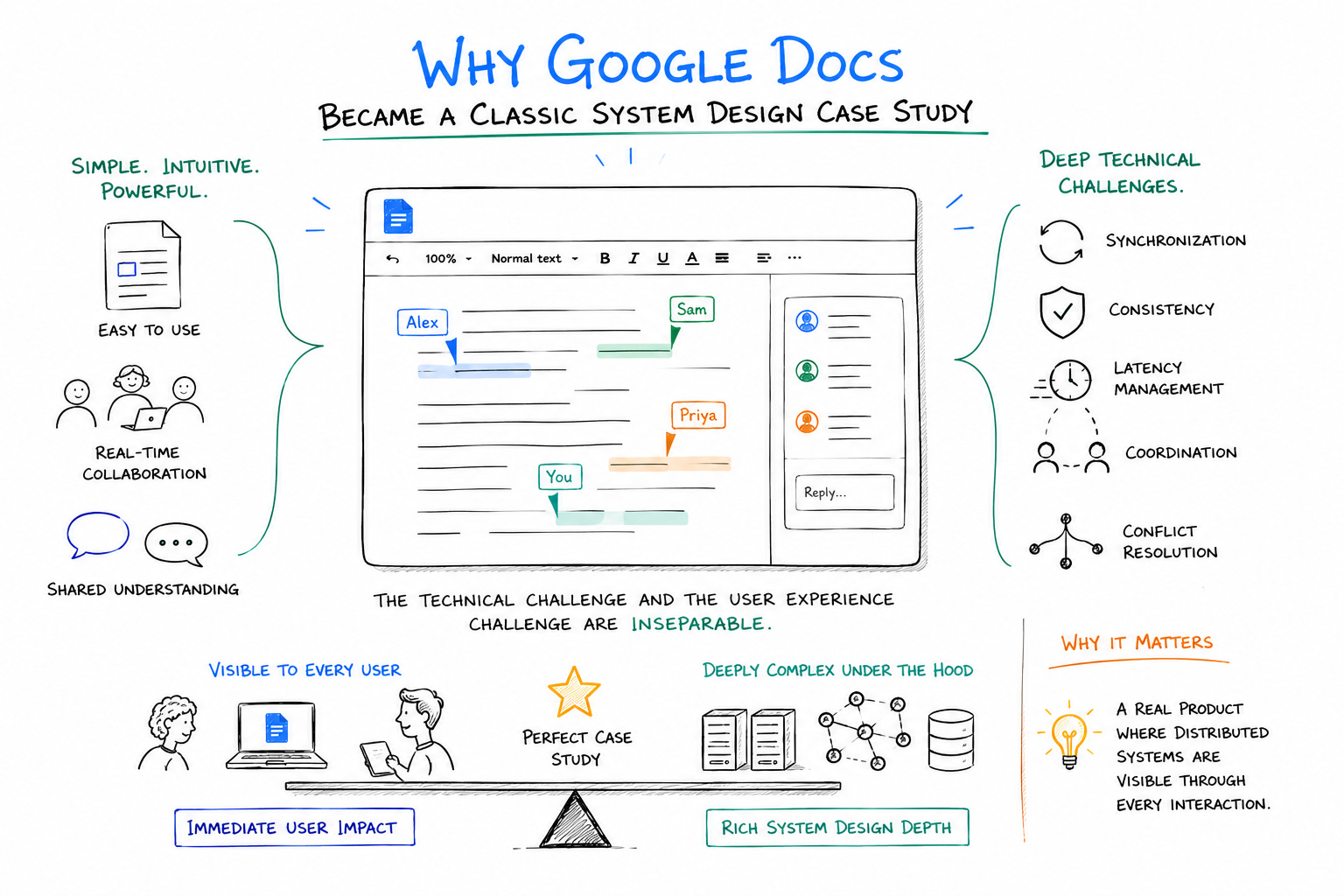
This duality explains why Google Docs system design appears so frequently in educational discussions. The product creates an accessible entry point into concepts like synchronization, consistency, latency management, coordination, and conflict resolution. Engineers can immediately understand the user-facing problem while gradually uncovering the architectural complexity underneath.
Google Docs is one of those rare systems where the technical challenge and the user experience challenge are inseparable.
Many distributed systems operate behind the scenes. Users benefit from them indirectly. Collaborative editing is different because the distributed nature of the system becomes visible through the interaction itself. Every shared cursor, synchronized edit, and real-time update reflects architectural decisions designed to preserve a seamless experience.
That combination makes Google Docs a remarkably effective lens through which to study modern software systems.
The balance between consistency and usability
Architectural discussions often involve competing priorities, and collaborative systems provide particularly vivid examples. Users want edits to appear immediately. They also want the document to remain correct. They want collaboration to feel effortless. They also expect reliability.
These goals are not always perfectly aligned. Immediate responsiveness may create coordination challenges. Strong consistency guarantees may introduce delays. Simplicity for users may require substantial complexity internally. The architecture becomes an ongoing negotiation between desirable outcomes.
What makes Google Docs interesting is not that it eliminates these tensions. It manages them effectively enough that most users never notice them. The system balances correctness with responsiveness in ways that support collaboration rather than interrupt it.
This highlights a broader truth about architecture. Good systems rarely maximize every desirable property simultaneously. Instead, they create experiences where trade-offs align with user expectations. The quality of the architecture often depends less on perfection and more on prioritization.
Collaboration software makes these trade-offs unusually visible because human interaction depends on them directly.
What Google Docs teaches about distributed systems
Many distributed systems concepts can feel abstract when introduced through technical definitions alone. Collaboration systems provide a more intuitive perspective because the consequences become visible immediately. Synchronization is no longer a theoretical concern. It becomes the difference between shared understanding and confusion.
Google Docs demonstrates that distributed systems are ultimately about coordination. Machines coordinate. Services coordinate. Users coordinate. The architecture exists to make these forms of coordination reliable despite imperfect environments. Networks introduce uncertainty. Participants act concurrently. Information moves continuously. The system must maintain coherence throughout.
What makes this particularly educational is that collaboration exposes the relationship between technical behavior and human experience. A synchronization issue becomes a communication issue. A consistency issue becomes a trust issue. Distributed systems stop feeling purely technical because their effects are experienced directly by users.
This perspective helps explain why collaborative software remains such a powerful teaching tool. It reveals that distributed systems are not merely about infrastructure. They are about enabling coordinated behavior across distance, time, and uncertainty.
Traditional document software vs collaborative document systems
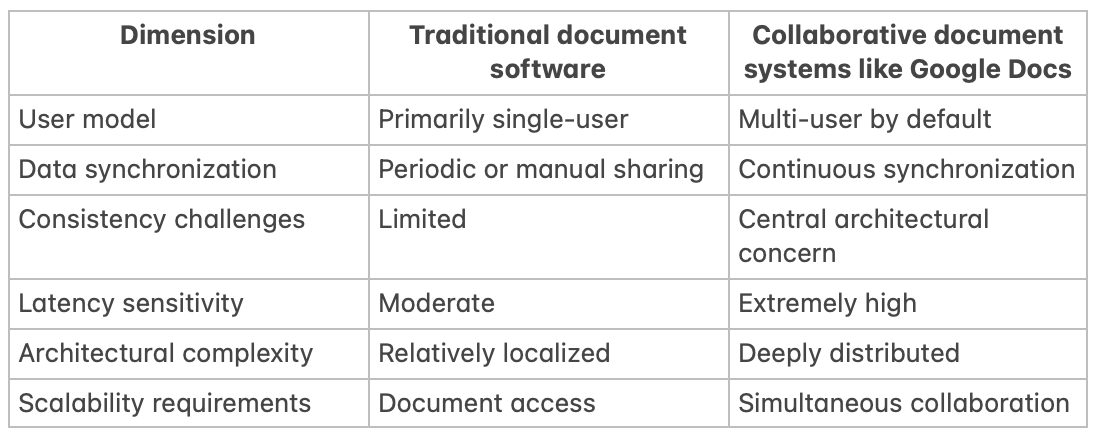
The comparison highlights how collaboration changes the nature of the problem entirely. Traditional document systems focus primarily on editing and storage. Collaborative systems must additionally manage coordination, synchronization, and shared experience. The document remains important, but the interaction between participants becomes equally important.
This shift illustrates a broader pattern in software evolution. As applications become more collaborative, architecture increasingly revolves around relationships rather than individual actions.
Why collaboration changes architecture
When multiple users become first-class participants, architectural priorities begin shifting. Storage remains important, but communication becomes equally important. Performance remains important, but responsiveness gains new significance. Correctness remains important, but coordination becomes central.
These changes influence nearly every architectural decision. Systems must account for simultaneous activity. Updates must propagate efficiently. State must remain understandable across multiple participants. The architecture evolves around the reality that users are interacting not only with software but with one another.
This transformation reflects a broader trend across modern applications. Collaboration is no longer limited to documents. Messaging platforms, project management tools, design software, development environments, and knowledge systems increasingly rely on shared interaction. The lessons learned from Google Docs now apply across entire categories of software.
The result is that collaboration has become an architectural concern rather than merely a feature.
What engineers learn from studying Google Docs
Studying collaborative systems teaches engineers lessons that extend far beyond document editing. Coordination emerges as a recurring theme. Consistency becomes easier to understand when viewed through the lens of shared experience. User expectations become more tangible when architecture influences interaction directly.
Engineers also learn the importance of abstraction. Users do not want exposure to complexity. They want confidence that the system behaves predictably. Effective architecture creates experiences that feel simple despite substantial complexity underneath.
Great systems don’t merely solve technical problems. They reshape what users expect software to do.
This may be the most enduring lesson of Google Docs. Once people experience seamless collaboration, they begin expecting collaboration everywhere. Architectural breakthroughs often become invisible because they redefine normality. Users stop viewing the capability as remarkable and start viewing it as expected.
That transition is one of the strongest indicators that a system has changed the industry.
What Google Docs reveals about modern software
When we zoom out, Google Docs becomes more than a document editor. It represents a shift in how software thinks about interaction. Earlier generations of applications focused primarily on individuals. Modern applications increasingly focus on groups.
This shift influences architecture across industries. Collaboration, synchronization, shared state, and coordination have become central concerns for many categories of software. User expectations evolved because products demonstrated new possibilities. Once collaboration became seamless in one context, people expected similar experiences elsewhere.
The result is that modern software increasingly behaves as a network of participants rather than a collection of isolated users. Systems must support interaction, not merely functionality. Google Docs helped establish that expectation.
Its influence extends far beyond documents.
Conclusion: collaboration as a systems problem
Google Docs system design remains fascinating because it sits at the intersection of technology and human behavior. On the surface, it appears to solve a document editing problem. At a deeper level, it solves a coordination problem. The architecture exists to help multiple people maintain a shared understanding despite operating across distributed environments.
This challenge brings together many of the most important ideas in modern software engineering: collaboration, consistency, latency, synchronization, distributed systems, and user experience. None of these concerns exist independently. They influence one another continuously.
What makes Google Docs particularly remarkable is not the complexity it contains, but the complexity it conceals. Users experience collaboration as natural because the architecture absorbs enormous amounts of coordination work on their behalf.
The hallmark of great system design is not visible complexity. It’s making complexity disappear for everyone except the engineers who built it.
And perhaps that is the broader lesson. The most influential software systems are often the ones that make extraordinarily difficult problems feel effortless. Google Docs changed expectations not because users understood its architecture, but because they never had to. That is what great systems design ultimately strives for.