

Difference between SDE2 and SDE3 System Design interviews at Amazon
The difference between SDE2 and SDE3 system design interviews at Amazon is often described in terms of complexity, scale, or technical depth, but they are not the most important distinctions.

Many engineers assume that the difference between SDE2 and SDE3 system design interviews at Amazon is primarily a matter of difficulty. The common perception is that both interviews are fundamentally the same exercise, except one requires designing larger systems, discussing more technologies, or handling more complex scalability requirements. On the surface, that assumption seems reasonable. Both conversations involve architecture, distributed systems, trade-offs, and technical decision-making. Both ask candidates to reason about systems under constraints. Both evaluate how engineers think through complexity.
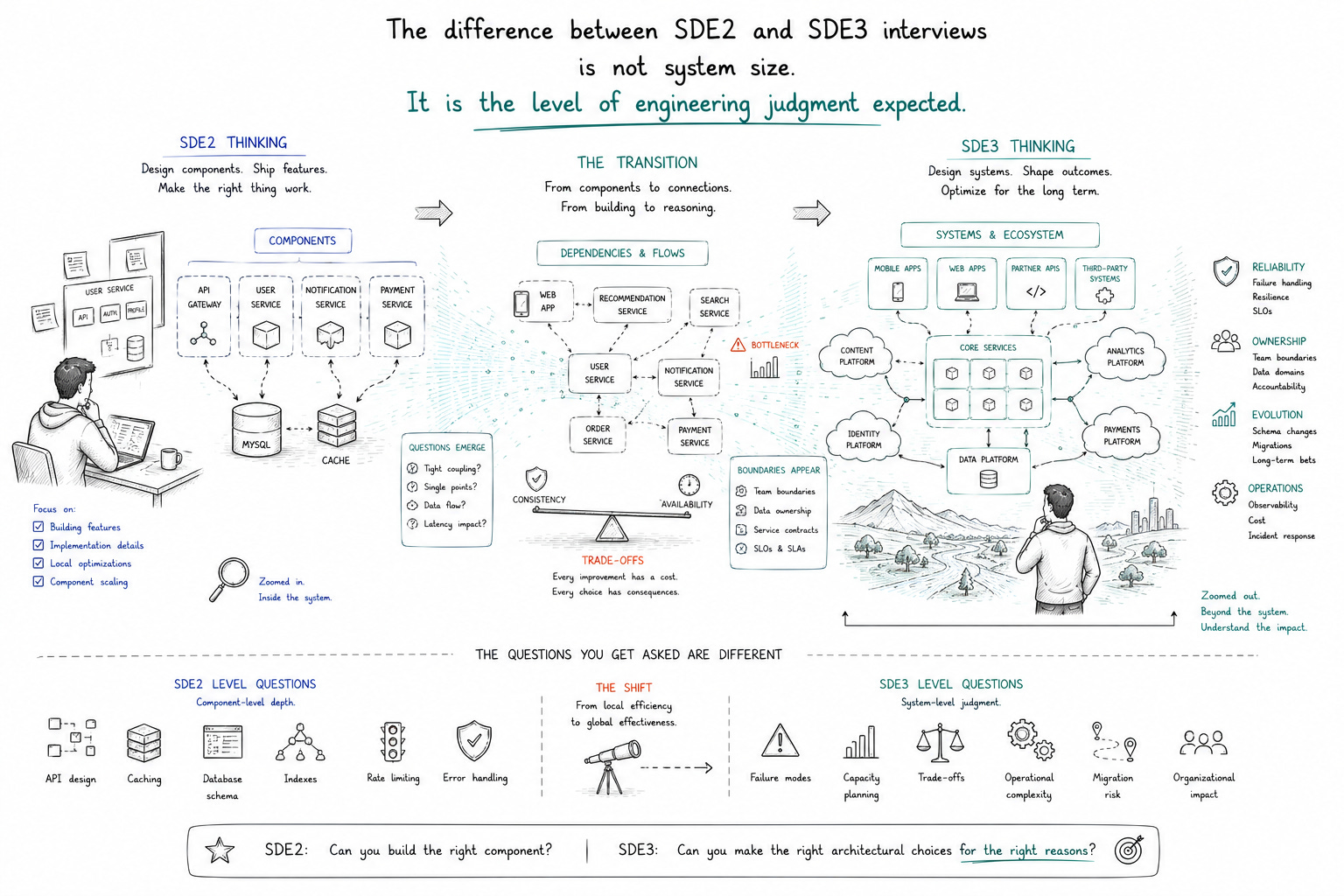
Yet after watching thousands of engineers progress through their careers, I’ve come to believe that this explanation misses the most important distinction. The difference is not simply about architectural sophistication. It is about the type of responsibility the architecture represents. The same diagram can tell very different stories depending on whether the engineer is responsible for building part of a system or shaping the future of an entire system. What changes between levels is not only what candidates know, but how broadly they think about consequences.
The biggest difference between SDE2 and SDE3 interviews is not the architecture. It’s the scope of responsibility hidden behind the architecture.
This is why many engineers are surprised when they begin preparing for higher-level interviews. They expect more technical depth and often encounter something different: broader conversations about ownership, ambiguity, trade-offs, operational consequences, and organizational impact. The architecture remains important, but it increasingly becomes a vehicle for evaluating judgment rather than implementation knowledge. In many ways, these interviews reveal how engineering itself evolves as careers progress.
Why career levels change the nature of technical conversations
One of the more interesting aspects of engineering careers is that technical growth rarely happens in a straight line. Early in a career, progress often feels directly connected to implementation ability. Engineers learn languages, frameworks, infrastructure patterns, and development practices. They become more effective at translating requirements into working systems. Success is relatively visible because the outputs are concrete.
As engineers gain experience, however, the work gradually shifts. The problems become less about implementation and more about decisions. Technical conversations begin to include questions that have no obvious answers. Trade-offs become harder to avoid. Stakeholder concerns become more significant. Architectural decisions start influencing teams, roadmaps, operational reliability, and long-term maintainability.
System Design interviews naturally mirror this progression because the skills required to operate effectively at different levels evolve as well. An engineer responsible for delivering a component needs different capabilities than an engineer responsible for influencing the direction of a platform. Both roles require technical competence, but they operate within different scopes of responsibility.
This is why level progression often feels less like learning new technologies and more like expanding the context within which decisions must be made. The systems become larger, but so do the consequences of architectural choices.
The transition from solving systems to shaping systems
One observation I’ve noticed repeatedly is that many SDE2 engineers spend most of their time solving problems within systems. They build services, improve components, optimize performance, address reliability concerns, and contribute meaningfully to larger architectures. Their work often involves deep ownership within a bounded area of responsibility.
As engineers move toward SDE3-level expectations, the nature of the work begins to change. The challenge increasingly involves shaping systems rather than simply contributing to them. Architectural discussions expand beyond local implementation concerns and begin incorporating questions about long-term evolution, cross-team coordination, organizational impact, and strategic trade-offs.
This transition changes how System Design conversations unfold. Discussions become less centered on individual components and more focused on how multiple components interact. The candidate is often expected to reason about boundaries, dependencies, ownership models, operational consequences, and future system growth. The architecture becomes a reflection of broader thinking.
What makes this shift difficult is that the underlying technologies may remain familiar. The complexity comes from the context. The engineer must consider more variables simultaneously while maintaining clarity about priorities. Technical depth remains important, but breadth becomes increasingly important as well.
Scope becomes the defining difference
If I had to identify a single concept that best explains the distinction between many SDE2 and SDE3 System Design discussions, it would probably be scope.
As engineers progress, the systems they influence become larger and more interconnected. Decisions increasingly affect multiple teams rather than a single codebase. Architectural choices shape not only implementation details, but operational practices, communication patterns, and organizational workflows.
Several characteristics tend to expand together:
Larger systems
More stakeholders
Greater ambiguity
Longer-term consequences
This is why higher-level interviews often feel different even when the technical concepts remain similar. The candidate may still discuss caching, storage, reliability, APIs, and scalability. The difference is that these decisions are now evaluated within broader contexts. The interviewer becomes interested in how architectural choices affect multiple dimensions of the organization simultaneously.
Scope changes the nature of trade-offs because broader systems introduce more competing priorities. Optimizing one area may create challenges elsewhere. Decisions become harder because the consequences become more distributed.
Ambiguity becomes part of the evaluation
One thing that often surprises engineers moving toward more senior responsibilities is how much ambiguity becomes part of the job itself. Early-career engineering work frequently begins with relatively clear requirements. The problem may be difficult, but the boundaries are usually visible.
Higher-level engineering work behaves differently. Requirements are often incomplete. Stakeholders disagree. Constraints emerge gradually. Information remains imperfect. Engineers must make decisions despite uncertainty rather than waiting for certainty to arrive.
This is one reason System Design interviews increasingly introduce ambiguity as expectations grow. The goal is not to confuse candidates. The goal is to observe how they navigate situations where there is no obvious path forward. Architectural judgment often reveals itself most clearly when multiple reasonable solutions exist simultaneously.
The ability to operate effectively in ambiguous environments becomes increasingly important because real-world systems rarely present themselves as neatly defined exercises. Mature engineers learn to make progress despite incomplete information. They identify assumptions, surface risks, evaluate trade-offs, and move conversations forward constructively.
In many ways, ambiguity functions as a proxy for responsibility. The broader the responsibility, the less likely it becomes that someone else has already defined the solution clearly.
The difference between knowing patterns and evaluating trade-offs
A recurring challenge in System Design education is helping engineers move beyond architectural patterns toward architectural reasoning. Patterns are valuable. They provide reusable solutions to recurring problems. But patterns alone rarely determine whether a design is effective.
Many candidates preparing for interviews focus heavily on collecting architectural patterns. They learn about queues, caches, event-driven systems, partitioning strategies, replication approaches, and communication models. The knowledge itself is useful. The difficulty emerges when they assume knowing patterns automatically translates into design maturity.
At higher levels, conversations increasingly revolve around consequences rather than components. The discussion shifts from what can be built to what should be built. Trade-offs become the center of the conversation because every architectural decision creates downstream effects.
Junior engineers often ask whether a design works. Senior engineers ask what breaks when it does.
This mindset reflects a deeper form of systems thinking. Instead of evaluating solutions in isolation, experienced engineers evaluate interactions, dependencies, risks, and long-term outcomes. The architecture matters, but the reasoning behind the architecture matters more.
Ownership changes the conversation
Ownership is one of those engineering concepts that is often discussed but not always understood clearly. Many people associate ownership with responsibility for delivery. While that certainly matters, ownership becomes much broader as engineering scope expands.
At higher levels, ownership increasingly includes responsibility for operational outcomes, architectural evolution, system reliability, maintainability, and long-term health. The engineer is no longer simply responsible for building something. They are responsible for helping ensure the system continues serving its purpose effectively over time.
This changes System Design discussions because ownership naturally extends the time horizon of decision-making. Engineers begin thinking not only about implementation, but also about monitoring, failure recovery, operational burden, migration strategies, and future growth. Architectural choices become evaluated through the lens of sustainability rather than immediate functionality.
Amazon interviews often surface these themes because ownership plays such an important role in engineering effectiveness. The conversation frequently extends beyond the initial design and into questions about how that design behaves under operational pressure. The architecture becomes a vehicle for exploring long-term responsibility.
Technical leadership without formal authority
One misconception many engineers have is that leadership begins only when management responsibilities appear. In reality, technical leadership often emerges long before formal authority enters the picture.
SDE3-level expectations frequently involve influencing architecture across boundaries that extend beyond direct implementation ownership. Engineers are expected to align teams, clarify trade-offs, communicate effectively, and guide technical direction. None of these activities necessarily require managerial responsibility. They require credibility, judgment, and communication.
This is why leadership themes often appear inside System Design interviews. The architecture itself may be technical, but the decisions surrounding the architecture often involve collaboration. Systems rarely exist within isolated organizational bubbles. They interact with other systems, teams, priorities, and constraints.
Strong technical leadership frequently manifests through clarity. Engineers help organizations understand complex decisions. They simplify discussions without oversimplifying reality. They create alignment around trade-offs. The influence emerges from reasoning rather than authority.
Typical SDE2 vs SDE3 System Design discussions
DimensionTypical SDE2 discussionsTypical SDE3 discussionsScopeIndividual systems or componentsMulti-system and cross-team concernsArchitectural depthComponent-level reasoningEcosystem-level reasoningAmbiguityModerately defined requirementsSignificant uncertainty and trade-offsStakeholder impactPrimarily local teamsMultiple organizations and stakeholdersOwnership expectationsDelivery and implementationLong-term system outcomesTrade-off complexityTechnical trade-offsTechnical and organizational trade-offsTime horizonNear-term executionLong-term evolution
The comparison highlights an important point. The distinction is not necessarily about intelligence, technical knowledge, or difficulty. It is about perspective. The broader the perspective required, the more architectural discussions begin reflecting organizational realities alongside technical realities.
Engineering growth often involves expanding the context within which decisions are evaluated. System Design interviews naturally reveal that expansion because architecture sits at the intersection of technology, operations, and organizational behavior.
Why operational thinking becomes increasingly important
As engineers gain responsibility, architecture and operations become increasingly difficult to separate. Early-career discussions often focus heavily on building systems. More experienced engineers spend substantial time thinking about maintaining them.
Reliability, scalability, observability, maintainability, failure recovery, deployment safety, and operational resilience all become central architectural concerns. A design that functions correctly but creates excessive operational burden may ultimately be less successful than a simpler alternative.
This operational perspective changes how engineers evaluate trade-offs. Features become only one part of the discussion. Operational consequences become equally important. The architecture is no longer judged solely by what it enables, but also by what it costs to sustain.
Many higher-level System Design conversations naturally gravitate toward these topics because mature systems spend far more time operating than being built. Long-term success depends heavily on operational quality.
Common misconceptions about SDE2 vs SDE3 interviews
Several misconceptions appear consistently whenever engineers discuss level progression.
One is the belief that SDE3 interviews are simply harder versions of SDE2 interviews. In practice, they often evaluate different dimensions of engineering thinking rather than merely increasing technical complexity.
Another misconception is that bigger diagrams indicate stronger answers. More components do not automatically imply better architecture. Complexity often introduces new risks and responsibilities. Mature engineers frequently optimize for clarity rather than scale alone.
There is also a tendency to equate seniority with technology breadth. Knowing more technologies can certainly help, but engineering maturity often manifests through prioritization, trade-off reasoning, and judgment rather than technology accumulation.
Finally, many people assume System Design interviews are primarily testing scalability knowledge. Scalability matters, but interviews frequently reveal broader qualities such as ownership, communication, decision-making, and long-term thinking.
What engineering maturity actually looks like
One of the more interesting aspects of engineering growth is that maturity often becomes easier to recognize than to define. Experienced engineers tend to exhibit certain recurring characteristics regardless of the specific technologies they work with.
Judgment stands out immediately. Mature engineers prioritize effectively. They distinguish important problems from merely interesting problems. They understand which trade-offs matter and which ones can be deferred. Their decisions often feel proportionate to the situation.
Communication also becomes increasingly important. Strong engineers explain reasoning clearly. They make complex topics understandable. They create alignment around difficult decisions. Their effectiveness extends beyond individual implementation work.
Engineering maturity often reveals itself not through complexity, but through clarity.
Perhaps most importantly, experienced engineers develop comfort with uncertainty. They recognize that architecture rarely involves perfect solutions. Instead of searching endlessly for certainty, they learn how to make thoughtful decisions despite incomplete information.
What these interviews reveal about engineering careers
When viewed through a broader lens, the difference between SDE2 and SDE3 interviews reveals something important about engineering careers generally.
Technical growth does not simply mean learning more technologies. Technologies change constantly. Responsibilities evolve differently. Over time, engineers become increasingly responsible for decisions, trade-offs, communication, coordination, and long-term outcomes. The work expands outward.
This is why many experienced engineers eventually spend more time discussing architecture than implementation. The systems become larger. The consequences become broader. The decisions become more significant. Technical depth remains important, but context becomes increasingly important as well.
The interview process reflects this evolution because organizations ultimately need engineers who can operate effectively within larger scopes of responsibility.
The hidden lesson behind level progression
Perhaps the most interesting lesson hidden inside level progression is that engineering growth increasingly becomes a story about decision-making.
Early career growth often centers around execution. Engineers learn how to build. Later growth increasingly centers around choosing what should be built, why it should be built, and how competing priorities should be balanced. Systems thinking expands alongside organizational impact.
This shift explains why architecture discussions become more nuanced at higher levels. The conversation is no longer only about technology. It becomes a discussion about consequences. Technical decisions influence teams, products, reliability, operational health, and long-term strategy simultaneously.
The engineer gradually becomes less defined by implementation output and more defined by the quality of decisions they help shape.
Conclusion: the shift from architecture to judgment
The difference between SDE2 and SDE3 system design interviews at Amazon is often described in terms of complexity, scale, or technical depth. Those differences certainly exist. But they are not the most important distinction.
The deeper difference lies in scope, ownership, ambiguity, and judgment. Higher-level conversations increasingly evaluate how engineers think when systems become larger, trade-offs become more complicated, and consequences become more distributed. The architecture remains important, but the architecture serves as a window into something larger.
What interviewers are often observing is not simply whether a candidate can design a system. They are observing how that candidate approaches responsibility. How they evaluate uncertainty. How they balance competing objectives. How they reason about long-term outcomes.
The most important architectural decision an engineer makes is not choosing a technology. It’s learning how to make decisions when there are no perfect options.
In the end, that may be what System Design interviews are really measuring as engineers grow. Not whether they can build increasingly complex systems, but whether they can exercise increasingly sound judgment while shaping them.