

Cloud System Design interview questions
At their core, cloud system design interview questions are often evaluating an engineer’s ability to make informed decisions

Over the past decade, cloud system design interview questions have gone from being a niche topic to a core part of technical hiring conversations. That shift is not accidental. It reflects a broader change in software engineering itself. As organizations moved away from managing physical infrastructure and toward cloud-native architectures, the skills required to design large-scale systems changed as well. Interviews evolved in response.
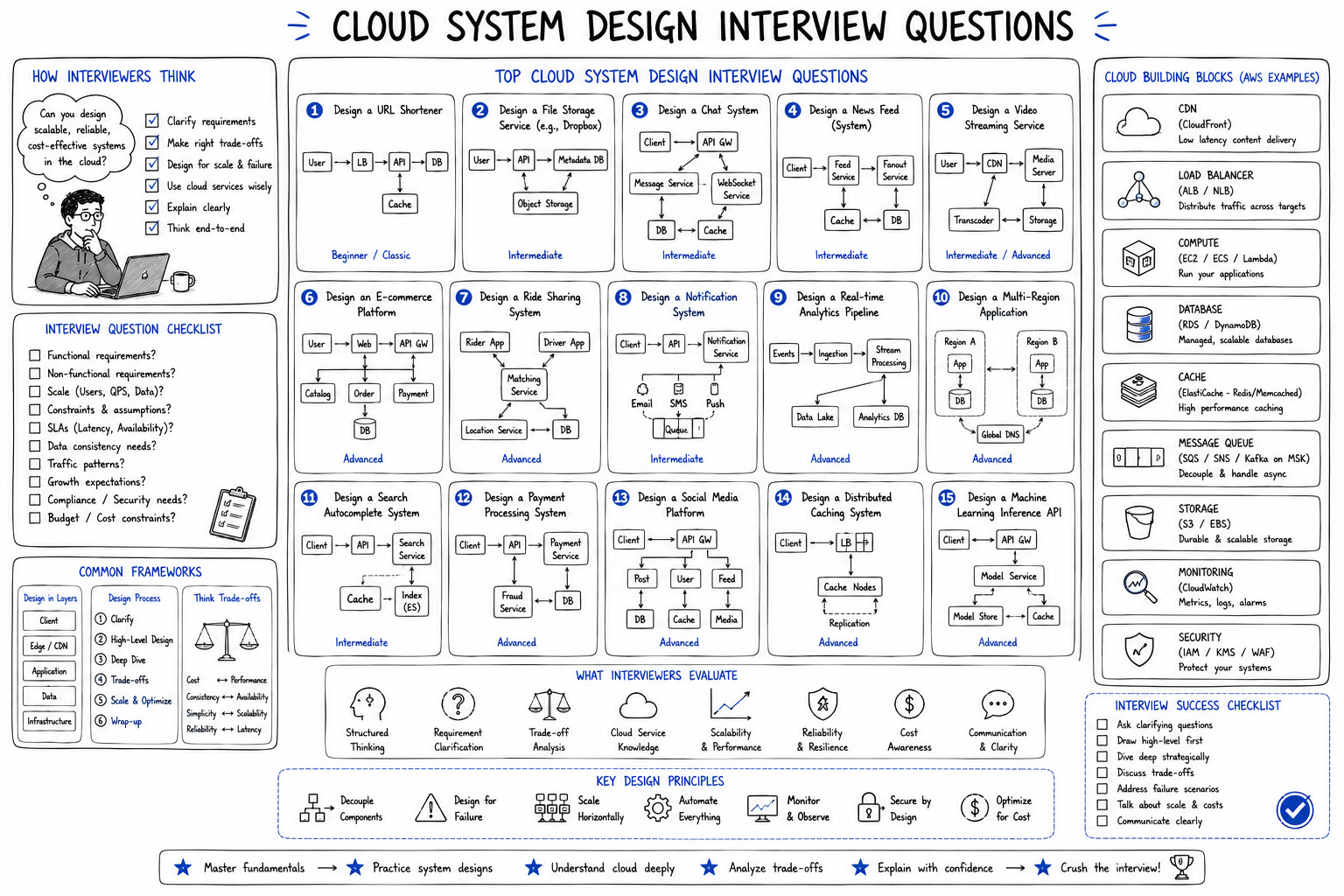
What’s interesting is that many engineers still approach these discussions as if they’re primarily testing cloud knowledge. They assume the interviewer wants to hear the names of managed services, deployment patterns, or infrastructure products. They spend hours memorizing cloud offerings and service catalogs, hoping that familiarity will translate into confidence during the interview. Yet the strongest candidates rarely stand out because they know more cloud services than everyone else.
In my experience, cloud system design interview questions are often evaluating something much deeper. They are trying to understand how an engineer reasons about complexity. They reveal how someone thinks about trade-offs, constraints, failure modes, and system evolution. The cloud provides the environment for the discussion, but the underlying evaluation is usually about judgment.
Most cloud system design interview questions aren’t really about cloud platforms. They’re about how engineers reason through complexity.
That’s one reason these interviews remain relevant even as technologies continue to change. The services evolve. The platforms evolve. The terminology evolves. But the need for engineers who can reason through uncertainty remains remarkably constant.
Why cloud computing changed System Design
Before cloud infrastructure became mainstream, architectural decisions often began with physical constraints. Engineers thought about hardware procurement, data center capacity, network equipment, and deployment cycles measured in weeks or months. Scaling was expensive, slow, and highly visible. Infrastructure limitations shaped architectural thinking from the beginning.
Cloud computing changed those assumptions dramatically. Suddenly infrastructure became elastic. Storage could grow on demand. Compute resources could appear within minutes. Managed services abstracted away large portions of operational complexity. Teams gained the ability to experiment with architectures that would have been prohibitively expensive only a few years earlier.
This transformation changed how engineers think about systems. Architectural discussions shifted away from hardware planning and toward service composition. Reliability strategies evolved because infrastructure failures became easier to tolerate. Scalability conversations became more dynamic because capacity constraints were no longer fixed in the same way. Entire categories of engineering decisions moved up the abstraction stack.
As a result, System Design interviews changed too. Questions increasingly focused on distributed systems behavior, cloud-native trade-offs, operational resilience, and service coordination. The challenge was no longer simply designing software. It was designing software that could thrive in highly dynamic infrastructure environments.
The mistake candidates often make
One of the most common preparation mistakes I see is that engineers focus heavily on cloud products instead of cloud thinking.
They memorize services. They learn feature comparisons. They become familiar with platform terminology. While that knowledge certainly has value, it often creates a false sense of preparedness. Familiarity with infrastructure products is not the same thing as understanding why those products exist or what architectural problems they are attempting to solve.
The distinction becomes obvious during interviews. Candidates may confidently recommend managed databases, serverless platforms, or messaging systems. But when the conversation shifts toward trade-offs, limitations, cost implications, failure modes, or scalability constraints, confidence often declines quickly. The discussion moves beyond product selection and into systems reasoning.
Cloud environments make this especially challenging because abstractions can hide complexity effectively. Engineers may spend years using managed services without fully understanding the distributed systems principles operating underneath them. The cloud simplifies implementation, but it does not eliminate architectural responsibility.
Eventually, memorization encounters uncertainty. And uncertainty is where genuine systems understanding becomes visible.
What cloud system design interview questions are actually evaluating
At their core, cloud system design interview questions are often evaluating an engineer’s ability to make informed decisions in environments filled with competing priorities. The interviewer is rarely looking for a perfect architecture. More often, they are trying to understand how someone approaches complexity.
The discussion frequently revolves around themes such as:
Scalability
Reliability
Failure handling
Cost awareness
Operational complexity
What’s interesting is that none of these areas belong exclusively to cloud computing. They are systems problems. The cloud simply creates new ways of approaching them.
Cloud-native systems require engineers to think across multiple abstraction layers simultaneously. Decisions about architecture influence cost. Decisions about reliability affect operational complexity. Decisions about scalability shape user experience. Strong candidates recognize these relationships and discuss them naturally.
This is why interviews often feel less like technical quizzes and more like engineering conversations. The most valuable signal usually isn’t the final design. It’s the reasoning process that produced it.
Why fundamentals matter even more in cloud environments
One thing we’ve observed repeatedly is that cloud abstractions often increase the importance of fundamentals rather than reducing it.
Many engineers assume that managed infrastructure eliminates the need to understand concepts like partitioning, consistency, replication, caching, or fault tolerance. In practice, the opposite is often true. Cloud platforms make these concepts easier to implement, but they remain just as important architecturally. The abstractions simplify execution while preserving the underlying trade-offs.
That’s part of why resources like Grokking the Fundamentals of System Design exist. Over time, a recurring pattern emerged among learners. Many candidates could discuss sophisticated architectures but struggled to explain the principles driving those architectures. The challenge wasn’t advanced knowledge. It was foundational understanding.
Strong fundamentals become increasingly valuable in cloud environments because abstraction layers continuously evolve. Technologies change. Services change. Platforms change. But engineers who understand the underlying principles can adapt much more effectively than those who rely primarily on memorized implementations.
The cloud rewards systems thinking. And systems thinking grows from fundamentals.
The rise of cloud-native mental models
Cloud-native architectures introduced a new set of mental models that many engineers had to learn gradually.
Modern systems increasingly rely on distributed services, asynchronous communication, event-driven workflows, managed infrastructure, and loosely coupled components. These patterns changed how engineers reason about software itself. Instead of thinking primarily about applications, teams began thinking about ecosystems of interacting services.
This shift required new forms of architectural intuition. Reliability became less about preventing failures and more about handling failures gracefully. Scalability became less about capacity planning and more about designing systems that adapt dynamically. Operational thinking expanded because architectures became more distributed and interconnected.
The challenge for many candidates is that these mental models develop through experience rather than memorization. Understanding event-driven systems conceptually is different from understanding how asynchronous behavior changes system design. Familiarity with cloud infrastructure does not automatically produce intuition about distributed coordination.
Cloud-native thinking represents a different way of reasoning about systems. Interviews increasingly reflect that reality.
Structured learning and systems intuition
One recurring challenge in System Design education is helping engineers connect individual concepts into coherent architectural thinking.
Most candidates learn concepts separately. They understand databases, caching, messaging, APIs, and scalability patterns as isolated topics. The difficulty emerges when those concepts must work together inside larger systems. Interviews expose this challenge because architectural reasoning requires synthesis rather than recall.
That’s part of why resources like Grokking the Modern System Design Interview were developed. The goal is not simply exposing learners to architecture diagrams. The goal is helping them observe how architectural reasoning unfolds when constraints interact and trade-offs emerge.
Many candidates do not struggle because they lack intelligence or motivation. They struggle because systems thinking is inherently relational. Understanding components is only the first step. Understanding how those components influence one another is where deeper intuition develops.
Structured learning can help because it makes those relationships visible.
The role of accelerated preparation
There are also situations where engineers need concentrated exposure to System Design concepts in relatively short periods of time.
Sometimes candidates already possess strong engineering experience but need a structured refresher before an interview process. Other times they understand individual concepts but want a higher-level framework for organizing what they already know. This is often where resources like System Design Interview: Fast-track in 48 Hours become useful—not as replacements for deep learning, but as ways to reconnect existing knowledge quickly.
Still, there is an important distinction worth making.
The fastest way to prepare for System Design interviews is rarely the fastest way to learn System Design.
Accelerated preparation works best when it builds on existing foundations. It helps organize knowledge, reinforce mental models, and surface important concepts. But genuine systems intuition develops over longer periods through repeated exposure to architectural reasoning.
The distinction matters because interviews often reward understanding more than speed.
Cloud service familiarity vs cloud systems understanding
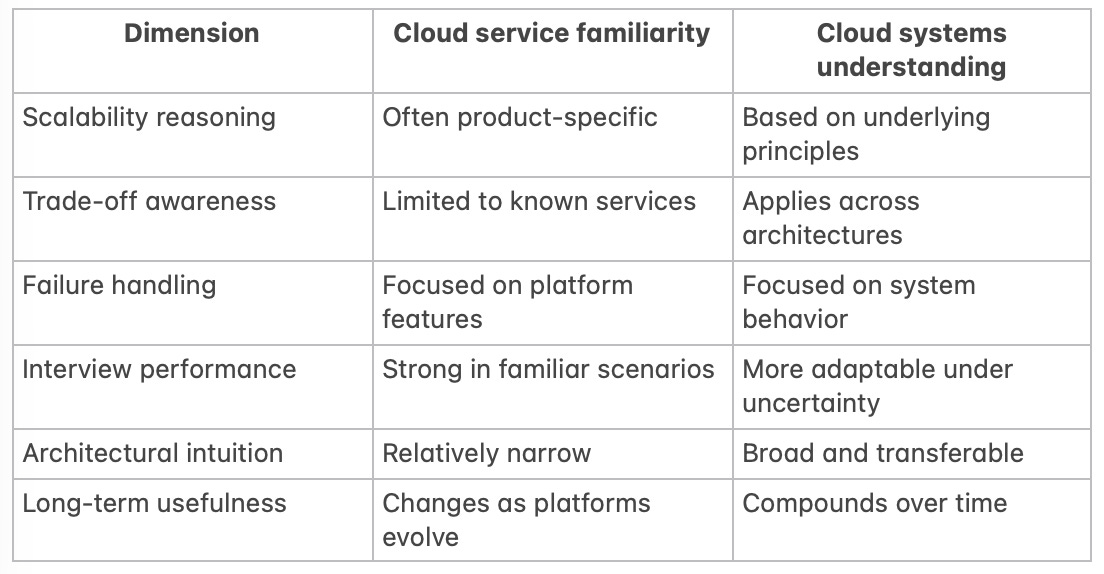
The difference between these two categories becomes increasingly important as interviews progress.
Cloud service familiarity often creates confidence early in discussions. Candidates can identify technologies quickly and discuss implementation options comfortably. But systems understanding tends to produce stronger conversations because it allows engineers to adapt when requirements shift or constraints change.
The most effective engineers usually possess both. They understand available tools, but they also understand the principles guiding tool selection.
Why cloud questions expose engineering maturity
Cloud-native environments create architectural choices that reveal engineering judgment remarkably well.
The reason is that cloud platforms offer flexibility. There are often multiple reasonable solutions available. Engineers must choose between managed services and operational control, simplicity and flexibility, performance and cost, consistency and availability. These decisions require judgment because there is rarely a universally correct answer.
Mature candidates tend to navigate these discussions differently. They acknowledge uncertainty. They discuss trade-offs openly. They recognize that architecture is often about balancing competing priorities rather than optimizing a single metric. Their answers feel grounded in reasoning rather than certainty.
This is one reason cloud interviews remain valuable despite evolving technologies. They reveal how engineers think when confronted with complexity that cannot be solved through memorization alone.
And ultimately, that is what many organizations care about most.
Misconceptions about cloud system design interview questions
Several misconceptions appear repeatedly among candidates.
One is the belief that knowing AWS, Azure, or Google Cloud thoroughly is sufficient. Platform knowledge helps, but interviews usually evaluate architectural thinking rather than service catalogs.
Another misconception is that managed services eliminate complexity. Managed infrastructure removes operational burden, but it does not eliminate trade-offs. Cost, latency, reliability, consistency, and scaling behavior still require careful consideration.
There is also a tendency to assume that cloud environments automatically solve scalability challenges. In reality, scalability remains an architectural property. Cloud platforms provide tools that make scaling easier, but good system design still matters.
Perhaps the most persistent misconception is that interview success comes primarily from memorization. Strong candidates often demonstrate something different: they reason effectively when they encounter situations they have never seen before.
That is a much harder skill to memorize.
What strong candidates tend to do differently
After observing many successful learners, certain patterns emerge consistently.
Strong candidates tend to approach systems with curiosity. They are interested in understanding why architectures behave the way they do. They ask questions about trade-offs. They explore constraints rather than avoiding them. Their preparation often focuses on understanding rather than accumulation.
They also communicate thoughtfully. Cloud system design interview questions frequently involve collaborative reasoning. Candidates who explain decisions clearly often create stronger discussions than those who rush toward solutions.
Trade-off awareness appears repeatedly as well. Strong candidates recognize that engineering decisions involve consequences. They rarely present architectures as perfect. Instead, they discuss strengths, limitations, and contextual considerations naturally.
Perhaps most importantly, they appear comfortable learning continuously. They treat cloud technologies as evolving tools rather than fixed knowledge domains.
What cloud interviews reveal about modern engineering
Cloud-native architectures changed software engineering in ways that extend far beyond interviews.
They altered how teams think about infrastructure. They shifted operational responsibilities. They introduced new abstractions while creating new forms of complexity. Engineers now reason about systems that are more distributed, dynamic, and interconnected than many of the architectures that came before them.
System Design interviews reflect those changes because they mirror real engineering challenges. The discussions revolve around scalability, reliability, trade-offs, coordination, and uncertainty because modern software systems revolve around those same themes.
Cloud computing didn’t remove complexity. It changed where complexity lives.
That observation captures much of what cloud-native thinking requires. The complexity did not disappear. It moved into abstractions, service interactions, operational behaviors, and architectural decisions. Engineers still need judgment. In many ways, they need more of it.
Conclusion: cloud thinking is ultimately systems thinking
When people talk about cloud system design interview questions, they often focus on technologies. They discuss platforms, services, and infrastructure patterns. Those topics matter, but they are not the whole story.
At a deeper level, these interviews are evaluating architectural reasoning. They are exploring how engineers think about scalability, reliability, complexity, abstraction, and trade-offs in environments where perfect answers rarely exist. Cloud-native architectures provide the context, but systems thinking provides the foundation.
Fundamentals matter because they create durable understanding. Structured learning matters because it helps connect concepts into coherent mental models. Cloud-native thinking matters because modern software increasingly operates through distributed abstractions. And engineering judgment matters because systems ultimately depend on decisions made under uncertainty.
The cloud has changed how software is built. But the most important skill remains remarkably familiar: the ability to reason clearly about complex systems in a world where the abstractions keep getting higher and the underlying complexity never fully goes away.