

What the 10 best System Design courses are really teaching
The real goal is not to finish a course and declare System Design complete but become the kind of engineer who can look at a complex system and not freak out.

There is a moment in many engineering careers when System Design suddenly stops feeling optional. For some engineers, that moment arrives during interview preparation. For others, it comes during a promotion conversation, a new architecture responsibility, or the first time a system they helped build begins to strain under real scale. Until then, System Design can feel like something senior engineers discuss in architecture reviews while everyone else keeps building features.
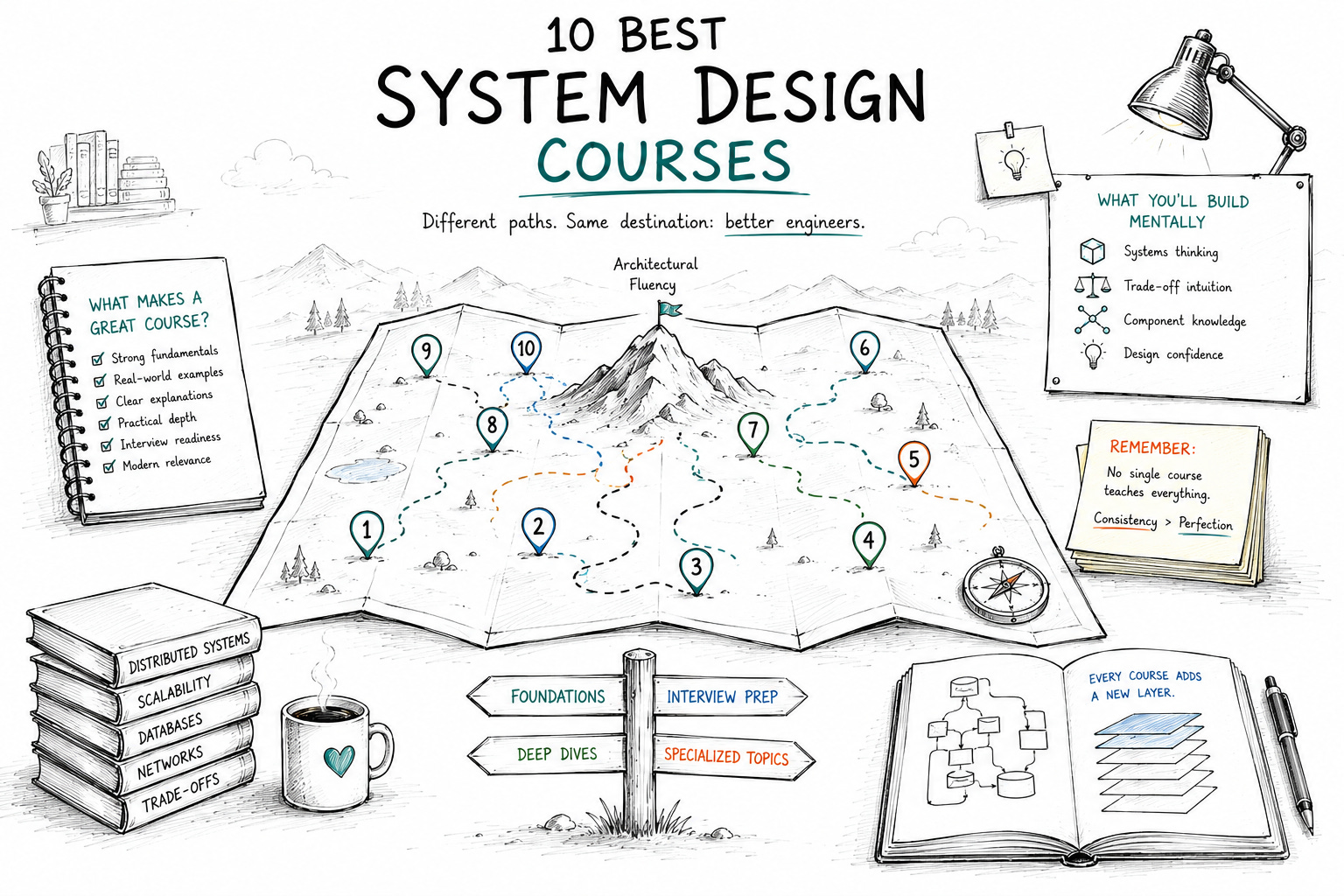
That shift explains why so many engineers search for the 10 best system design courses. On the surface, the search looks practical. People want a resource that helps them prepare, learn quickly, and feel less uncertain. But underneath that search is often a deeper anxiety. System Design is difficult because it is not a single topic. It is a way of thinking across databases, APIs, distributed systems, scalability, reliability, trade-offs, and organizational constraints.
One thing we have observed repeatedly at Educative is that learners arrive with very different needs. Some engineers need fundamentals because they never learned the vocabulary of architecture. Increasingly, others need to understand AI system design because modern architectures are changing quickly.
The goal of learning System Design is not memorizing more diagrams. It is developing better judgment when systems become too complex for simple answers.
The better question is often: What kind of learning problem am I trying to solve right now?
The fundamentals stage
The fundamentals stage is where many engineers need to begin, even if they are tempted to skip it. This is the stage where concepts like scalability, availability, consistency, latency, caching, replication, partitioning, and load balancing start becoming part of the engineer’s working vocabulary. These ideas may seem basic, but weak fundamentals create fragile understanding later.
That is part of why resources like Grokking the Fundamentals of System Design exist.
Many engineers struggle not because they lack motivation, but because they entered System Design through interview questions before building the conceptual foundation underneath them. The goal of fundamentals-focused learning is not to overwhelm learners with large architectures. It is to make the basic forces of system behavior easier to see.
A related learning challenge is recognizing recurring architectural ideas. This is where System Design Patterns becomes relevant.
Patterns help engineers understand why certain solutions appear repeatedly across systems. Caching, sharding, queues, replication, rate limiting, and service decomposition are not isolated tricks. They are recurring responses to recurring pressures.
The important thing is not merely knowing pattern names. It is understanding the problems that created them. Strong System Design learners eventually stop asking, “Which pattern should I use?” and start asking, “What pressure is this system experiencing?”
The interview stage
The interview stage introduces a different challenge. Many engineers understand concepts in isolation but struggle to organize them into a coherent conversation. System Design interviews require technical reasoning, but they also require communication, prioritization, and comfort with ambiguity. The interviewer is often evaluating how a candidate thinks, not whether they can reproduce a memorized architecture.
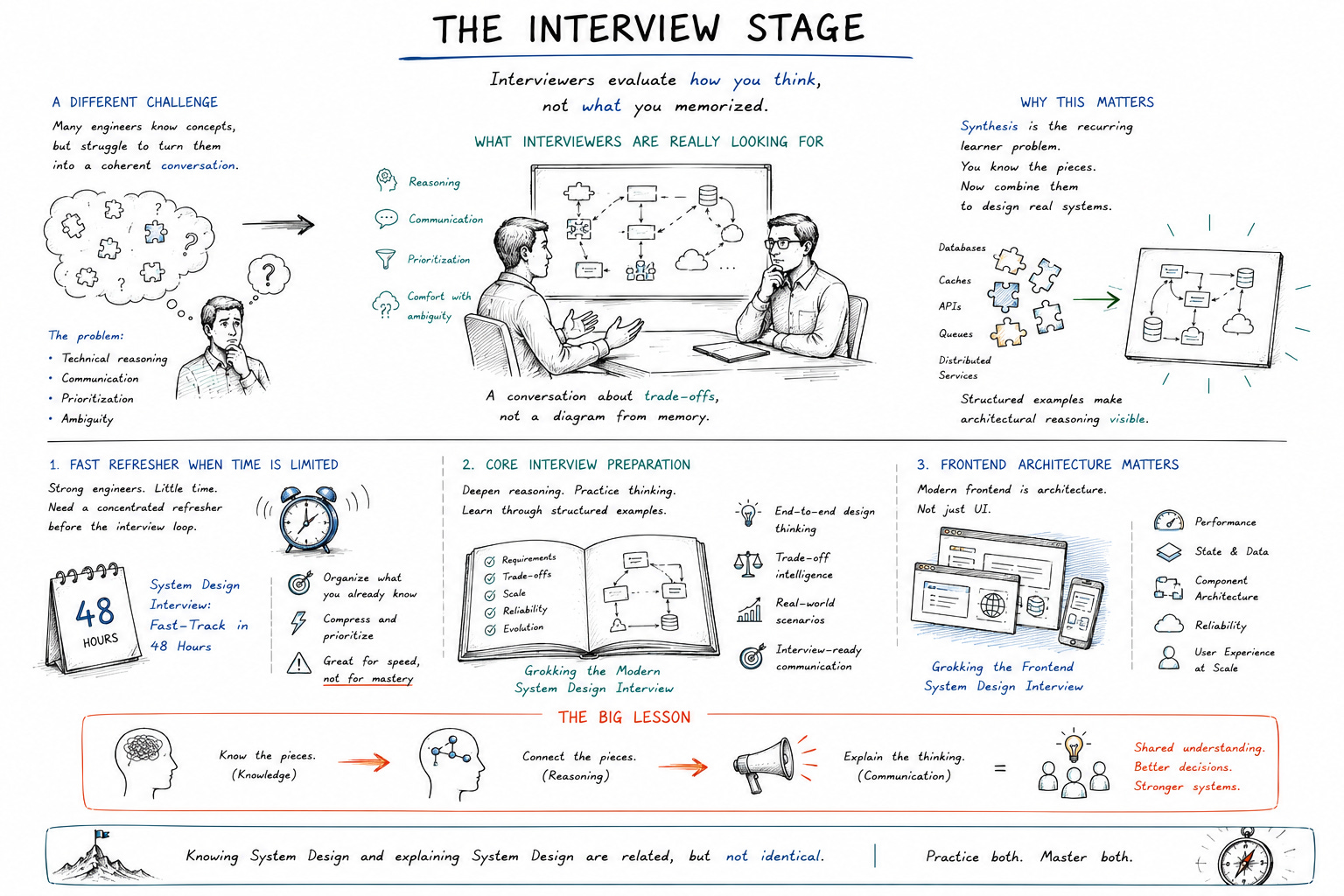
That is part of why Grokking the Modern System Design Interview has become one of the most recognized System Design learning paths.
The recurring learner problem here is synthesis. Engineers may know about databases, caches, APIs, queues, and distributed services, but they need to see how those ideas combine when designing real systems. Structured examples can make architectural reasoning visible.
Some engineers arrive at this stage with very little time. They may already have strong engineering experience, but they need a concentrated refresher before an interview loop.
System Design Interview: Fast-Track in 48 Hours serves that kind of learning need. Compressed preparation can help organize existing knowledge quickly, but it should not be confused with long-term mastery.
Frontend architecture has also become an important part of System Design discussions.
Grokking the Frontend System Design Interview reflects a shift in how engineers think about large-scale user experiences.
Modern frontend systems are no longer just UI layers. They involve performance, state management, data fetching, component architecture, rendering strategies, reliability, and user experience at scale.
The interview stage teaches an important lesson: knowing System Design and explaining System Design are related, but they are not identical skills.
The distributed systems stage
At some point, surface-level architecture is no longer enough. Engineers begin asking why distributed systems behave the way they do. They encounter questions about consistency, replication, failures, coordination, consensus, partitioning, and fault tolerance. These topics can feel abstract until engineers see how often they shape real architectural decisions.
Distributed Systems for Practitioners speaks to this stage of learning. The word “practitioners” matters because distributed systems are not only theoretical. They show up in ordinary engineering decisions whenever services communicate over networks, data is replicated, failures are partial, and systems must remain available under uncertainty.
For engineers who want to go deeper into production-style architecture, System Design Deep Dive: Real-World Distributed Systems addresses another recurring need. Many learners can understand simplified diagrams, but real-world systems are messier. They evolve over time, accumulate trade-offs, and operate under imperfect constraints. Deep learning requires exposure to that messiness.
This stage is where many engineers begin developing architectural maturity. They stop treating scalability as a generic goal and start thinking about specific bottlenecks. They stop treating reliability as uptime alone and start thinking about failure modes. They stop treating distributed systems as diagrams and start seeing them as operational environments.
Distributed systems learning is often where System Design becomes less about interviews and more about engineering itself.
The AI systems stage
System Design is changing because software itself is changing. AI systems introduce new architectural questions around model behavior, inference latency, retrieval, orchestration, evaluation, data pipelines, hallucination risk, observability, and human oversight. These are not traditional backend concerns dressed in new terminology. They represent new kinds of system behavior.
Machine Learning System Design reflects one branch of this evolution. ML systems require engineers to think about data quality, training pipelines, model serving, feature stores, monitoring, drift, and feedback loops. The architecture is not only about serving requests. It is about building systems whose behavior depends on data and statistical performance over time.
Grokking the Generative AI System Design addresses another emerging need. Generative AI systems introduce challenges around prompts, retrieval-augmented generation, context management, model routing, cost, latency, safety, and output evaluation. These systems can look simple at the interface level while hiding significant architectural complexity underneath.
Agentic System Design points toward an even newer category of architecture. Agentic systems involve AI agents that can plan, use tools, coordinate workflows, and act with varying levels of autonomy. This changes how engineers reason about orchestration, governance, observability, and control. The system is no longer only executing predefined workflows. It may be reasoning through goals.
The AI systems stage shows why System Design cannot remain static. The fundamentals still matter, but the architectures we apply them to keep evolving.
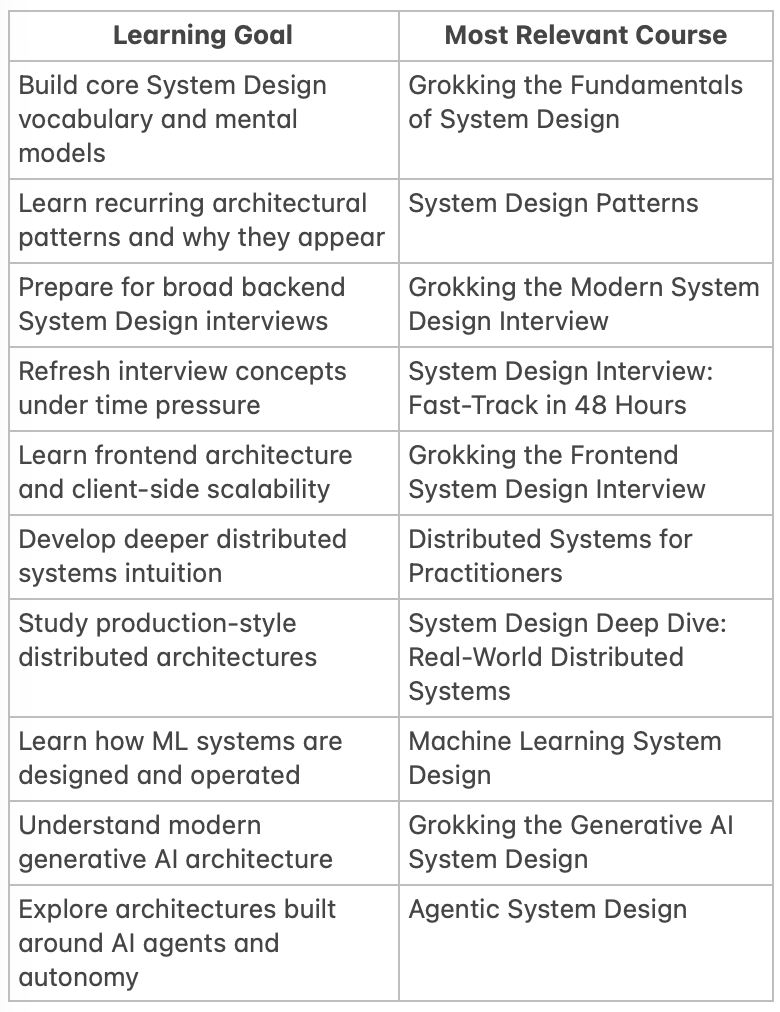
Mapping learning goals to courses
What strong System Design learners tend to do differently
One thing we have observed repeatedly is that strong learners do not simply consume more content. They ask better questions while learning. They do not only ask what architecture was chosen. They ask why it was chosen, what trade-offs it introduced, and what would change if the requirements changed.
They also revisit fundamentals more often than beginners expect. Experienced engineers know that concepts like latency, consistency, availability, partitioning, and reliability never really disappear. They show up again and again in different forms. The architectures change, but the underlying forces remain familiar.
Strong learners also become comfortable with ambiguity. They stop expecting every design problem to have one clean answer. They begin to see architecture as a process of reasoning through constraints rather than arriving at perfect diagrams.
The best System Design courses do not remove ambiguity. They help engineers become better at thinking inside it.
That mindset changes how engineers learn. Courses become less about collecting answers and more about strengthening judgment.
Conclusion
Engineers often search for the 10 best system design courses because they want clarity. They want to know where to start, what to study, and which resource will finally make System Design feel less overwhelming. That search makes sense, but the better question is often more personal: What am I trying to learn right now?
If the gap is fundamentals, start with fundamentals. If the gap is interview structure, focus on interview reasoning. If the gap is distributed systems depth, go deeper into real-world architectures. If the gap is AI architecture, study how ML, generative AI, and agentic systems change design assumptions.
System Design is not mastered through diagrams alone. It is learned through repeated exposure to trade-offs, constraints, failures, abstractions, and evolving requirements. Courses are valuable when they help engineers see these patterns more clearly and reason about them more confidently.
The real goal is not to finish a course and declare System Design complete. The real goal is to become the kind of engineer who can look at a complex system, identify the forces shaping it, and make thoughtful decisions despite uncertainty.
That is why System Design remains one of the most valuable skills in engineering. It is less about memorizing architecture and more about developing better judgment over time.